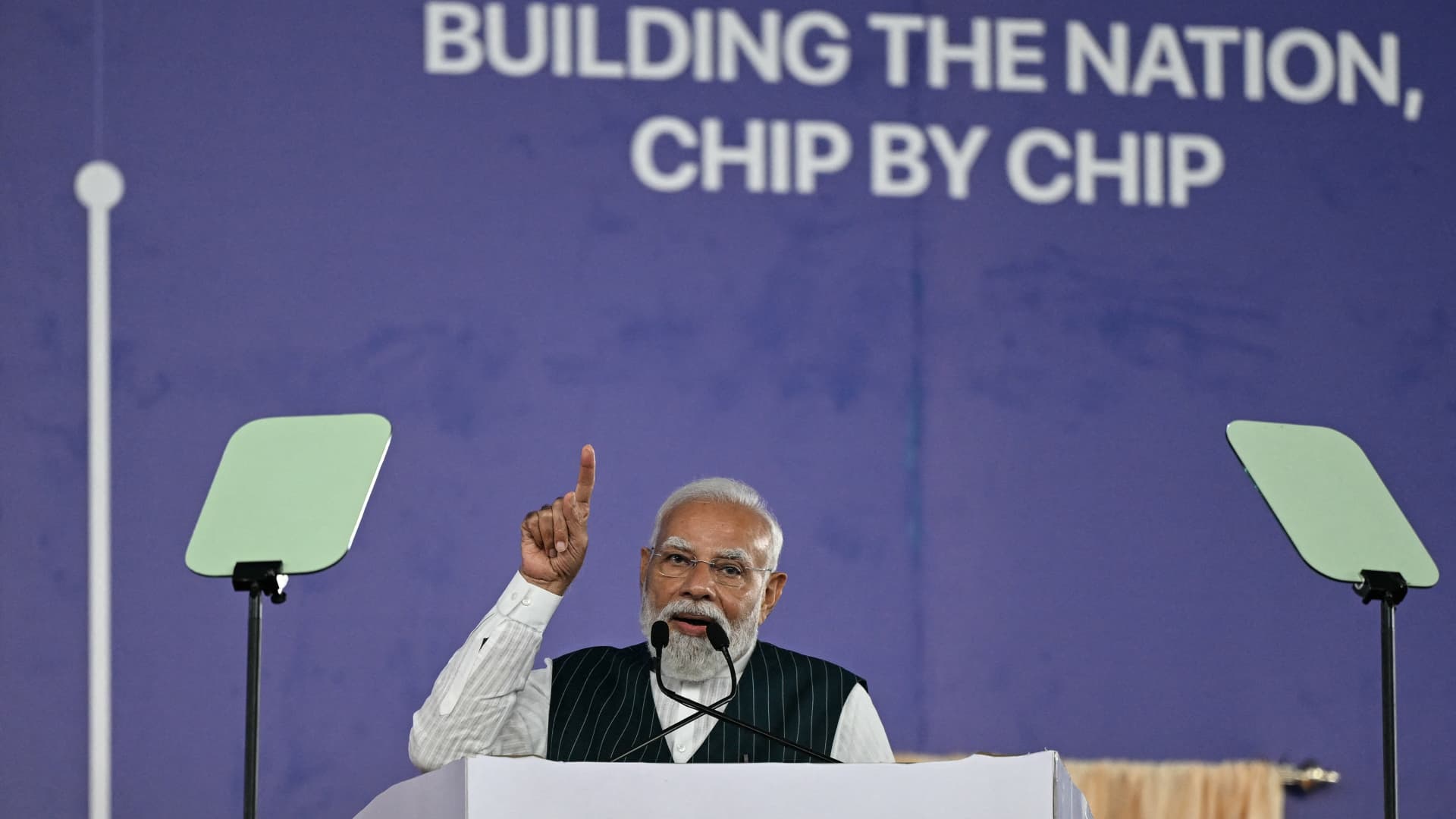

India’s Prime Minister Narendra Modi delivers remarks at the opening of CG Semi’s outsourced semiconductor assembly and testing, or OSAT, facility in Sanand on July 4, 2026. (Photo by Shammi MEHRA / AFP via Getty Images)
Shammi Mehra | Afp | Getty Images
India’s stronger-than-forecast 7.8% economic growth in the June quarter is facing fresh questions after a former senior government official alleged the headline figure was flattered by downward revisions to the previous year’s data.
The debate comes as several of the world’s largest economies, including the U.S., China and Japan, contend with slowing momentum amid trade pressures, geopolitical tensions and elevated energy costs. India, by contrast, has continued to stand out as the fastest-growing major economy.
Subhash Chandra Garg, India’s finance secretary from 2017 to 2019, claimed that nominal gross domestic product for the April-June quarter of 2025 was revised down by 6 trillion rupees, or about $63.5 billion, to 80 trillion rupees in the latest release. According to Garg, that lower base made the most recent quarter’s GDP figure of 88.27 trillion rupees appear stronger in year-on-year terms.
India’s chief economic advisor, V Anantha Nageswaran, pushed back against that criticism in an interview with local media on Thursday, describing it as an exercise in “cherry-picking” data. He said the latest GDP estimates were prepared using the financial year ended March 2023 as the new base year, and that the shift in methodology resulted in revisions to quarterly numbers from the previous year.
As part of such statistical updates, Nageswaran said, some quarterly figures may be “bumped up” while others may be “bumped down.” The key, he added, is to assess the data for consistency rather than focus on one revision in isolation.
India’s finance ministry did not respond to CNBC’s request for comment. The ministry instead shared a link to Nageswaran’s remarks in local media.
Missing GDP?
Garg on Thursday told CNBC that a change in methodology does not explain “what went out of the production to bring down the value of last year’s GDP by six trillion rupees.” He argued that so far, the government has not explained what has led to the “missing GDP.”
Prime Minister Narendra Modi’s political rivals on the same day backed Garg, with the Indian National Congress party claiming that the GDP over the last four years has been “revised down by 43 lakh crore ($455 billion).”
These are large “corrections” and imply that an excess of goods and services was added to the GDP and has now been removed, the political party said in a post on Thursday.
India Commerce Minister Piyush Goyal, in response to skepticism over the GDP figures, has said that “India’s 7.8% growth is a reality.”
In a report last year, the International Monetary Fund had raised concerns over the accuracy of the Indian government’s economic data and assigned it a “C grade,” its second-lowest rank. To address some of the major concerns, such as an outdated base year and the use of wholesale price indices and single deflation for calculating inflation, the country adopted a new statistical framework in February.
“India’s GDP data still relies heavily on formal-sector corporate data, while a significant part of the informal economy has to be estimated,” Reema Bhattacharya, head of Asia research at Verisk Maplecroft, told CNBC.
This gap often fuels skepticism around the headline numbers, which don’t necessarily match up with what people are seeing on the ground, she added.
The IMF did not comment on the controversy around India’s latest GDP print.
Experts told CNBC that Garg’s argument is technically unsound as it compares figures from two different base years, but some, like Anil Sood, professor and co-founder of Mumbai-based Institute of Advanced Studies in Complex Choices, said “estimation errors” in past data are a concern.
After the new series was released in February, Sood said all the previous GDP and GVA (gross value added) numbers were revised down.
“What the new series shows is that the estimated size of the Indian economy was smaller than what was projected under the old series,” he said.
Growth is real
The GDP figures in the first quarter are “looking better,” primarily due to the better methodology, Anubhuti Sahay, head of India economic research at Standard Chartered Bank, told CNBC, but argued that base revisions did not have “much role” to play.
“It is not that the GDP number is only froth,” Sahay said, adding that the percentage of growth can be debated, but the number shouldn’t be dismissed outright.
India’s key high-frequency indicators are “holding up undoubtedly,” despite the global energy price shocks and supply chain disruptions, she said, while warning that the growth was not uniform and quality jobs, the impact of El Nino on the rural economy are some of the challenges.
Meanwhile, softening is still seen over the rest of the year. Global brokerages Morgan Stanley and Citi have forecast economic growth of 7.3% for the 12 months ending in March 2027.
The economic activity in the June quarter was unusually driven by a sharp rise in investments and stronger exports, while household consumption improved at a relatively mild pace, and this is “not sustainable” amid current geopolitical risks, said Jaydeep Mukherjee, professor of economics at Great Lakes Institute of Management Chennai.


