
Share this @internewscast.com
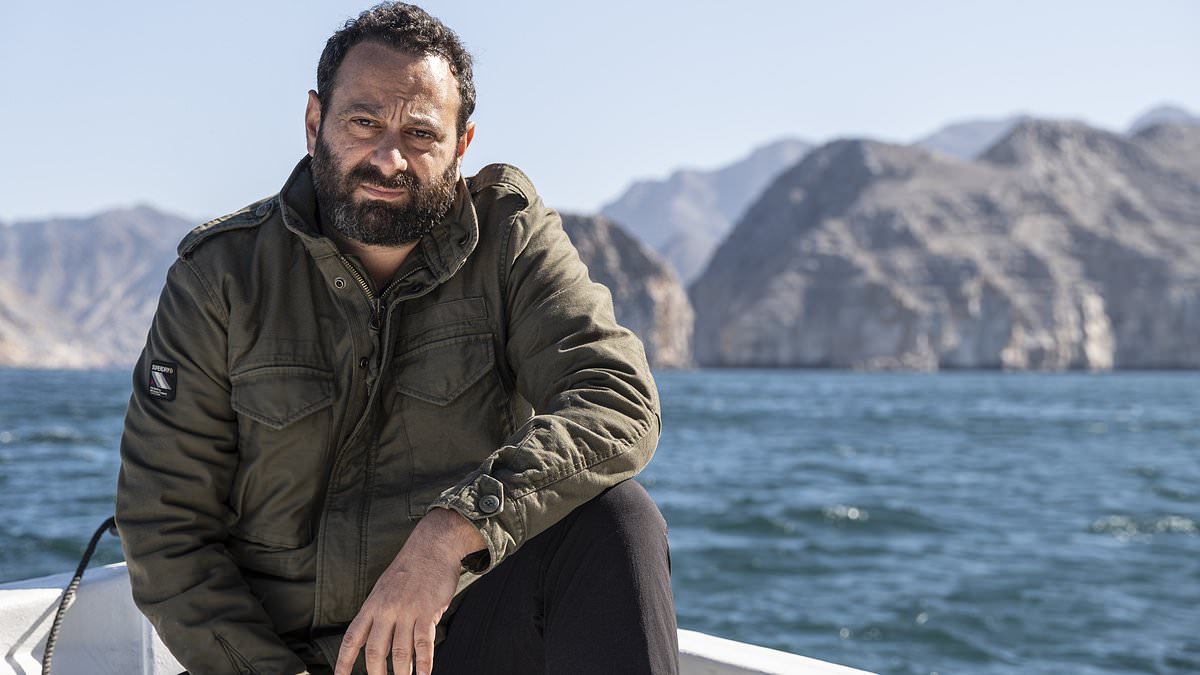
From the deck of a boat, Iran’s mountainous coastline emerges faintly on the horizon, just over 20 miles away. Though it appears as a distant, dark line, its presence looms large in my thoughts, bridged by both memory and imagination.
My mother’s family fled Iran half a century ago during a clerical revolution. Two decades back, I spent a summer immersing myself in Persian studies there. Now, gazing across a slender stretch of water, I am once again reminded of that land.
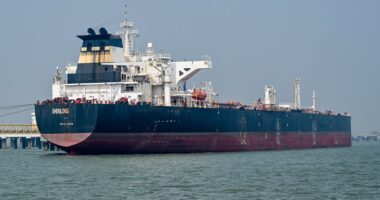
The afternoon sun casts a glow over the Strait of Hormuz, painting it as a serene expanse of deep blue, framed by rugged mountain chains under a piercingly clear sky. Massive tankers, reminiscent of aircraft carriers, glide through shipping lanes, laden with the vital fuels that power the world. The tranquil scene belies the strait’s strategic significance.
This narrow waterway is one of the most critical junctures on the planet.
Each year, approximately 20% of the world’s oil and a significant portion of its liquefied natural gas traverse this 96-mile-long channel, which narrows to just 21 miles at its tightest point. One lane directs Gulf oil eastward towards Asia, while the other directs flows westward to Europe and the United States.
If this passage were ever blocked, even momentarily, the impact would be immediate: oil prices would soar, markets would reel, and governments would scramble to respond.
All Tehran would need to do is make the passage unsafe or impassable – and the mechanics for doing so are brutally simple.
A scatter of naval mines in shallow water would do the trick, or mobile anti–ship missiles hidden in cliffs and fishing ports. If the Iranians wanted to be bolder, drones and fast–attack craft could swarm a tanker or two, seizing one, damaging another and choking the lane.

The Daily Mail’s David Patrikarakos in the Strait of Hormuz, a mere 20–odd miles away from Iran

A young Iranian woman lights a cigarette off of a burning picture of Iran’s Supreme Leader Ayatollah Ali Khamenei
Of course, the global reaction would be huge but if Tehran’s fanatical mullahs think the game is truly up, would they care?
This is yet one more paradox that surrounds the Islamic Republic. Externally, it sits astride one of the world’s great strategic arteries, capable of shaking the global economy.
Internally, it is imploding. Its legitimacy has bled out. Its authority now rests not on belief but on the rope, on rape, truncheons and prison cells. My diagnosis is that the rot is terminal.
Death may not be imminent, but it will come – and it is incumbent on us to help midwife it.
Yesterday Reza Pahlavi, the son of Iran’s late shah – who has lived in exile in the US since the 1979 revolution that brought the mullahs to power – declared he, too, was confident the regime is finished.
‘The Islamic Republic will fall – not if, but when,’ Pahlavi told a news conference in Washington.
For decades now, he has been campaigning for intervention to oust the theocracy and he has offered to be a figurehead to lead a transition to democracy. ‘I will return to Iran,’ he declared yesterday.
But before the end of the republic, there will be more blood and more chaos. Dying regimes are often at their most dangerous in the long twilight between loss of public consent and actual collapse. They still have the guns – and they still command the men willing to fire them.

Yesterday Reza Pahlavi, the son of Iran’s late shah – who has lived in exile in the US since the 1979 revolution that brought the mullahs to power – declared he, too, was confident the regime is finished

Iran’s Supreme Leader Ayatollah Ali Khamenei. Photos of the two Ayatollahs, Khomeini and Khamenei, still hang on walls; TV anchors still parrot revolutionary slogans, but the images and words are hollow
Even by the regime’s own estimates, between two to three thousand have been killed, making it one of the greatest massacres in the Islamic Republic’s history; opposition sources like the Iran International news channel put the figure at closer to 12,000.
The past two weeks were devastating. Streets became killing fields. Regime storm troopers scythed through crowds. Bodies fell and were left where they lay, warnings smeared across the pavement. In Tehran, most protesters were armed with nothing more than the courage to take a stand. But in more rural areas and some provincial towns, the streets tipped into something close to open war.
Here the people used knives and machetes, they had hunting rifles, and even the odd military weapon; and they changed the nature of the fight. For the state, batons and tear gas no longer sufficed. It was forced to answer with live rounds, shot high into faces and chests, the crack of automatic fire echoed down alleyways
The wounded were dragged away or hunted down in hospital wards, where the smell of blood and disinfectant hung in the air and plain–clothes men took names and made arrests, turning places of healing into annexes of state terror.
In some towns, security units swept through protest districts with automatic fire, cutting people down in minutes. It wasn’t a police exercise; it was a cull. And beneath it all was cruelty as cold as it was methodical.
Victims were shot, and, in a practice common to most wretched authoritarian regimes, their families later billed for the price of the bullet in exchange for the body to bury. In the Islamic Republic even mourning has become a state shakedown.
The state now governs as an occupying force in its own cities. It knows its foundations are splitting and tries to hammer them back into place with violence.
In Washington, Donald Trump watched it all with rising fury. First, he urged Iranians to keep protesting, even posting that ‘help is on its way’ before then warning Tehran that executions – particularly of 26–year–old protester Erfan Soltani, whom the regime had scheduled for hanging after only a perfunctory judicial process – would bring ‘very strong action’.

Protesters set fire to a car in Tehran. Even by the regime’s own estimates, between two to three thousand have been killed, making it one of the greatest massacres in the Islamic Republic’s history

Protesters wade through tear gas during an anti-government protest in Tehran
These weren’t platitudinous statements of vague support – they were unambiguous promises. Iranians heard him. Those inside felt emboldened, they rose up harder. Those outside in the diaspora looked on, waiting for him to act.
And for a while it seemed like he would. Contacts in Israel spoke of imminent strikes. Lufthansa in Israel ordered its staff to leave and cancelled all flights. US forces began evacuating from Al Udeid Air Base in Qatar, the largest American military base in the Middle East. But late on Wednesday Trump announced that a ‘credible source’ had informed him the regime had eased off.
‘We were told that the killing in Iran is stopping, and there’s no plan for executions,’ he said, presumably referring to the Iranians’ announcement that Soltani’s execution had been postponed.
And so: nothing. Just as abruptly, the temperature dropped. No strike. No intervention. A climb–down – or at least the appearance of one.
With no direct relations between the two powers, interpreting US–Iran interaction is always an exercise in geopolitical tea–leaf reading; the countries communicate through overt threats and more subtle signalling.
Here, it appears Trump offered the mullahs an off–ramp and they have taken it – for now. Then again, this is Donald Trump we are talking about. His comments could be a feint designed to lull Iran into a false sense of security.
Don’t forget that he did the same in June last year when he said that ‘maybe US intervention isn’t necessary’ in Iran (as Israel went toe–to–toe with the Ayatollahs) and that he was ‘considering a ceasefire’. Days later he rained destruction down on Iran’s nuclear facilities.
Either way, one thing remains clear: the Islamic Republic has entered what might be called its security–state phase. The regime has imposed what amounts to martial law, terrorising protesters off the streets.
Photos of the two Ayatollahs, Khomeini and Khamenei, still hang on walls; TV anchors still parrot revolutionary slogans, but the images and words are hollow.

In Tehran, most protesters were armed with nothing more than the courage to take a stand

A protester in Zurich lights a cigarette off a picture of the Ayatollah. As 2026 dawned, Iranians fought not only for their own freedom, but for a world that rejects Islamist barbarism, that looks to the future rather than the past, and that believes in a democratic order
Every execution, every blinded youth, every blood–soaked street widens the gulf between ruler and ruled. The social contract is no longer just frayed but severed. Consent has been replaced by coercion; legitimacy by fear.
This is what terminal rot in the body politic looks like: still moving, still able to maim, but already doomed by the sickness at its core. The question is not whether the disease is fatal, but how long the patient can be kept on violent life support; and how much harm it will do in the meantime.
For the West, the temptation is to treat Iran’s internal crisis as tragic but contained, and its external menace as a separate, manageable problem.
But we must understand that this division is an illusion. A state that survives by terror at home will project that terror outward. A regime that governs through fear will use fear as a weapon abroad. The prison–yard rope and the shipping–lane mine are parts of the same kit.
This is why backing the Iranian people against the Ayatollahs is not only a moral duty but a strategic one. And let us be clear: this is a fight that can be won.
Here at the narrow throat of the world’s energy trade, I can feel, almost physically, a geopolitical truth: if the Ayatollahs were truly strong, they would close the straits. They’ve never dared. The tankers still move. The vital artery remains open. They’ve blustered, they’ve threatened – and that’s it. They know what would follow, the blowback they’d get.
That restraint is so telling. This is a regime that luxuriates in killing at home, and through its proxies like Hamas and Hezbollah and the Yemeni Houthis abroad.
But those proxies have been dismantled by Israel and the US, and Iran is too cowardly to strike out on its own. When it vowed ‘severe revenge’ on America after Trump had Revolutionary Guards leader Qasem Soleimani killed in January 2020, it dared only to carry out some symbolic strikes on a US base without any fatalities.

A protester in Edinburgh holds a Make Iran Great Again poster featuring the face of exiled crown prince Reza Pahlavi
Now factor in something else. The answer to the often–asked question of what Trump can do to the Iranian regime is that he can hit them hard. He can hunt the men who run the killing machine: name more of the judges, the prison chiefs, the Guard commanders; freeze more of their money, bar the travel of any who have escaped sanctions so far, turn them into fugitives in the world’s financial system.
He can throttle the Guard’s business empire – its ships, its ports, its front firms, its insurers. He can make every dollar harder to move and easier to seize.
He can tear holes in any future internet blackout the regime might impose – push satellite links, smash jamming, flood the country with digital light.
And he can make deterrence plain: throw naval and air power into the Gulf, escort tankers, ring Hormuz with steel, and spell out the price of any mine laid or ship seized – or any future massacres.
In the end, the answer to how long a dying system can sustain itself through fear alone is to be found not just in Iran’s behaviour but our own. Let this guide our actions going forward.
It has been an extraordinary two weeks for me as someone of Iranian heritage: fear, hope, anger, and then a deep, settling sadness.
Nearly half a century ago my maternal family fled Tehran as medieval clerics smothered one of the world’s great civilisations in violence and superstition.
As 2026 dawned, Iranians fought not only for their own freedom, but for a world that rejects Islamist barbarism, that looks to the future rather than the past, and that believes in a democratic order in which their immense talents can serve not just their own country, but humanity at large.
And before long they will have to fight for it again. For that reason, their struggle is ours, their hope our hope. Never forget it.