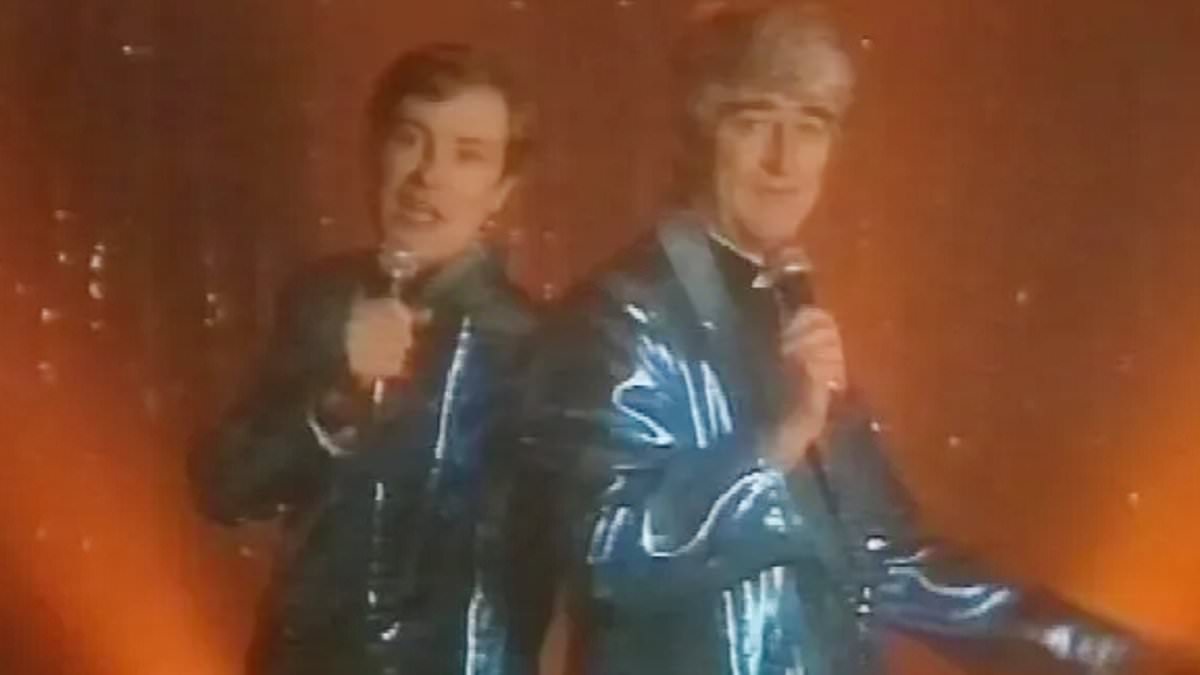

An Irish television station has opted to air a Eurovision-inspired episode of the beloved sitcom Father Ted instead of the actual song contest, as a form of protest against Israel’s involvement.
This Saturday night, RTÉ, Ireland’s national broadcaster, will showcase the memorable 1996 Father Ted episode titled ‘A Song For Europe.’ In this fan-favorite episode, priests Ted and Dougal humorously attempt to represent Ireland in the fictional ‘Eurosong’ contest, a clever spoof of Eurovision.
The duo delivers a hilariously disastrous one-minute performance of ‘My Lovely Horse,’ ultimately scoring ‘nul points’ after scheming to prevent Ireland from winning and thus avoiding the responsibility of hosting the event the next year.
While the Eurovision Song Contest kicks off today in Austria, controversy clouds the 70th anniversary celebration due to Israel’s participation.
Vienna, the host city, has been adorned with heart motifs and the event’s theme ‘United by Music.’ This week, performers from 35 nations will vie for the title of Europe’s top musical act.
Despite the festivities, countries including Spain, Ireland, the Netherlands, Slovenia, and Iceland have chosen to boycott the contest in protest of Israel’s involvement.
Ireland has won Eurovision seven times, making it the most successful country in the competition’s history along with Sweden.
But RTÉ said it would not be competing in Eurovision for the first time in 61 years last December, citing the ‘appalling loss of lives in Gaza’.
Ireland’s state broadcaster will play a Eurovision-themed episode of Father Ted in place of the singing contest’s final
RTÉ said it would not be competing in Eurovision for the first time in 61 years, citing the ‘appalling loss of lives in Gaza’. Pictured: Noam Bettan, representing Israel attends the 2026 Eurovision Song Contest’s ‘Turquoise Carpet’ event in Vienna, Austria, May 10, 2026
Israeli singer Noam Bettan is among 15 acts competing for votes from viewers and national juries in Tuesday’s semifinal at the Wiener Stadthalle arena.
Bettan is seeking to get Israel, which came second in 2025, into Saturday’s final with the ballad ‘Michelle’.
Like last year’s Israeli competitor, Yuval Raphael, he has practised singing while being booed.
The Irish website Extra.ie has congratulated RTÉ on the scheduling, which it described as ‘genius trolling’.
Slovenia, meanwhile, said it would broadcast a documentary about Palestine.
‘Instead of the Eurovision circus, the national television programme will be coloured by the thematic program series “Voices of Palestine”,’ Slovenian broadcaster RTV said.
Spain’s RTVE will run its own musical special, ‘The House of Music’.
The boycotts are a financial blow to Eurovision, which is funded largely by participating broadcasters, and to public broadcasters at a time when many are under financial pressure from government funding cuts and competition from social media.
Join the discussion
Has Eurovision become impossible to separate from politics?
Last year’s contest saw pro-Palestinian protests that called for Israel to be expelled over the conduct of its war against Hamas in Gaza and allegations it ran a rule-breaking marketing campaign to get votes for its contestant after Israel finished second last year. Pictured: Yuval Raphael, representing Israel, performs “New Day Will Rise”, during the Grand Final of the 2025 Eurovision Song Contest in Basel, Switzerland, May 17, 2025
Long a forum for good-natured and sometimes more pointed national rivalries, Eurovision has found it hard to separate pop and politics in recent years.
Russia was expelled in 2022 after its full-scale invasion of Ukraine.
Tensions rose again after Hamas’ October 7, 2023, attack on Israel, which killed some 1,200 people, and Israel’s subsequent campaign in Gaza that has left more than 70,000 people dead.
The last two Eurovision contests have seen pro-Palestinian protests both outside the venues and inside, forcing organisers to clamp down on political flag-waving.
Several performers and countries have called for the exclusion of Israel, which has competed in Eurovision since 1973, one of a few non-European countries to do so.
The 2024 contest in Malmo, Sweden, and last year’s event in Basel, Switzerland, saw pro-Palestinian protests that called for Israel to be expelled over the conduct of its war against Hamas in Gaza and allegations it ran a rule-breaking marketing campaign to get votes for its contestant after Israel finished second last year.
When organisers declined to kick Israel out, five countries announced in December that they would not participate this year.
The European Broadcasting Union, which runs Eurovision, has toughened voting rules in response to the vote-rigging allegations, halving the number of votes per person to 10 and tightening safeguards against ‘suspicious or coordinated voting activity’.

Fans attend the opening ceremony of the Eurovision Song Contest 2026 at the City Hall Square in Vienna, Austria on May 10, 2026
Israel last year got 83 per cent of its points from the public for its song ‘New Day Will Rise’ and came second overall.
The winner, Austria’s ‘Wasted Love’, got just 41 per cent of its votes from the public, and had to rely on the support of national juries to power its way to the top.
Posts and photos from the Israel X account run by Israel’s foreign ministry and dated on the day that Israel competed in last year’s semi-final had encouraged people to vote for its singer Yuval Raphael, adding that ‘you can vote up to 20 times’.
‘We saw some activity last year which we could describe as disproportionate marketing and promotional activity that we felt was out of sync with the nature of the show, so we put some rules in about that,’ Eurovision Song Contest Director Martin Green told Reuters, without referring directly to the posts.
Several pro-Palestinian demonstrations are planned in Vienna during Eurovision week, and security is tight, with police officers from across Austria deployed in the capital and support from forces in neighbouring Germany.


