
Israel captain Manor Solomon has promised to seek “revenge” when his side face the Republic of Ireland for the second time in the Nations League on Sunday, declaring: “They hate us and we don’t like them.”
Ireland secured a 3-0 victory when the teams met in the Hungarian city of Debrecen last week, in a fixture that has become one of football’s most politically charged encounters.
Calls for Ireland to boycott the match were made because of the ongoing Israel-Gaza war, with similar demands continuing ahead of Sunday’s second meeting in Backa Topola, Serbia.
Tensions rose further on Saturday when Ireland manager Heimir Hallgrimsson was forced to end his press conference early. An Israeli journalist had accused Ireland’s players of using a racist term to describe Israel’s team.
The boycott calls formed part of the “Stop The Game” campaign, organised by pressure group Irish Sport for Palestine and backed by former manager Brian Kerr and ex-international James McClean.
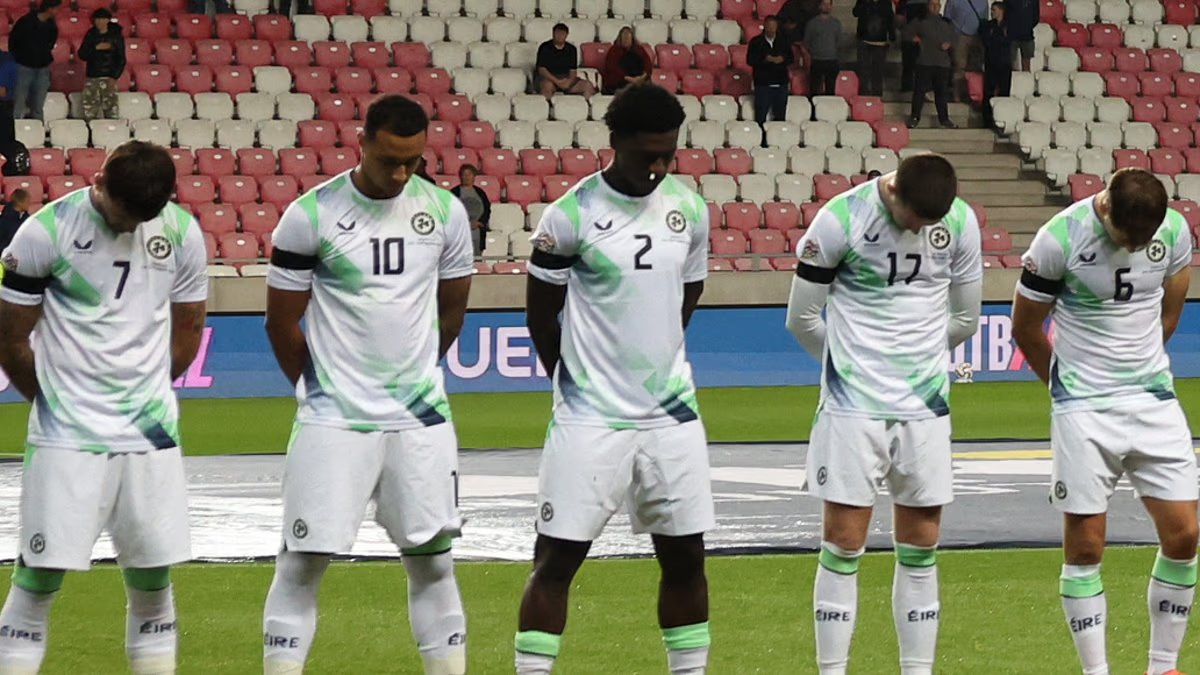
Although the match went ahead, Ireland captain Dara O’Shea did not shake hands with Israeli counterpart Solomon before the coin toss. Ireland’s players also wore black armbands throughout the game “in recognition of all lives lost in the [Gaza] conflict”.
Ireland goalkeeper Gavin Bazunu, 24, chose not to play on ethical grounds after the squad held four hours of discussions and voted on whether to take part.

The Republic of Ireland will meet Israel for a second time in the Nations League in another politically charged fixture

Ireland manager Heimir Hallgrimsson brought his press conference to an early end after an Israeli journalist accused his players of racism
An Irish Times reporter warned that the “potential scale of fallout to come is the stuff of Saipan 2.0”. The reference was to the infamous 2002 episode in which Roy Keane left Ireland’s World Cup squad after a dispute with manager Mick McCarthy, an incident that divided public opinion.
Questions over the Israel fixtures had been building for months. In July, the Football Association of Ireland held a vote on whether the matches should proceed. At an extraordinary general assembly, members voted 75-32, with three abstentions, to support a motion confirming that the FAI should fulfil its obligations by playing Israel.
The motion acknowledged strong support for Palestine and the controversy surrounding the UEFA Men’s Nations League fixtures. However, it said members recognised the “profound impact” that failing to fulfil UEFA commitments could have on Irish football and its future development, and therefore endorsed playing the matches.
The FAI had previously warned that cancelling the fixtures could bring a “significant financial impact”. It also said UEFA disciplinary action could result in relegation to League C of the Nations League and reduce Ireland’s qualification prospects for UEFA Euro 2028.
Last year, the FAI approved a motion calling on UEFA to exclude Israel from European club and international competitions.
The organisation later said UEFA had rejected a request to prevent the two nations from being drawn together, arguing that they were not in direct conflict. UEFA did approve the use of neutral venues for the fixtures after Israel and Ireland were placed in the same Nations League group.
FAI president Paul Cooke and chief executive David Courell have defended the governing body’s handling of the controversy, which has drawn Ireland’s players and manager Hallgrimsson into an increasingly political debate.
Before the first match, Hallgrimsson said his team were “playing against genocide” amid Israel’s attacks on Palestine, where more than 70,000 people have been killed since the war in Gaza began.

A friendly in May was interrupted twice when fans threw tennis balls bearing the Palestine flag onto the pitch as protesters urged Ireland to boycott the Israel fixtures


Former manager Brian Kerr and ex-international James McClean are among the prominent figures supporting a boycott
Hallgrimsson’s remarks prompted an angry response from Israeli officials, who accused the Icelandic coach of “stupidity, ignorance and hypocrisy”.
Ireland’s second-choice goalkeeper Bazunu then pulled out of the fixture last weekend, issuing a statement insisting he isn’t against Israelis or Jews – but against the atrocities in Gaza.
‘Representing my country means everything to me,’ Bazunu said. ‘I have the utmost respect for every single one of my teammates, the manager, his staff and the Irish people.
‘However, I have reached a decision that I have not taken lightly. I am a man of strong faith and try my best to be a person of character and principle, therefore I feel it would be wrong to participate in the upcoming fixtures against Israel.
‘My decision is based purely upon my belief that the killing of innocent people is wrong. It is important to note that my stance is not in opposition to the Israeli people or the Jewish community but against the atrocities in the region.
‘There are few times when you get a chance in life to stand for something bigger and I strongly believe that this is one of them.’
The Irish Times later reported that multiple players ‘turned’ on the goalkeeper, with ‘genuine anger’ towards him leaving him ‘brutally isolated’. However, Bazunu’s decision had reportedly led to some players considering pulling out alongside him, before a ‘significant majority’ voted in favour of playing the game and protesting.
According to former Irish manager Kerr, that vote occurred in the absence of Bazunu and ended 14-8 in favour of fulfilling the fixture. The FAI refused to confirm or deny those figures.

Ireland’s substitutes and staff looked at the floor during Israel’s anthem in the first match last weekend, with the squad having voted on the eve of the tie to fulfill the fixture

Bazunu’s withdrawal meant that Jimmy Dunne, the QPR centre-back, was named as a keeper on the official team-sheet due to UEFA rules requiring teams to name at least three goalkeepers in their squad.
Bazunu was part of Ireland’s squad for their midweek match against Austria, but was replaced in the squad for the second fixture against Israel by Josh Keeley.
Hallgrimsson has claimed there have been a lot of ‘lies’ around Bazunu’s situation and insisted the squad had welcomed him back for the match against Austria.
‘It is probably more tough for him than the other players but they have really welcomed him,’ Hallgrimsson said in midweek. ‘There have been a lot of lies said around all of this, but we welcome him back.
‘That he is taking part is amazing and it shows his character as well, to be with us. I want to give him praise for that. I want to give the players praise for how welcome they have been with him.
‘Life goes on, Gavin is a part this group. It shows how strong the bond is between these players. Even a thing like this is not breaking us. We are sticking together.’
Bazunu was not the only player thrust into the spotlight, with Hallgrimsson admitting he had taken the decision to leave out Finn Azaz, who has Israeli heritage, from the first match.
Azaz was named in the squad for last weekend’s fixture, but remained on the bench throughout the victory in Debrecen.

Goalkeeper Gavin Bazunu withdrew from the squad due to Israel’s actions in Gaza

Finn Azaz, who has Israeli heritage, was an unused substitute in the first match with Hallgrimsson having since praised his ’emotional awareness’ around the Ireland camp
Azaz’s mother has Israeli citizenship, while he has previously spoken about how his grandmother had been a general in the Israel Defence Forces.
Hallgrimsson, who admitted Azaz is in a ‘different position to other players in our squad’, praised his conduct in the Ireland camp.
‘I think Finn has shown incredible emotional control and awareness,’ Hallgrimsson said. ‘In my mind at the moment, he is one of the persons I admire the most in how he conducted himself in all of this.
It is about being a member of a team, you need to listen to all opinions. To do your work with grace and understanding of all opinions.
‘Talking about walking the extra mile to be a part of a national team, I don’t have words to explain to you. He has so much respect in this group of players. Again, he is one of the persons I admire the most in the world at the moment.’
According to the Irish Independent, Azaz had made an ‘impassioned speech’ to team-mates to present an Israeli perspective amid discussions as to whether the match would take place.
Reports in Ireland followed suggested Azaz is considering retiring from international football following this window.
The second match, which Hallgrimsson confirmed in midweek would take place, could yet prove more charged following the fallout from the first fixture.
The customary pre-match handshake did not take place and during the playing of the Israel anthem, Ireland’s starting XI looked towards the floor in unison – as did their substitutes. Ireland also decided against giving a pennant to Israel to mark the match – a standard gesture in all international fixtures.
There were no handshakes as full time and Ireland’s players were booed by the small number of Israeli fans present as they left the field.
The FAI are also investigating allegations forward Adam Idah was racially abused by Israel supporters. The organisation has said it was informed by a delegate a UEFA investigation could not take place because no clear allegation of racism was reported during the game.

Captains Dara O’Shea and Manor Solomon did not shake hands prior to the match in Hungary

The Republic of Ireland earned a dominant 3-0 victory in the Nations League clash
The events around the match also prompted an explosive outburst post-match from Israel captain Solomon, who declared Israel is ‘ten times better’ than Ireland.
‘They said nonsense [to us] during the game, I don’t want to talk about them,’ the West Ham attacker said. ‘If I say what I think about them, I’ll probably be banned for a few games so I don’t want to say. Of course they hate us and we don’t like them.
‘I believe in ourselves that we can do it. I know who I’m with here, I know the players and the team, we will get out of this and get revenge for this.
‘I’m already looking forward to the next game against them, it’s going to be completely different. What they did with the anthem? I’m not interested in them, we have a country that is ten times better than theirs, stronger, an amazing country with amazing people.
‘We are proud to wear the national team’s shirt and be Israelis. We are proud of our country and our soldiers. [The Irish] can play all their tricks. We are Israelis and love the country. And that will always be the case.’
The remote Serbian town of Backa Topola will provide the venue for the second fixture, in a match taking place behind closed doors.
Hallgrimsson has borne the brunt of questions around the fixture beyond football matters, but Irish press officers were forced to intervene in Backa Topola on Saturday after he was first seemingly asked to comment on the Flydubai incident, which saw a flight from Dubai to Tel Aviv diverted amid an alleged hijacking by a co-pilot with ‘extremist views’.
‘What do you say about the people you support, the ideology is based on murder, just this week one of them tried to kill 100 Israeli passengers, 27 children. Innocent children and thousands of others,’ the first journalist managed, before being pulled up by Ireland’s press officer Kieran Crowley.
‘We are only concentrating on football questions today,’ said Crowley, before a second journalist asked a far more incendiary question.
The second Israeli journalist alleged that Ireland players had called their Israeli counterparts ‘monkeys’, prompting an immediate response from Crowley, who said: ‘That is completely untrue. That is completely untrue.’
The press officer then attempted to take the microphone from the journalist who insisted that he was doing ‘his job’ and told him ‘you cannot take it’ in an attempt to keep hold of it.
‘They are not lying about it,’ the journalist insisted, while a representative close to Hallgrimsson called an end to the press conference and for the Irish media to follow him out for a separate media huddle.
‘You’ve just broadcast a lie,’ he said to the second journalist, who continued to state that he was entitled to ask the question in the open press conference.

Israel captain Manor Solomon boasted how his country is ‘ten times better’ than Ireland, stating ‘they hate us and we don’t like them’
An Israeli television reporter is believed to have then followed the manager into the hall to demand further access beyond UEFA’s pre-match agreement, but was blocked by a member of Ireland’s security team.
No UEFA delegate was present for the press conference.
Hallgrimsson later described the interruption to Irish media as a ‘verbal attack’.
The fixture had initially been scheduled to take place in Dublin, but was moved after the threat of a boycott grew and after a friendly with Qatar in May was stopped twice when tennis balls featuring the Palestine flag were thrown onto the pitch.
While the match will be shown by RTE in Ireland, the broadcaster will again cut back its screening of the game with no studio punditry, no advertising and only using commentary from an international feed.
RTE had said it would only ‘meet its contractual obligations’ to broadcast the fixtures.
Hundreds of pubs in Ireland refused to show the first fixture between the teams and vowed to do so again for the second.
The Nations League fixtures have come amid wider tensions between Ireland and Israel.
In May 2024, Ireland officially recognised a Palestinian state – alongside Spain and Norway – and later that year joined South Africa’s Gaza genocide case against Israel in the International Court of Justice.
The country has also refused to take part in Eurovision due to Israel’s ongoing participation in the song contest and was the first EU nation to boycott goods from illegal Israeli settlements in the West Bank.
In June, the country issued travel bans on Israeli government ministers Itamar Ben-Gvir and Bezalel Smotrich.
Gaza’s Hamas-run Health Ministry last week said the Palestinian death toll has risen to 74,016, with 175,068 wounded.
The war began on October 7, 2023, when Hamas-led militants invaded Israel, killing some 1,200 people, mostly civilians, and taking 251 others hostage.
While a ceasefire that took effect last October 10 has halted the heaviest fighting, Israeli strikes have continued in what the military has said are responses to threats or attacks.
Since the ceasefire, 1,145 Palestinians have been killed, said the ministry, which is part of the Hamas-led government.

The teams will meet again in the Serbian town Backa Topola on Sunday night
Meanwhile, seven Israeli soldiers have been killed since the ceasefire.
Next steps in the US-brokered ceasefire remain largely stalled.
Israeli forces now control over half of the territory, and Prime Minister Benjamin Netanyahu says they will not withdraw until Hamas disarms.
Between the highly charged Nations League matches this week, Ireland boss Hallgrimsson admitted ‘none of us have experienced a situation like this.’
‘When we look back in two or three weeks we will see we could have done things better, he said.
‘But, hopefully, in time, we will see that we took more right decisions than wrong ones.’


