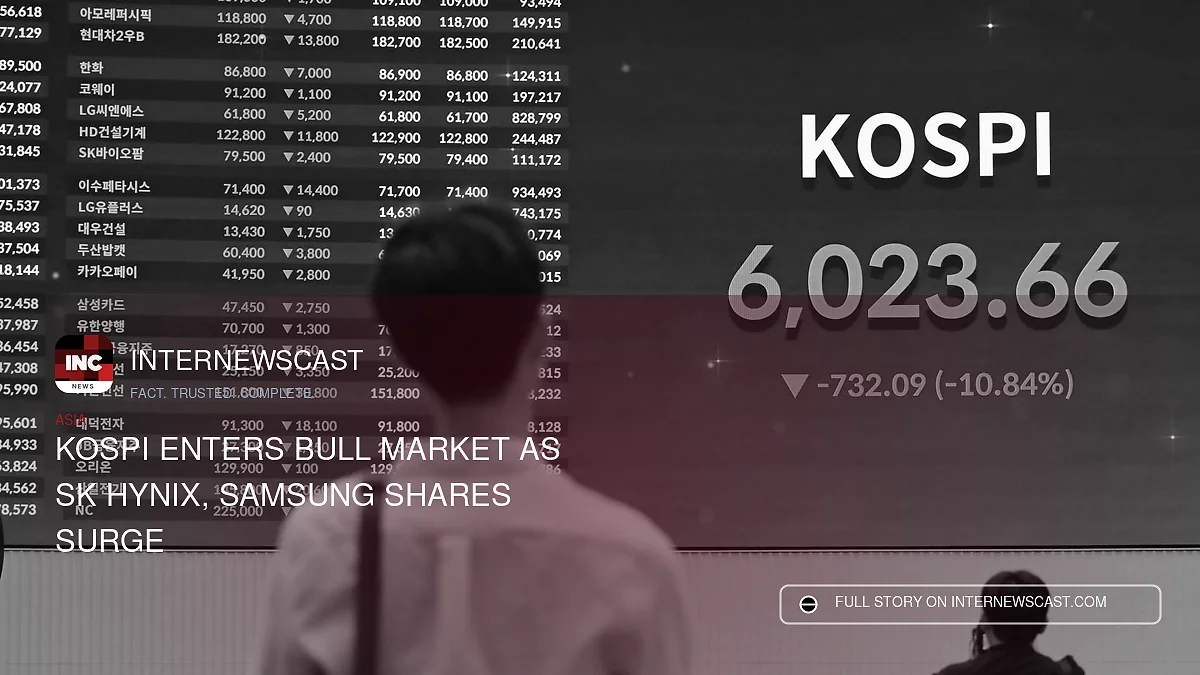

A man watches a stock index board displaying South Korea’s benchmark KOSPI after trading closed in Seoul on July 28, 2026.
Greg Baker | AFP | Getty Images
South Korea’s Kospi has bounced sharply from its most recent sell-off, climbing back into bull-market territory as investors return to the semiconductor heavyweights that carry much of the benchmark index.
The index is now up more than 20% from its July trough, meeting the widely followed definition of a bull market. The rebound follows a steep decline last month, when leveraged trades and forced selling helped drag the Kospi into bear-market territory.
The rapid recovery highlights just how volatile technology stocks remain, while putting a key question back in focus for investors: Can South Korea’s stock market rally keep going?
For market bulls, the outlook depends heavily on whether South Korea’s chip leaders can deliver earnings strong enough to match rising expectations. Solid U.S. technology results, along with ongoing commitments to artificial intelligence infrastructure investment, have bolstered confidence that demand for memory chips will stay resilient.
“The AI rally and continued strong earnings have been a constant during the sell-off, so it is fundamentals returning the market back to normalcy rather than the other way around,” said Peter Kim, head of global investment strategy at KB Securities.
Kim said investors had not seriously questioned valuations or earnings during the semiconductor slump, arguing that the downturn was driven more by technical pressures and fund flows than by a deterioration in business fundamentals. The forced unwinding of leveraged positions has also eased after regulators tightened rules and brokerages brought margin and risk requirements back to more normal levels. That, he suggested, may leave the market on steadier ground than it was during the surge that came before the crash.
Concentration risks — or rewards?
The Kospi’s dependence on just a handful of semiconductor companies makes its bull run overly exposed to shifts in sentiment toward AI.
“Korea’s equity market is basically synonymous with the AI hardware trade at this point,” said Phillip Wool, head of research at Rayliant Global Advisors.
The rebound has been partly technical, Wool said, as forced selling subsided, dip buyers returned and fear of missing out took hold. But stronger-than-expected Big Tech earnings have also reinforced expectations for AI infrastructure spending and helped underpin upward revisions to growth forecasts for Korean hardware companies.
“Anything that calls this narrative into question, whether it’s soft guidance on capex from hyperscalers, sagging token pricing, Fed tightening fears, we can expect to see a pullback,” Wool said. “Expect continued volatility as long as there’s uncertainty about how AI hardware spending will play out.”
Supporting the bull case, Billy Leung, investment strategist at Global X ETFs pointed to Korea’s corporate-governance reforms and “Value-Up” program, which have helped reduce the “Korea discount.”
The “Korea discount” refers to the longstanding tendency of South Korean companies to trade at lower valuations than comparable global peers.
“The KOSPI is in a bull market, but the more important question is whether the rally is being driven by speculation or by a genuine improvement in fundamentals,” Leung said.
He sees Korea as closer to a fundamentally supported bull market than a speculative bubble, with semiconductor earnings’ expectations continuing to rise. But elevated retail participation, heavy index concentration and ambitious market targets are also beginning to resemble late-cycle behavior.
Others warned about reading too much into the 20% milestone.
“I would be cautious about describing this as a completely new bull market,” said Jung In Yun of Fibonacci Asset Management Global. The rebound represents both a technical recovery from forced selling and “a genuine return of stability,” he said.
His base case is for the broader bull trend to continue, backed by semiconductor earnings and improved risk appetite, but at a slower and bumpier pace. “After such a steep rebound, some consolidation would be healthy, and investors should not expect the market to rise at the same pace from here.”


