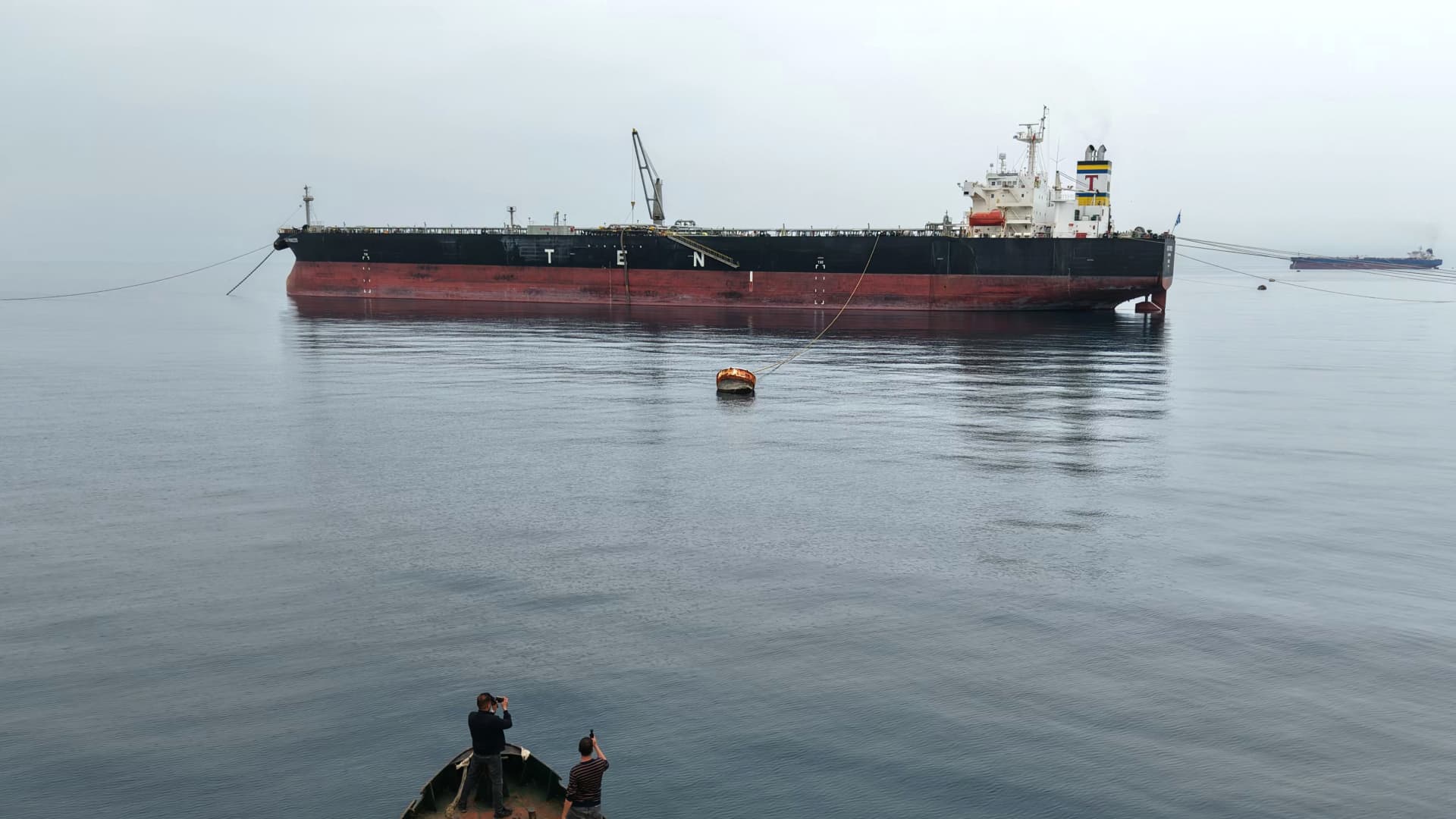

The Greek-flagged crude oil tanker “Asahi Princess” is being prepared for operations off the coast of the Baniyas port refinery in Syria, located along the Mediterranean Sea, as of April 15, 2026. Iraq has started exporting crude oil by transporting it via tanker trucks through Syria, according to a statement from the country’s oil ministry. This development comes on the heels of a significant drop in oil revenue, which an official reported had decreased by more than 70% compared to February’s figures.
Credit: Bakr Alkasem | AFP | Getty Images
On Friday, oil prices experienced a decline as the United States and Iran were anticipated to engage in direct discussions in Pakistan.
By 2:05 p.m. ET, Brent crude futures, the international oil price benchmark, had decreased by 0.23% to $104.83 per barrel. Meanwhile, West Texas Intermediate futures saw a more substantial drop of about 2%, settling at $93.90.
The White House confirmed on Friday that U.S. special envoy Steve Witkoff and Jared Kushner are scheduled to travel to Pakistan on Saturday morning for face-to-face negotiations with Iranian officials, as announced by press secretary Karoline Leavitt.
Iran’s Foreign Minister, Abbas Araghchi, stated earlier on Friday that he plans to visit Islamabad, Muscat, and Moscow. His aim is to “closely coordinate with our partners on bilateral issues and consult on regional developments.”
Meanwhile, Israel and Lebanon agreed Thursday to prolong their truce by three weeks following a meeting at the White House with senior U.S. officials, President Donald Trump said Thursday.
The ceasefire, initially set to last 10 days, will now give more time for diplomatic negotiations, with Washington also pledging support to bolster Lebanon’s defenses against Hezbollah.

U.S. oil prices since the start of the year
While the ceasefire between the U.S. and Iran has held, the conflict has evolved into naval blockades keeping the vital Hormuz Strait closed, as both attempt to gain economic leverage to secure a deal favorable to their interests.
“The longer the strait remains closed, the greater the economic costs — raising the likelihood that one side will be forced to back down” Commonwealth Bank of Australia wrote in a note published Friday.
About 20 million barrels of oil and petroleum products were shipped every day through the strait before the war.
“We judge the U.S. will be the first to back down because of mounting political and economic costs. But there remains a risk of major military escalation that would significantly push up the U.S. dollar,” the analysts wrote.
Fatih Birol, head of the International Energy Agency, told CNBC on Thursday that “We are facing the biggest energy security threat in history.”
“As of today, we’ve lost 13 million barrels per day of oil … and there are major disruptions in vital commodities,” he told Steve Sedgwick virtually at CNBC’s CONVERGE LIVE in Singapore.
Birol has previously warned that the Iran war and ongoing closure of the Strait of Hormuz would result in “the largest energy crisis we have ever faced” and urged governments to bolster their resilience with alternative energy sources.
— CNBC’s Holly Ellyatt contributed to this report.


