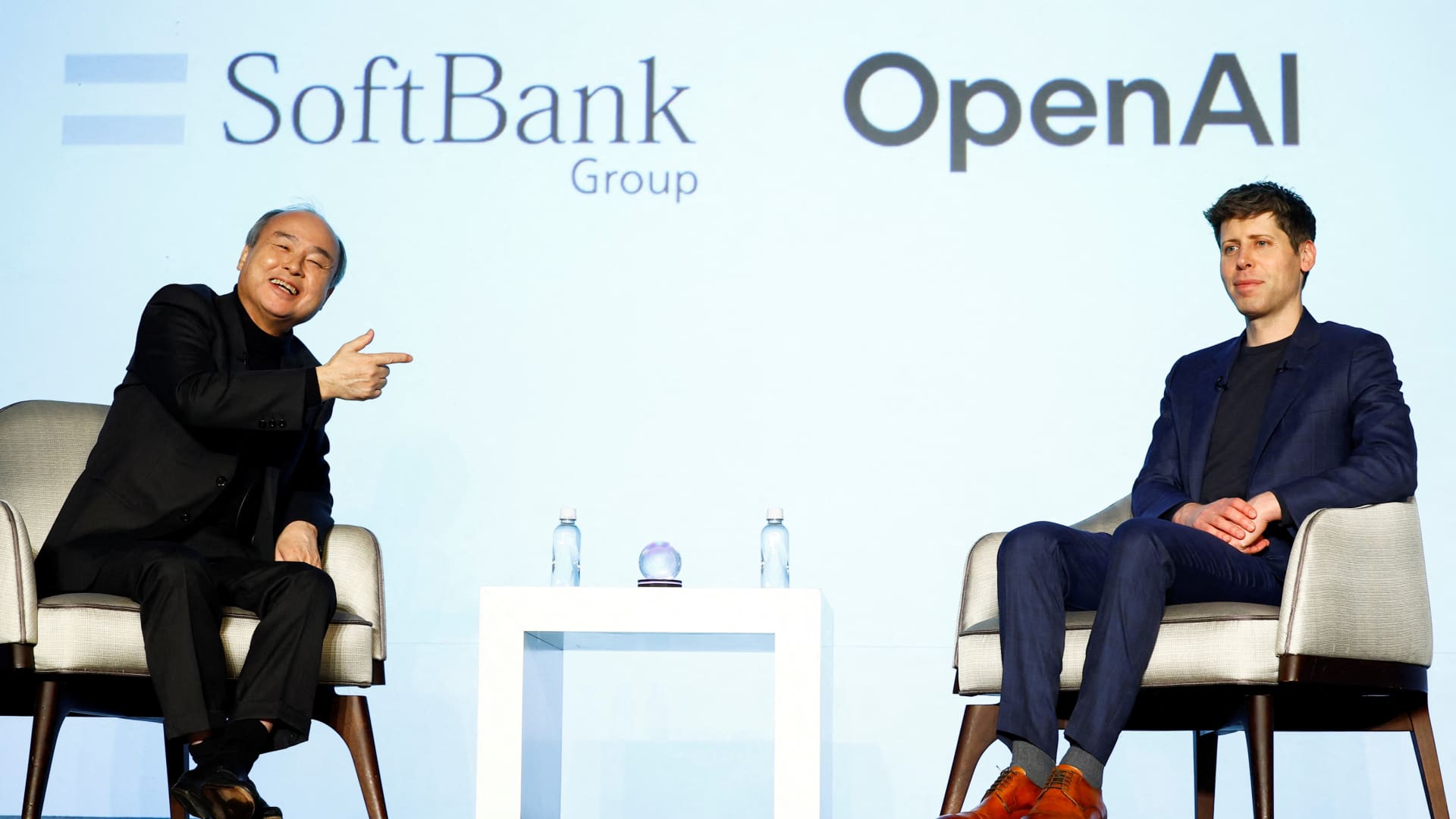

In a significant event in Tokyo, Japan, on February 3, 2025, SoftBank CEO Masayoshi Son and OpenAI CEO Sam Altman were present to advocate for the integration of AI in business operations.
During the event, Masayoshi Son shared with CNBC that OpenAI is developing its next model through an existing AI model, signaling a move towards “superintelligence.” This revelation underscores the potential of AI to surpass current technological capabilities.
Son’s statements come at a time when Anthropic, another key player in the AI field, has expressed concerns about the need to slow down AI development to manage the consequences of its rapid evolution.
As the head of SoftBank, a major global technology investor and a significant shareholder in OpenAI, Son has considerable insight into the AI sector. In a recent conversation with CNBC, he mentioned discussions with OpenAI’s CEO Sam Altman and the company’s engineers, revealing that AI is now capable of designing successive models. This marks a pivotal shift, as it suggests that future AI models may be beyond the design capabilities of human engineers.
Son runs SoftBank, one of the world’s biggest tech investors and one of the largest OpenAI shareholders. In an interview with CNBC on Monday, Son said he had spoken to OpenAI CEO Sam Altman and engineers at the firm, who told him that an AI “model is designing” a future model.
“So that’s going to happen to all the other major models,” Son said, adding that engineers will no longer be smart enough to design the next model.
“So once that happens, [the] model generates [the] next model … and it’s going to be exponentially smarter than all of us. That’s a superintelligence,” Son told CNBC.
An OpenAI spokesperson declined to comment on unreleased models but highlighted areas where the company was already using AI in model development.
In February, OpenAI said its GPT‑5.3‑Codex is its “first model that was instrumental in creating itself.” The team behind Codex, which is OpenAI’s coding tools, “used early versions to debug its own training, manage its own deployment, and diagnose test results and evaluations.”
‘Artificial superintelligence’
Son’s comments are part of a broader conversation about “artificial superintelligence” or ASI, a term that in 2024 he described as AI that is 10,000 times smarter than humans. At the time, Son said ASI will be here in 10 years.
However, he told CNBC on Monday that when he laid out that timeline nearly two years ago, he was “trying to be conservative because people get shocked.”
“In my mind, I thought it was coming in four years instead of 10 years. Now, I say it’s coming in the next two years,” Son said.
The SoftBank CEO said he currently uses OpenAI’s ChatGPT two to three hours a day as the AI is smarter than he is in “most subjects.”
In the next couple of years, AI will be smarter than humans in around 70% to 80% of subjects, and those subjects in which it exceeds human intelligence, it “may be 10 times smarter than average people,” Son said.
Son has been bullish on AI for several years and has positioned SoftBank in the middle of the boom through its ownership of chip designer Arm and stake in OpenAI as well as investments in areas such as robotics and autonomous driving.
He told CNBC that the AI revolution is 50 times bigger than the dot-com revolution in the 2000s.

Anthropic warnings
The dangers of more advanced AI systems were thrust into the spotlight Thursday after Anthropic released a blog post about “recursive self-improvement” or RSI, a trend where an AI system is “capable of fully autonomously designing and developing its own successor.”
While Anthropic said that there would be positive outcomes, it warned that “full recursive self-improvement also might increase the risks of humans losing control over AI systems.”
The company, which develops the AI chatbot called Claude, said a coordinated effort between AI labs to slow down the development of this technology “would likely be a good thing.”
When talking about OpenAI’s model improvement, it’s unclear if Son was referring to RSI. But in June, an OpenAI research paper said there are “early signs” of RSI in today’s systems.
“We expect this to increase competitive pressures among developers and nations, and create governance challenges that existing institutions are not equipped to address. As RSI emerges, societies will need ways to shape the trajectory of AI development and ensure that it serves human interests,” the paper said.