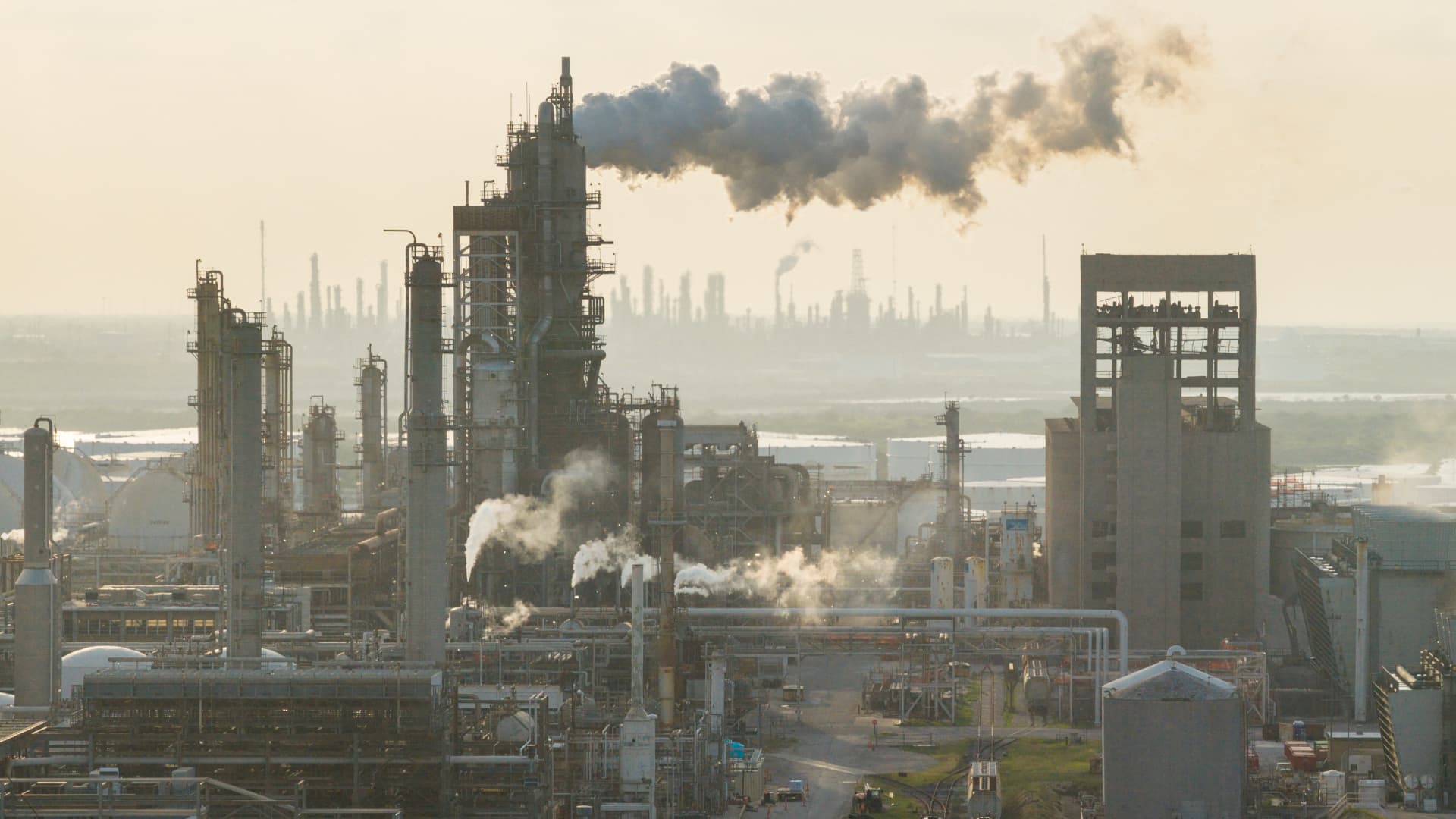

An aerial view captures a Valero refinery on May 5, 2026, in Corpus Christi, Texas.
Credit: Brandon Bell | Getty Images
The oil market witnessed renewed momentum on Friday as tensions flared between the United States and Iran in the Strait of Hormuz. The exchange of fire between the two nations has heightened concerns that the already delicate ceasefire is on the verge of collapsing, posing a potential threat to one of the world’s most crucial oil shipping lanes.
In response, the international benchmark Brent crude futures for July delivery climbed by 1.20%, reaching $101.26 per barrel. Meanwhile, U.S. West Texas Intermediate futures for June delivery saw an increase of 0.88%, bringing prices to $95.64 per barrel.
The strained ceasefire faced further pressure as Washington and Tehran traded blame over the initiation of the recent skirmishes in the Strait of Hormuz. This development arises amid reports that Iran is evaluating a U.S. proposal aimed at ending the ongoing conflict.
In a call with an ABC News reporter on Thursday, U.S. President Donald Trump downplayed the incident, asserting that the ceasefire remains intact and describing the military strikes as “just a love tap.”

Oil prices since the start of the year
In a Truth Social post, Trump said U.S. forces had wiped out the Iranian targets involved in the clash, including small boats and drones. He also warned that Iran would face further military strikes if it failed to agree to a nuclear deal.
Market optimism over a possible reopening of the Strait of Hormuz faded after reports emerged that Washington was preparing to resume naval operations escorting commercial vessels through the waterway, ANZ wrote in a note, adding that oil prices suffered a “rollercoaster rise” as doubts emerged over U.S.-Iran peace negotiations.
Trump later paused “Operation Freedom,” the U.S. naval mission aimed at escorting commercial vessels through the Strait of Hormuz.
“The risk of a proposed U.S. peace deal breaking down will likely keep oil markets volatile,” said ANZ Research’s experts.
Citi analysts said they expect broader financial markets to stabilize despite recent volatility linked to the Middle East, though the bank warned that the path toward normalization is unlikely to be smooth and could keep oil prices elevated in the months ahead.
— CNBC’s Kevin Breuninger contributed to this report.


