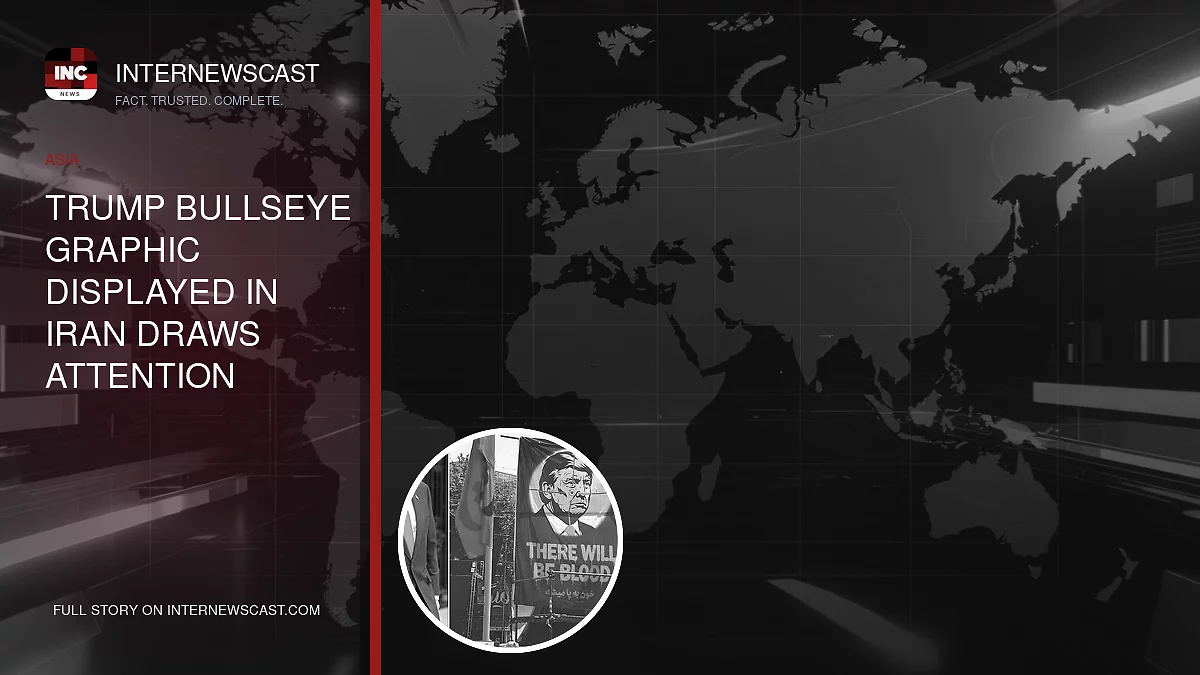

Exclusive photos and video obtained by the Daily Mail reveal a huge custom banner looming over Tajrish Square in Tehran, Iran’s capital, after it was put in place late last week.
The striking display features a sharply detailed caricature of Donald Trump, with his face unmistakable, positioned beneath what appears to be a large blood-red painted sniper-style bullseye.
Under the image of the targeted President, a stark message appears in oversized crimson English capital letters: “Never will be blood.”
The highly visible installation, widely viewed as state-sanctioned propaganda, has alarmed residents in the busy northern Tehran square.
Iranians who contacted the Daily Mail described the banner as a disturbing escalation, even in a country where official anti-American messaging and “Death to America” slogans have long been part of the political landscape.
“They never do this,” one worried local resident told the Daily Mail, referring to the unusually explicit nature of a public graphic threat aimed at a President in such a heavily trafficked part of the city.
“They rarely put up banners like this, but at night during events in this same square, they often make verbal threats against him… They [the people] are very angry about what the regime has turned this place into. They have disrupted everyday city life with all this loud and unpleasant noise.”


‘Kill Trump’ Signs and Iran-Linked Propaganda
The exact meaning of the English phrase “Never will be blood” has quickly become a focus of speculation, confusion and concern.
Observers are debating whether it is a defiant vow that the blood of Iranian figures the US administration killed will never be forgotten and will be avenged, or a bold claim that the regime is not afraid of conflict.
Regardless of the exact nuance, locals say the intent is unmistakably hostile, particularly given the precise positioning of the crosshairs.
Ominous ‘Kill Trump’ signs – written in both English and Farsi – have also been erected across the capital during the height of the war with Iran.
Back in late July, an AI-generated propaganda video released by Iran’s IRGC-affiliated Tasnim News Agency has directly targeted First Lady Melania Trump and her son Barron, weaponizing her penchant for high-end Manhattan shopping.
Highlighting luxury Fifth Avenue hot spots like Bergdorf Goodman and Saks Fifth Avenue, the threat details Secret Service security preparations, while inciting ‘freedom fighters’ to execute plots ranging from bribery to poisoning.
This propaganda campaign, which includes images of Melania, Barron and Ivanka Trump with their eyes edited shut and labeled ‘killed,’ marks just one of the latest threats from the Iranian regime that has actively pursued assassination attempts against the Trump family, including a murder-for-hire plot previously charged by the Justice Department.

Questions Over Mojtaba Khamenei’s Whereabouts
Meanwhile, Ayatollah Khamenei’s son, Mojtaba, his father’s successor, has vanished from sight, sparking a wave of rumors across the country.
Following the February US-Israeli airstrikes that assassinated his father, Iran’s Assembly of Experts swiftly fast-tracked his hardline son, Mojtaba, as the country’s third Supreme Leader to project immediate stability.
While the official regime narrative insists he is operating from deep underground due to extreme security protocols, intense internal rumors suggest he was severely disfigured or injured in the initial blast that killed his family
If Mojtaba is in fact dead, the country is legally run by a fragile, ideologically divided three-man council that includes the President, the Chief Justice and Senior Cleric.
This would eventually result in elections for a new Supreme Leader, sparking a massive crisis of legitimacy and first break in the Khamenei bloodline.
Several Iranian sources stressed that no-one has seen or heard from the late Supreme Leader’s son in months.
Meantime, Trump said the United States is shifting toward a ‘low-key’ approach in its conflict with Iran, signaling a turn away from direct military strikes to focus on economic containment and naval pressure.
Speaking Sunday, Trump pointed to Iran’s soaring inflation and liquid cash shortages, asserting that Tehran is struggling to pay its armed forces – a financial strain exacerbated by an ongoing US naval blockade.

Trump Shifts Toward ‘Low-Key’ Approach on Iran
‘We are low-keying it. We are only semi-negotiating with them,’ Trump told Axios, describing the strategy as a strategic ‘chess game.’
The administration’s stance comes as diplomatic efforts to secure the Strait of Hormuz remain stalled.
A prospective agreement brokered by Oman to restore partial commercial traffic through the vital shipping lane fell apart Saturday after Tehran issued a list of demands.
Iran’s Supreme National Security Council declared the waterway will remain closed to ships linked to ‘hostile countries’ until Washington halts hostilities, lifts its naval blockade, completely compensates Iran for war damage, and unconditionally releases frozen assets.
Iranian Foreign Minister Abbas Araghchi confirmed Sunday that no direct negotiations are currently taking place between Washington and Tehran.
A 60-day window to negotiate a broader settlement is set to expire in just over a week, though officials indicate the timeline may be extended.
The standoff with Iran coincides with broader friction across the region.
Israeli Prime Minister Benjamin Netanyahu recently dismissed a US-backed peace framework for Gaza, emphasizing that Israeli military forces will not withdraw until Hamas is fully disarmed.
With direct talks on hold and key maritime routes restricted, Washington appears content to rely on prolonged fiscal pressure to force concessions from Tehran.


