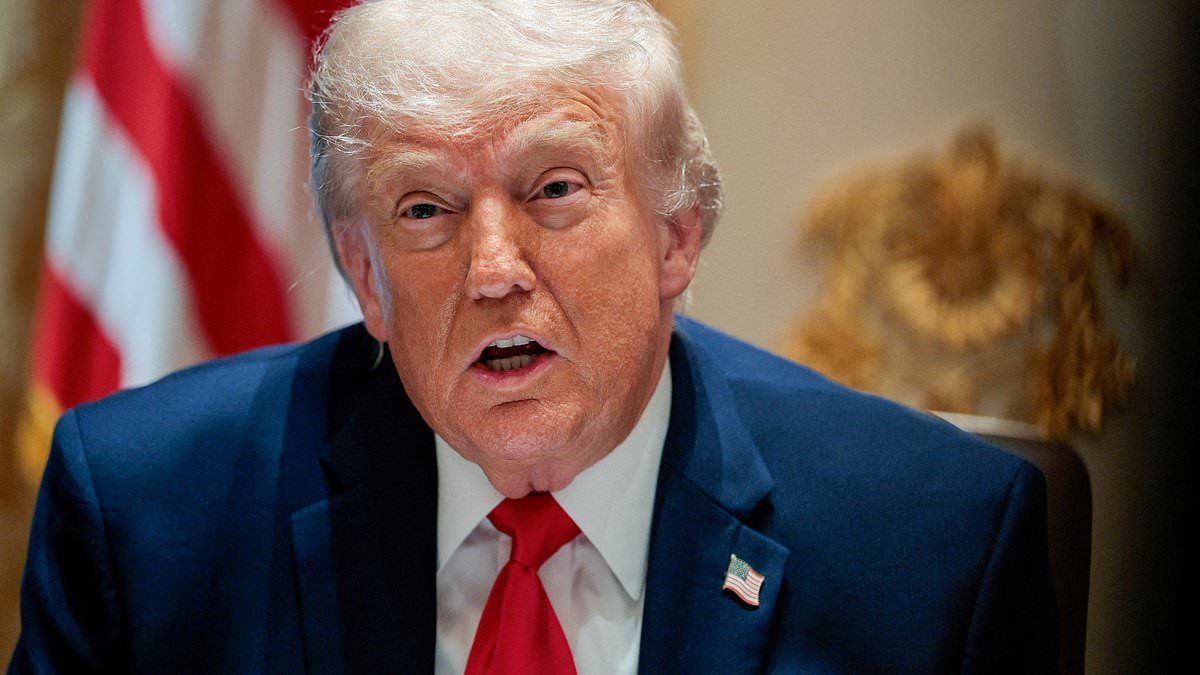

On Wednesday, President Donald Trump announced that Iran has committed to not pursuing nuclear weapons, hinting at a potential future meeting with Iran’s Ayatollah. During his appearance on the ‘Pod Force One’ podcast, Trump shared that Iran’s leader is participating in peace discussions with the United States, describing the situation as swiftly progressing in a positive direction. “I am open to meeting him, and it’s likely to happen at some point, depending on developments,” Trump remarked about the Ayatollah. He noted, “They have already agreed to forgo nuclear arms, although Tehran could still reverse this stance.”
Trump Defends Iran Strikes While Seeking Nuclear Deal
Trump underscored the necessity of addressing the issue with Iran, emphasizing, “Despite our economic success, we cannot allow them to possess nuclear weapons.” He continued, “They might change their mind, but agreeing to abandon nuclear ambitions was crucial.” Trump also mentioned that there is no current need for U.S. ground troops. Meanwhile, he admitted to a tense exchange with Israeli Prime Minister Benjamin Netanyahu, expressing dissatisfaction with Israel’s ongoing conflicts with Lebanon. “I was not exactly angry, just a bit upset about his persistent issues with Lebanon,” he explained. Despite this, Trump stated that his relationship with Netanyahu remains strong.
Gulf Ceasefire Tested as Iran Strikes Kuwait
These developments occur amidst renewed tensions in the Gulf region, as Iranian missile strikes have reportedly damaged Kuwait’s airport, prompting U.S. military action near the Strait of Hormuz. These incidents pose a challenge to the fragile ceasefire, leading to a more than 2% increase in oil prices, as the strait continues to face partial closure following previous U.S. and Israeli strikes on Iran. In Kuwait, flights were temporarily halted at the international airport after Iranian drone and missile attacks caused damage to airport facilities and diplomatic sites, resulting in casualties. Kuwaiti authorities and state media reported that Kuwait Airways has since resumed operations from Terminal 4, after assessing the damage and implementing safety protocols.
Bahrain’s army said it had intercepted three missiles and several drones, as Iran said it had attacked the headquarters of the US Fifth Fleet in the country, as well as an airbase and helicopters in another, unspecified, regional state. The US military said two Iranian missiles aimed at Kuwait fell short or broke up in flight, while several ballistic missiles failed to strike their targets in the region. The military adviser to Iran’s supreme leader on Wednesday warned of more missile and drone strikes should the US renew its attacks on Iran. ‘Every shot fired and every attack will be met with a deluge of missiles and drones,’ Mohsen Rezaei posted on X, adding that ‘the aggressor will swiftly be punished’. The Islamic Republic accused Kuwait and Bahrain of allowing the US to use their territory to launch attacks on an Iranian tanker and the strategic island of Qeshm.
‘The foreign ministry… condemns the colonialist use by the United States of the territory and infrastructure of countries in the region to advance its aggressive plans against Iran, and emphasises the direct and unmistakable responsibility of the leaders of Kuwait and Bahrain for last night’s acts of aggression,’ a statement said. Iran’s Fars and Tasnim news agencies, both believed to be close to the Guard, reported that Tehran’s negotiators have stopped communicating with ceasefire mediators, as tensions flared in Israel’s separate but related fight against the Iranian-backed Hezbollah militant group in Lebanon. A regional official involved in the mediation, speaking on condition of anonymity to discuss the talks, told AP that Iran had not communicated at all on Tuesday after saying that a ceasefire needed to be enforced in Lebanon for negotiations to continue.
Trump dismissed the claims on Truth Social, writing: ‘Fake News Reports that the Islamic Republic of Iran, and the U.S.A., stopped speaking a few days ago are false and erroneous.’ Last week, Iran and the US signalled progress towards a tentative initial agreement to halt the war and reopen the strait, but the two sides have yet to sign off on the deal, which would leave more complex negotiations for later. Rezaei said on Tuesday Iran would not allow the US to ‘overreach’ either in negotiations or ceasefire arrangements. In a post on X, he warned that any aggression would be met with a barrage of missiles and drones. Anwar Gargash, diplomatic adviser to the UAE president, said repeated attacks on Kuwait and Bahrain required a firm, unified and cohesive Gulf response. ‘The aggression does not target one country alone, but all of us,’ he wrote on X. In further signs of escalation, the US military said it had downed drones targeting civilian ships in regional waters and US forces in Kuwait, and had carried out strikes on Qeshm Island near the Strait of Hormuz after attempted attacks by Iran.
Iranian media said that the Revolutionary Guards’ navy targeted a vessel it identified as the Panaya with missiles, in response to what it said was a US attack on an Iranian tanker near Hormuz. ‘Disrupting the security of the Strait of Hormuz will carry a heavy price for the US military,’ media cited the Guards as saying. Earlier, Iranian media said Tehran had not been in contact with Washington for several days, though US President Donald Trump said negotiations were continuing. Writing on Truth Social on Wednesday morning, Trump said: ‘The conversations between us have been going on continuously, including four days ago, three days ago, two days ago, one day ago, and today.’ Since mid-March, he has repeatedly said he is close to a deal to end the fighting and pave the way for negotiations on thorny issues including the future of Iran’s nuclear program. Trump has said his top priority is to stop Iran from acquiring nuclear weapons. Iran denies it is developing a nuclear bomb and says its atomic program is for peaceful purposes.
As part of any deal, Tehran is seeking a halt to fighting in Lebanon, access to billions of dollars in oil revenues, waivers on crude exports, a lifting of a US blockade on its ports and continued leverage over the strait. Meanwhile, the war has killed thousands, mainly in Iran and Lebanon, while causing global economic pain by severely disrupting energy supplies and other shipping. It also sparked off the latest round of conflict between Israel and Iran-backed Lebanese militant group Hezbollah, with Israel pursuing its deepest incursion into Lebanon in 25 years. On Tuesday, Israel kept up strikes on a string of southern towns, Lebanese security sources said, despite a US-mediated partial ceasefire unveiled on Monday. On Wednesday, the Israeli military said it had intercepted a ‘hostile aircraft’ that crossed into northern Israel.


