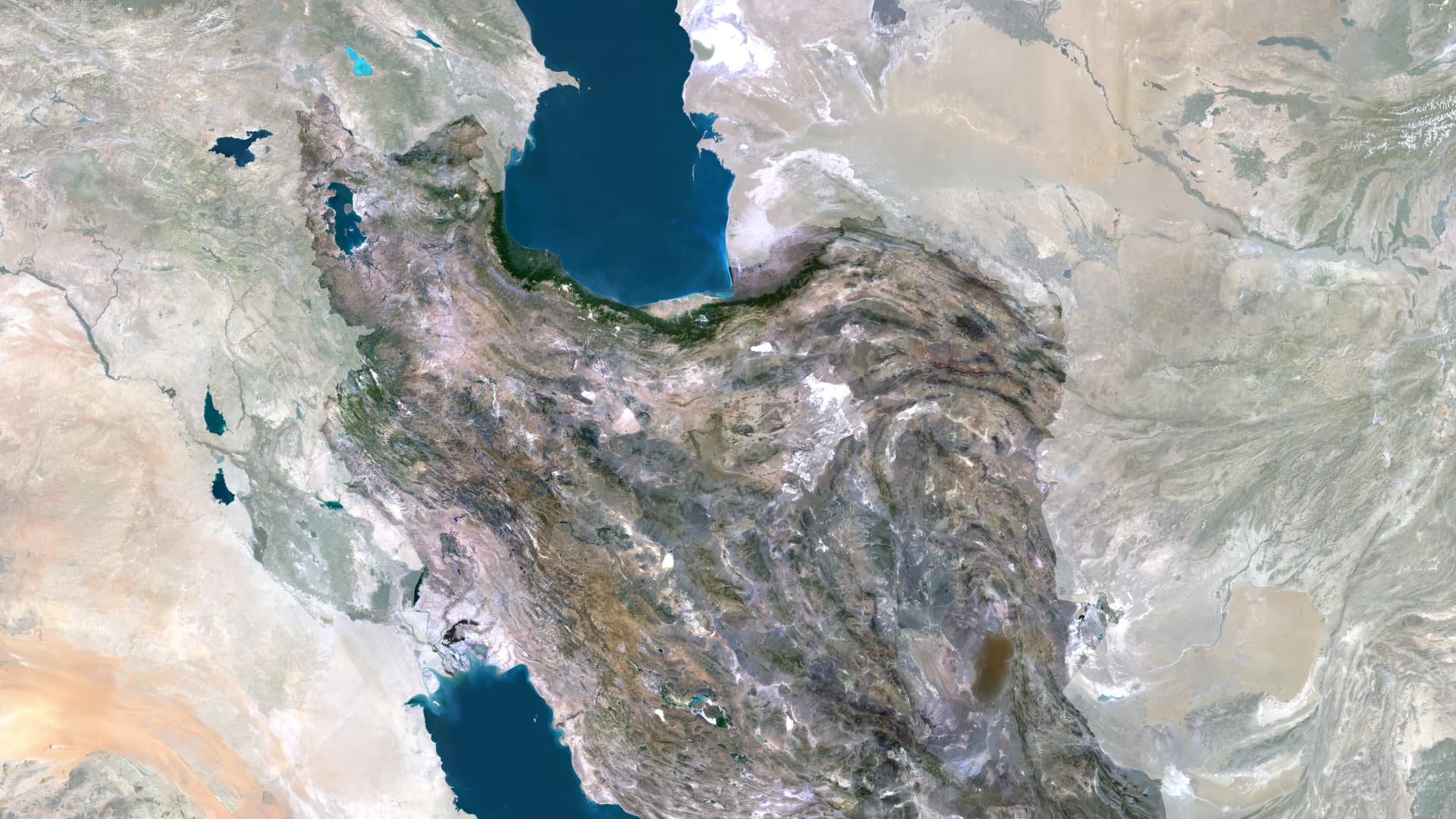

Satellite image of Iran with mask. The view was created using data captured by the LANDSAT 5 and LANDSAT 7 satellites. Iran, Middle East, Asia, true-color satellite image with mask. (Photo by Planet Observer/Universal Images Group via Getty Images)
Planet Observer | Universal Images Group | Getty Images
U.S. President Donald Trump said talks with Iran are set to start Monday, after he chose not to proceed with fresh military strikes against the Middle Eastern nation. The move renewed cautious hopes that diplomacy could ease a conflict that has rattled global energy supplies.
“Now what we’re doing is we’re talking to them in the form of a negotiation. It begins tomorrow afternoon,” Trump told reporters Sunday while traveling aboard Air Force One. He did not provide details on where the discussions would take place or who would take part.
Trump said he had canceled the planned strikes at the request of Saudi Arabia, the United Arab Emirates, Qatar and Iran. He also characterized a potential agreement involving the Strait of Hormuz and Iran’s denuclearization as “imminent.”
Iran, however, appeared to push back on the prospect of direct talks. Foreign Ministry spokesperson Esmail Baghaei again cast doubt on any immediate negotiations with the United States.
Speaking at a press conference Monday, Baghaei said there was no current plan for negotiations with Washington. He reiterated that Tehran is, for now, only holding discussions with Oman related to the Strait of Hormuz.
On Saturday, Trump said the planned operation would have been the largest since World War II, while stressing that the United States remained prepared to strike Iran.
The Strait of Hormuz — which handled around one-fifth of global oil supply before the war — has seen traffic drop to a trickle with sporadic increase in ship transits on positive headlines.
Oil retreated on signs of a diplomatic breakthrough. West Texas Intermediate futures for September delivery declined nearly 6% to $79.66 per barrel. Brent crude futures for October delivery lost 5.16% to $83.39 a barrel.
BMI, a research unit of Fitch Solutions, said in a note Monday that a broader diplomatic understanding on reopening the Strait of Hormuz is still achievable this quarter, while raising the probability of its escalation scenario to 35% from 25%, citing mounting military, diplomatic and economic signs of rising US-Iran tensions.
“Diplomatic progress is likely to be punctuated by periodic military flare-ups, while miscalculation by either side could trigger a renewed escalation,” BMI analysts wrote in a note. The firm said the key issue to watch is the future governance of the strait, as the Iran-Oman talks — potentially backed by Gulf states, China and the U.S. — point to efforts to build a post-conflict shipping framework.
Shipping risks persist even as diplomacy appears to be advancing. The United Kingdom Maritime Trade Operations said it received a report of an incident 20 nautical miles northeast of Khasab, Oman — at the mouth of the Hormuz strait — with a tanker’s master reporting an explosion in close proximity to the vessel at about 20:37 UTC Sunday (4:37 pm ET). The vessel and crew were safe and authorities are investigating, UKMTO said, advising ships to transit with caution.
The latest proposal announced by Trump over the weekend calls for the U.S. and Iran to return to negotiations and continue ironing out some of the thorny issues that had derailed diplomatic efforts, according to the Associated Press, citing a regional official involved in the mediation efforts.
The official said the proposal also includes a reopening of the Hormuz Strait and halting attacks across the region, including by Iranian-backed militias in Iraq on the Arab Gulf countries and Jordan.
The U.S., for its part, will end its naval blockade on Iran and allow Tehran to export its oil, the official said, adding that no deal has been reached, although the mediation efforts remained underway.

Trump’s weekend reversal has lowered the temperature after days of escalating attacks across the Gulf. Kuwait said on Saturday that Iranian forces launched a wave of drones within its airspace, with its military destroying multiple aircraft after Iran targeted critical infrastructure in the country’s north.
A parallel track with Muscat is also advancing. Iranian diplomats said Tehran was close to reaching a new arrangement with Oman to manage shipping through the Strait of Hormuz, a deal critical to preventing the war from escalating further, according to the Financial Times.
Iranian officials said negotiations over future management of the Hormuz strait with Oman, which sits on the opposite shore of the waterway, are in their final stages. The agreed shipping route would be different from those used before, according to Iran’s foreign ministry spokesperson Esmaeil Baghaei, adding that the new route was separate from the issue of the strait’s reopening or continued closure.