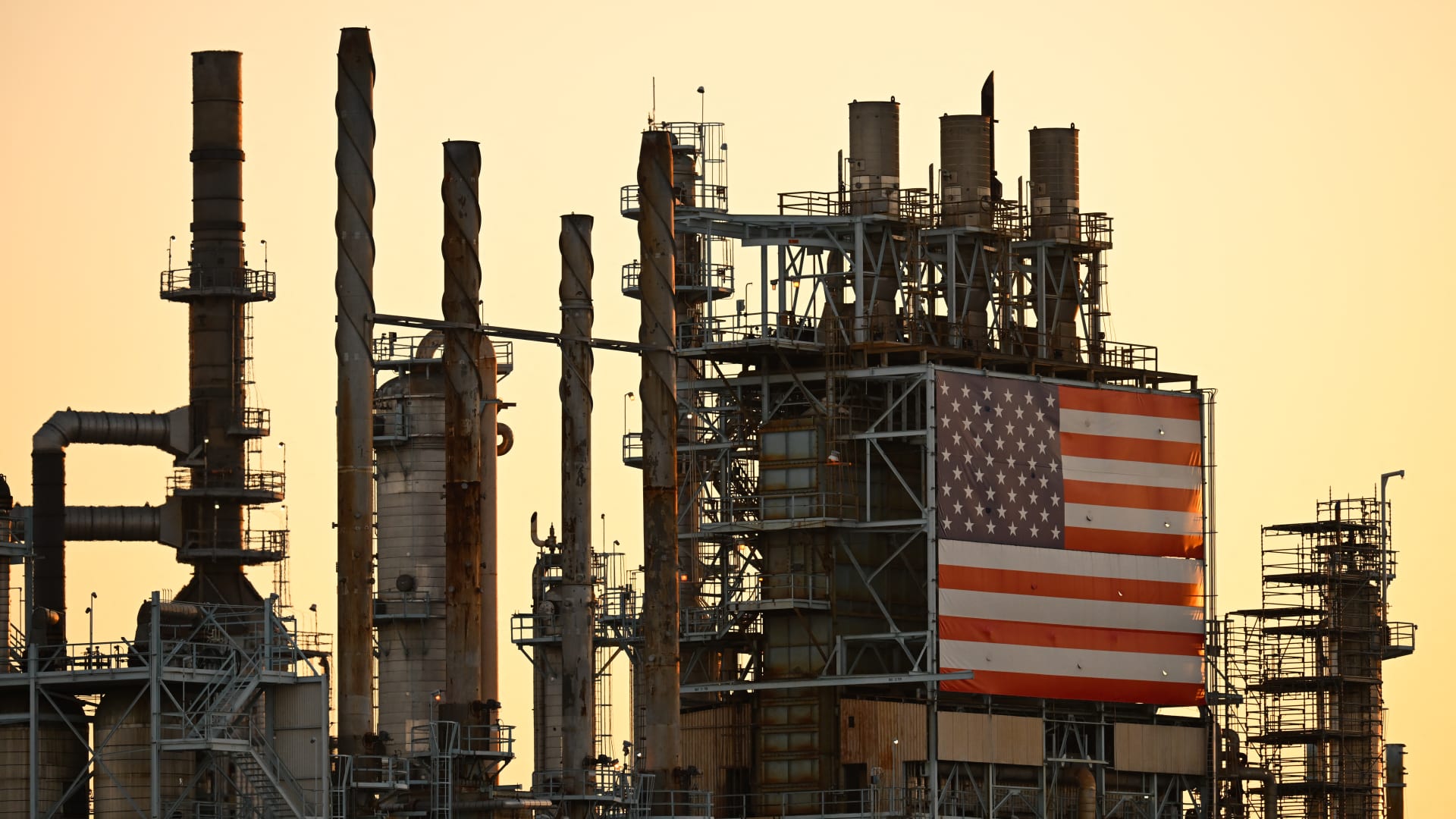

Vehicles travel along the 405 Freeway overpass past a U.S. flag outside Marathon Petroleum Corp.’s Los Angeles Refinery in Carson, California, on September 22, 2026.
Patrick T. Fallon | Afp | Getty Images
U.S. President Donald Trump said the White House is still seriously considering a diesel export ban as political pressure grows to address surging fuel costs ahead of November’s midterm elections.
“We’re thinking about it very seriously,” Trump told a Fox News reporter on Sunday while attending the Presidents Cup golf tournament in Illinois.
“That can oftentimes lead to a little bit of an increase on gasoline for cars, so we’re looking at it very seriously. We may do it,” he said.
Trump has previously voiced support for restricting exports as retail diesel prices reach record levels. Earlier this month, he said the administration would decide quickly “one way or another” whether to impose a ban.
Energy Secretary Chris Wright has said the administration is weighing restrictions rather than a complete prohibition. Politico reported last week that the Trump administration was preparing a 90-day diesel export ban plan.
The prospect of the world’s largest diesel exporter halting overseas shipments has drawn strong opposition from the U.S. energy industry. Analysts have also warned that the policy could backfire, worsening the global fuel crisis.

Diesel prices have surged amid hostilities involving the U.S. and Iran, as well as Russia and Ukraine, with the conflicts disrupting key oil and fuel trade routes. The average U.S. diesel price stood at about $6.50 a gallon on Friday, according to AAA—well above its level a year earlier but slightly below the record $6.53 reached on September 22.
Morgan Stanley commodity strategists said a U.S. export restriction would probably push domestic diesel prices lower at first, because the country has become an important source of marginal supply as shipments from Russia and the Middle East have declined. However, they cautioned that the policy could trigger “potentially adverse reactions downstream.”
“Not only would diesel prices be higher globally, but there could be a feedback loop to U.S. gasoline prices as refinery runs adjust,” the strategists wrote in a research note published Thursday.
‘The biggest problem for the global oil system’
Benedict George, head of European product pricing at Argus Media, said any U.S. restriction on diesel exports would likely drive European diesel prices and premiums over crude to “a new unprecedented level.” He noted that the U.S. has supplied roughly half of Europe’s diesel imports over the past several months.
“It’s really important to be clear that there is no measure yet and it’s very unclear whether there will be a measure at all and what the measure will be even if there is a vision,” George told CNBC by telephone.
George said conversations with European oil traders showed that most remain skeptical the U.S. will restrict diesel exports, given the significant challenges such a policy would create for American oil companies.
Cars line up to refuel at a Rosneft petrol station in St. Petersburg, Russia, on September 15, 2026.
Anadolu | Anadolu | Getty Images
In the U.S., sharply higher diesel costs are adding to financial pressure on farmers, agricultural workers, truck drivers and households as the November midterm elections approach.
The American Petroleum Institute, an oil industry lobbying group, was among the first to oppose the possibility of a U.S. diesel export ban after Trump appeared to endorse the idea last week.
API CEO Mike Sommers said in a statement that “restricting U.S. energy exports would only compound the problem—exacerbating refining challenges and ultimately hurting consumers.”
“The answer is more supply and more flexibility—not new restrictions that risk making a difficult situation worse,” Sommers added.
Trump has previously urged Ukrainian President Volodymyr Zelenskyy to stop targeting Russian oil refineries, saying the attacks are “hurting the world” as fuel supply disruptions continue to prop up U.S. diesel prices.

Ukraine, which fears an extremely difficult winter period amid expectations of another Russian assault on its energy infrastructure, has previously characterized Russian oil refineries as legitimate military targets.
Argus’ George said Ukrainian attacks on Russian oil refineries have added a whole new layer to the global supply crunch, making diesel “the biggest problem for the global oil system, whereas before it was one of several very big problems.”
What next for the global diesel supply crunch?
Asked for his outlook on how long the global diesel supply crunch could last, George said the uncertainty is so extreme that some traders have simply given up trying to forecast the market.
“One trader was saying to me recently that he doesn’t bother trying to forecast now because it feels like a waste of effort. You have literally no idea what is going to happen,” George said.
“We don’t know if the U.S. will introduce any restrictions, but I think all anybody has talked about is a short-term measure, so two or three months at an absolute most … so there is a kind of time horizon on the U.S. restriction of exports, if it were to happen,” he said.
“But on the Russia-Ukraine conflict, who knows? I mean, literally nobody knows. Nothing has worked so far to resolve that situation and similarly for the semi-closure of the Strait of Hormuz.”
— CNBC’s Spencer Kimball and Michael Bloom contributed to this report.


