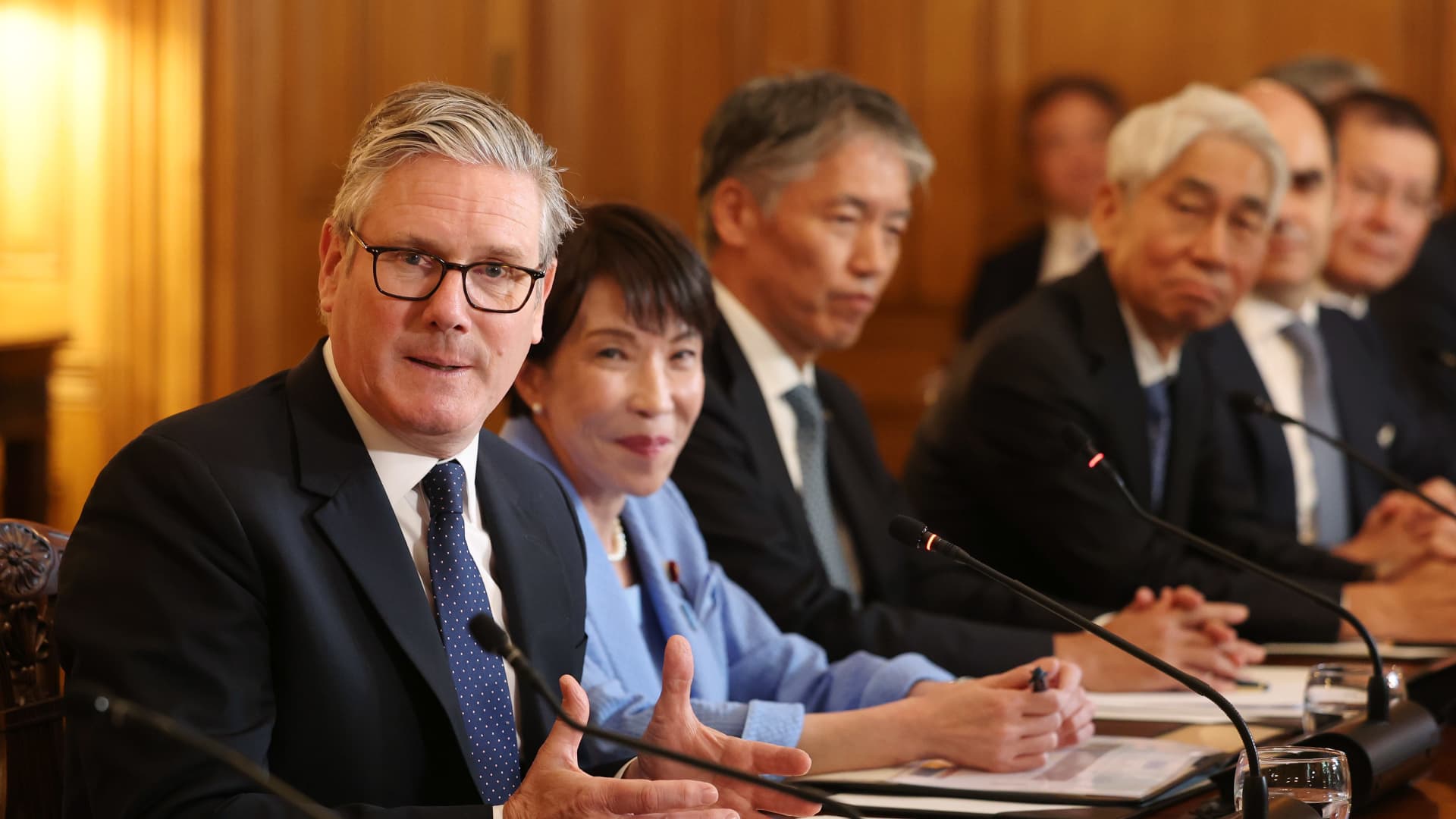

Keir Starmer, the U.K. prime minister, met with Japan’s Prime Minister Sanae Takaichi at 10 Downing Street in London on Sunday, June 14, 2026.
Andy Rain | Bloomberg | Getty Images
Leaders around the world welcomed the U.S.-Iran agreement aimed at ending the war in the Middle East, while some European governments indicated they could consider easing sanctions on Tehran if it takes concrete steps to limit its nuclear activities.
Following more than three months of fighting, the U.S. and Iran struck a deal on Sunday that would immediately and permanently halt the conflict, according to Pakistani Prime Minister Shehbaz Sharif. The agreement is set to be signed Friday in Switzerland and is expected to launch a further 60 days of negotiations focused on Iran’s nuclear program.
President Donald Trump said he would approve the immediate lifting of the U.S. naval blockade. Although the full terms have not yet been made public, Iranian state media reported last Friday that a 14-page draft memorandum called for the U.S. to remove oil sanctions and for Iran to reopen the Strait of Hormuz within 30 days.
China’s foreign ministry also welcomed the preliminary peace agreement and said it hoped the formal signing would go ahead as planned.
“We hope all parties to stick to the path of peace and solve issues through dialogue,” a spokesperson said during a press briefing on Monday.
In a joint statement after the agreement was announced, the U.K., France, Germany and Italy commended it as “a moment of opportunity to restore regional stability and stabilise the global economy,” adding they were prepared to lift relevant sanctions in response to “clear and verifiable steps taken by Iran regarding its nuclear program.”
The group, known as the E4, in the statement also called for the agreement to be “implemented rapidly and comprehensively” and that the “urgent reopening of the Strait of Hormuz with unconditional and unrestricted freedom of navigation is essential.”
The European nations stressed that “Iran must never acquire a nuclear weapon. We stand ready to work with the US, Iran and the IAEA [International Atomic Energy Agency] to this end,” according to Reuters.
We strongly hope that this memorandum will be steadily implemented, that free and safe navigation in the Strait of Hormuz will be actually ensured.
Sanae Takaichi
Japan Prime Minister
U.K. Prime Minister Keir Starmer welcomed the deal as a “hugely important step forward in ending the war,” while stressing that the Strait of Hormuz, a critical energy chokepoint that has effectively been closed for the duration of the war, must remain “fully and permanently open.”
Japan’s Prime Minister Sanae Takaichi said that the country welcomed the agreement as “a major step toward resolution of the situation,” according to a Google translation of her statement on X on Monday.
“We strongly hope that this memorandum will be steadily implemented, that free and safe navigation in the Strait of Hormuz will be actually ensured, and that a final agreement on Iran’s nuclear issue and other matters will be realized at the earliest possible date,” Takaichi said.
‘No peace while Lebanon is in flames’
Trump is expected to meet with leaders from the Group of Seven — Canada, France, Germany, Italy, Japan, the U.K — and the European Union at this year’s summit, which starts Monday in Evian, France.
President of the European Commission Ursula von der Leyen welcomed the agreement, which she said should allow for the “immediate” toll-free reopening of the Strait of Hormuz and “end Iran’s nuclear and ballistic programs.”
However, Von der Leyen cautioned that “there can be no peace in the Middle East while Lebanon is in flames.”
“Once again Europe calls on all parties to respect Lebanon’s sovereignty and territorial integrity and implement a genuine ceasefire. In Evian, G7 leaders will meet partners from the Gulf and the wider Middle East. Europe is ready to play its part,” she said on Monday.
Soon after, Israeli Defense Minister Israel Katz said in a statement that the Israel Defense Force would remain in the so-called “security zones” in Lebanon, as well as Gaza and Syria.
Katz added that Israel would retaliate in kind if Iran attacks the country in response to events in Lebanon.
World leaders hopeful for easing energy prices
United Nations Secretary-General António Guterres congratulated the warring parties on the agreement, calling it “a critical step towards the peaceful settlement of the conflict,” and expressed appreciation for the role played by Pakistan, Qatar and other Middle Eastern countries in supporting the talks.
A critical step towards the peaceful settlement of the conflict.
António Guterres
United Nations Secretary-General
Australia’s government said that while full economic recovery would take time, reopening the Strait of Hormuz was “essential to easing pressure on energy prices,” according to a statement from Prime Minister Anthony Albanese.
Canberra urged all parties to pursue a durable peace through dialogue and diplomacy, and called on Iran to address longstanding concerns about its nuclear program and its threat to international security.
The Ministry of Foreign Affairs in Qatar also hailed the deal in a statement, calling it “an important step towards consolidating sustainable peace and promoting economic growth regionally and internationally.”
Egypt’s foreign ministry said in a statement that the agreement “could help restore regional and global security and stability.”
The deal came after months of stop-start negotiations and bouts of fighting in the region since late February, roiling global energy markets and stoking fears of a global recession.
Oil dropped after the deal announcement Sunday, with Brent crude falling about 4% to $83 a barrel and WTI sliding 4.8% to $80.80.
A finalized peace deal could ease inflationary pressures “enormously,” restore consumer confidence and give global central banks more room to maneuver on monetary policy, Christian Noyer, honorary governor of the Bank of France, told CNBC’s “Squawk Box Asia” on Monday. “We were very much hoping that this sort of event would come as soon as possible.”


