
Share this @internewscast.com
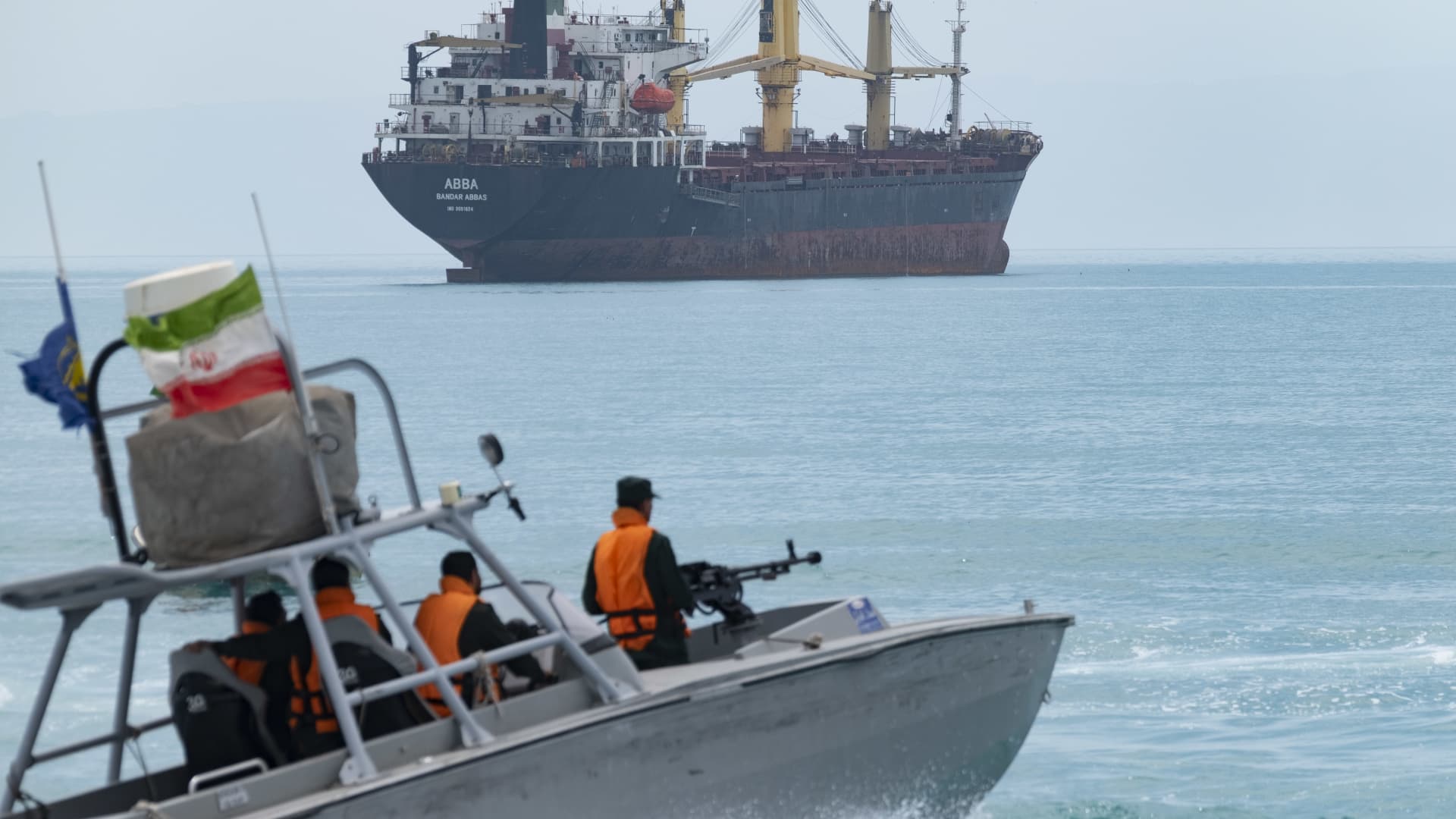
A speedboat from the Islamic Revolutionary Guard Corps (IRGC) cruises through the Persian Gulf, passing near a cargo ship.
Image Credit: Nurphoto via Getty Images
Amid ongoing tensions between Washington and Tehran, U.S.-flagged ships have been cautioned to navigate well clear of Iranian waters when transiting the Strait of Hormuz. The warning comes as a precaution to avoid potential confrontations.
On Monday, the U.S. Maritime Administration released a notice urging ship captains to reject any attempts by Iranian forces to board their vessels. This advisory follows recent incidents, including one on February 3rd, where attempts were made to coerce commercial ships into Iranian waters using small craft and helicopters.
If an Iranian boarding attempt occurs, U.S. crews have been instructed not to engage in physical resistance. The notice emphasizes that avoiding forceful resistance does not equate to consenting or agreeing to the boarding.
Should Iranian forces board a U.S.-flagged commercial vessel, crews were advised not to “forcibly resist the boarding party,” the notice said. It added that refraining from forcible resistance does not imply consent or agreement to that boarding.
The advisory recommended that ships transiting eastbound in the Strait of Hormuz stay close to the Omani side of the waterway.
The guidance followed a round of indirect talks between the U.S. and Iran held in Oman on Friday, centered on how to approach discussions over Tehran’s nuclear program. The meeting marked the first talks between the two countries since U.S. bombers struck three Iranian nuclear sites during a 12-day war with Iran last June.
Iran’s president, Masoud Pezeshkian, described the talks as “a step forward,” while signaling they would be the opening stage of a longer diplomatic process rather than a path to a quick resolution. Iranian Foreign Minister Abbas Araghchi also told state media that the talks were a “good start.”
President Donald Trump said the Oman talks were “very good” and that more sessions were planned, even as he warned Iran that failure to reach a deal would carry “very steep” consequences for Iran.
Israeli Prime Minister Benjamin Netanyahu is set to meet Trump in Washington on Wednesday to discuss the U.S.-Iran talks. Israel, a close U.S. ally, has lobbied Washington to dismantle Iran’s nuclear program, curb its ballistic missile program and end its support for militant groups in the region.

The Strait of Hormuz, a narrow waterway connecting the Persian Gulf and the Arabian Sea, has returned to the spotlight this year after Trump warned of possible military action against Tehran.
About 13 million barrels per day of crude oil transited the Strait of Hormuz in 2025, according to data from market intelligence firm Kpler, accounting for nearly a third of global seaborne crude flows.
Any disruption to those flows would ripple through global energy markets. Iran has in the past threatened to close the Strait during previous confrontations, raising the prospect of higher oil prices.