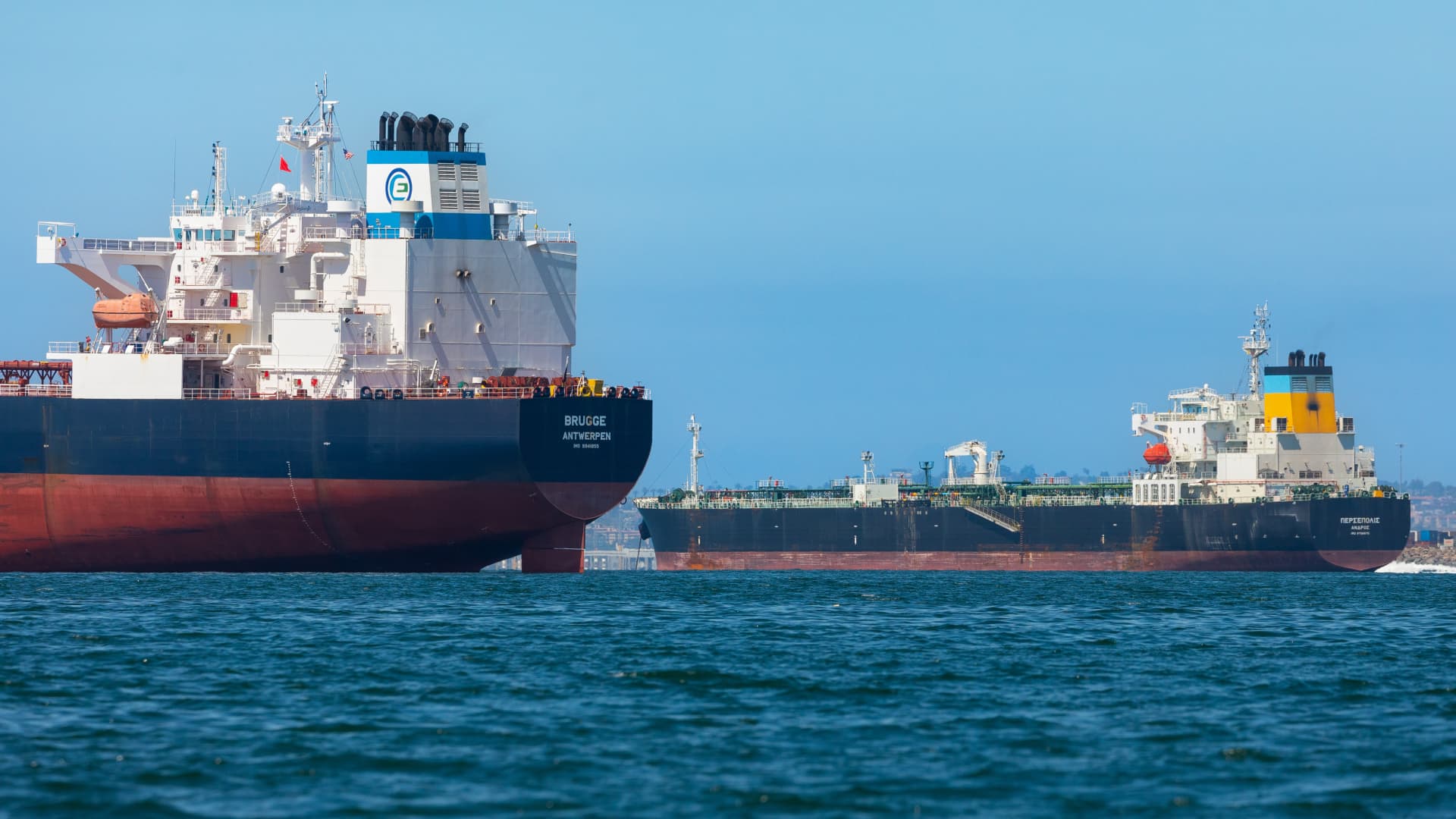

The Brugge oil tanker sits at anchor near the Port of Long Beach in Long Beach, California, U.S., on Thursday, May 7, 2026.
Tim Rue | Bloomberg | Getty Images
The United States has moved to broadly ease sanctions on Iranian oil, permitting trade conducted in U.S. dollars for the first time in more than 40 years as Washington and Tehran continue delicate negotiations aimed at securing a lasting peace agreement.
On Monday, the U.S. Treasury Department issued a 60-day exemption that allows Iran to produce and sell crude oil, petroleum products and petrochemicals in dollar-based transactions through Aug. 21.
The measure, known as General License X, also authorizes transactions involving vessels and companies that had previously fallen under U.S. sanctions. In theory, it could also allow Iranian crude to return to the U.S. market, a flow that has largely disappeared since the 1990s amid extensive sanctions, according to the U.S. Energy Information Administration.
Monday’s action represents the most significant easing of U.S. oil sanctions on Iran since the 1979 Islamic Revolution, unwinding years of economic pressure intended to squeeze Tehran’s finances and potentially opening the door to billions of dollars in new oil revenue for the Iranian government.
The license may free up roughly 67 million barrels of Iranian crude currently held in floating storage in the Gulf, creating a possible $8 billion to $9 billion boost for Iran, according to Miad Maleki, a former Treasury sanctions official who is now a senior fellow at the Foundation for Defense of Democracies, a Washington-based think tank.
“Production, sales, dollar payments, petrochemicals and protected shipping — all switched on at once,” Maleki said. “Together, they amount to a sustained reopening of Iran’s most important revenue stream.”
U.S. President Donald Trump defended the lifting of the sanctions, saying on Monday that any oil profits were meant for Iran to purchase American agricultural goods, rather than rebuild its military.
The latest sanctions relief followed a memorandum of understanding signed last week between the U.S. and Iran. Talks in Switzerland that concluded Monday have yielded positive progress toward a final deal.
Iranian crude exports have picked up in recent weeks as the U.S.-Iran negotiations progressed, with 6.79 million barrels shipped out last week — the highest level in two months — according to maritime intelligence firm Windward.
Iranian crude, which typically trades at a discount to global benchmarks, could also shift to a premium above Brent given demand pressure, further increasing Tehran’s revenue windfall, said Brett Erickson, a managing principal at Obsidian Risk Advisors.
Shadowy network
The latest exemption allows Iran to receive oil proceeds directly into its central bank, reducing the transaction costs previously incurred by routing payments through shadow banking intermediaries.
“With dollar clearing now authorized, expect China to accelerate purchases aggressively,” said Maleki. Chinese buyers, in the past, have settled transactions through opaque channels to avoid secondary U.S. sanctions exposure.
The license removes the principal banking friction constraining volume, giving both state refiners and independent refineries, or teapots, access to intermediary banking networks they previously had to circumvent, Maleki said. He expects a rapid storage “top-off cycle” under which Chinese buyers could rush to replenish stockpiles before the exemption expires in August.
China currently purchases roughly 90% of Iran’s oil exports, with teapots accounting for the bulk of China’s imports. The country’s crude imports shrank by an unprecedented 4.8 million barrels per day between February and May — a steeper drop than the 4 mbd decline seen during the depths of the pandemic in the second half of 2020, according to JPMorgan.
Signs of a pickup have yet to materialize, said Muyu Xu, senior oil analyst at Kpler. Buyers are scrambling to assess the new authorization and complete internal compliance reviews — particularly those not previously active in Iranian crude, Xu said.
That said, Chinese buyers’ interest ultimately will rise, though actual procurement would depend on pricing and cargo availability, Xu added.
Iran will likely use this 60-day window to repair war-damaged oil facilities and lock in longer-term contracts with Chinese buyers, said Michael Feller, chief strategist at Geopolitical Strategy. “This will be a huge boost to Iran, both to its economy and its sense of victory.”


