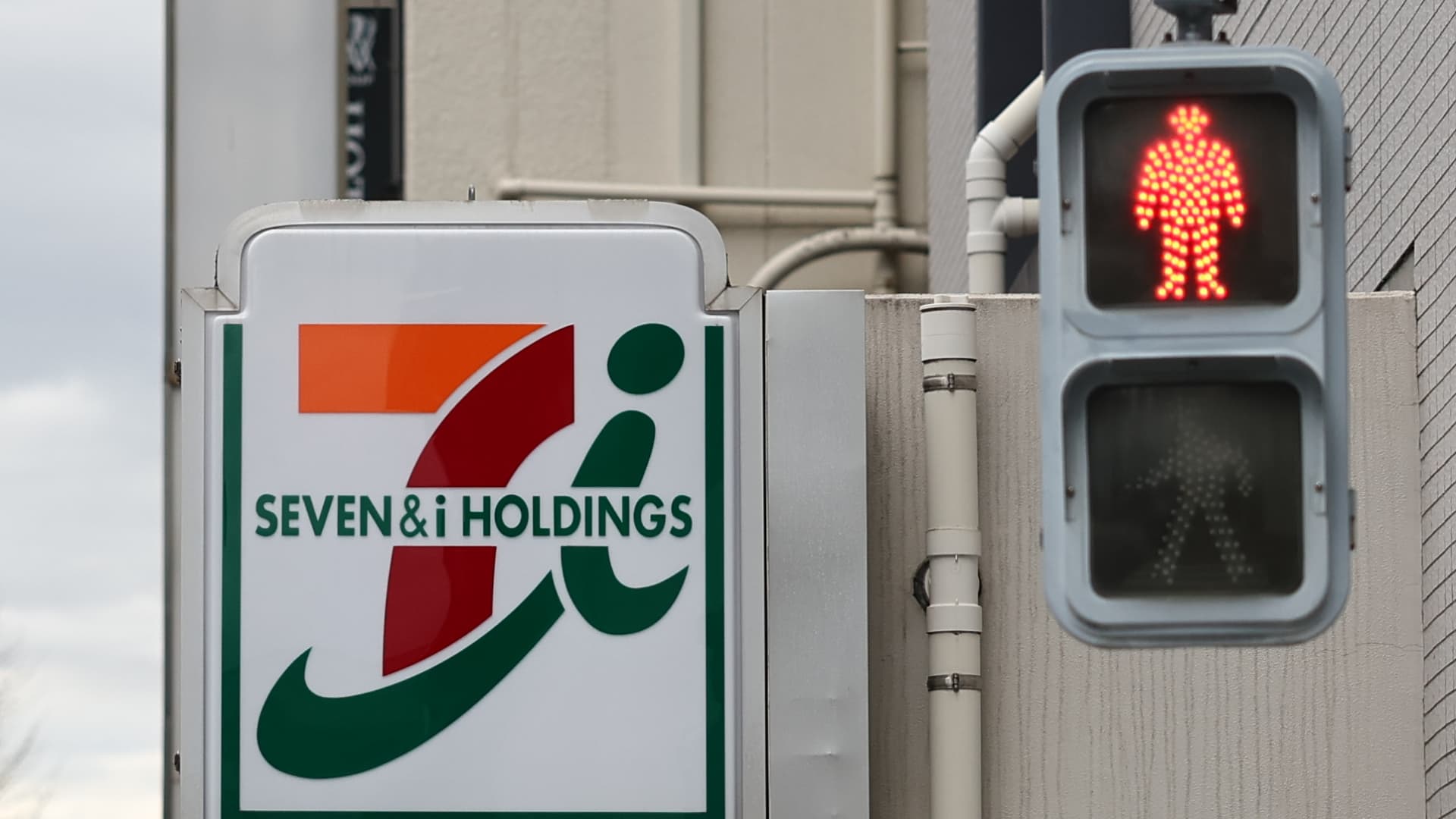

The logos of 7-Eleven and its parent company, Seven & i Holdings, are pictured in Tokyo, Japan, on March 19, 2026. (Photo by Jakub Porzycki/NurPhoto via Getty Images)
NurPhoto | NurPhoto | Getty Images
7-Eleven’s second effort to establish a foothold in India through franchising has ended with the closure of its stores, but the Japanese convenience retail giant says it is not abandoning its ambitions in one of the world’s largest consumer markets.
Reliance Retail, the master franchisee for 7-Eleven in India, closed all 31 locations nationwide at the end of September, a spokesperson for the Japanese company confirmed to CNBC by email. Reliance Retail is part of Indian billionaire Mukesh Ambani’s Reliance Industries.
The 7-Eleven representative said the company remains interested in serving Indian consumers and “looks forward to exploring several options to advance our presence in the market over the long term.”
The spokesperson did not comment further on Reliance’s decision or clarify the current status of the agreement between the Japanese and Indian companies.
Reliance Retail had not responded to CNBC’s emailed request for comment at the time of publication.
7-Eleven and Reliance announced their partnership in 2021, following the breakdown of the Japanese retailer’s earlier arrangement with Future Retail. In a regulatory filing, Future Retail said the agreement had been ended mutually because it was “not able to meet the target of opening stores and payment of franchisee fees.”
Analysts told CNBC that the store closures appear to signal a strategic reset rather than a complete withdrawal from India. Their assessment comes as fellow Japanese convenience store operator Lawson prepares its own entry into the market.
The shutdown does not indicate that “7-Eleven is giving up on India,” said Sohrab Bararia, a partner at Grant Thornton Bharat. Instead, he described it as a possible reconsideration of the existing franchise structure, especially in light of the losses generated under the current model.
7-India Convenience Retail, a wholly owned Reliance Retail subsidiary that signed the master franchise agreement with 7-Eleven in 2021, recorded a net loss of almost 900 million rupees ($9.3 million) for the year ended March 2026. Revenue for the period stood at approximately 920 million rupees. Data from Tracxn shows that annual losses have risen steadily from 52 million rupees in the financial year ended March 2022.
The Challenges
Industry experts say small-format convenience stores face a difficult challenge in India: giving shoppers a strong enough reason to visit. Larger retailers can compete through lower prices, broader assortments and more immersive shopping experiences, while compact outlets often operate with fewer products and less pricing power.
At the same time, rapid grocery-delivery platforms offering orders within 10 minutes are gaining traction in major Indian cities. These services combine convenience with a broader product selection, making them increasingly attractive to urban consumers.
“Small-format stores, meanwhile, bear high rents and full staffing costs but generate relatively low sales per outlet,” said Bharat Birla, executive director at Anand Rathi Investment Banking.
Still, analysts believe Japanese convenience retailers may be able to carve out a distinct position in India’s crowded market, which includes quick-commerce companies as well as neighborhood mom-and-pop shops. A strategy built around services, prepared food and other offerings beyond a traditional grocery-led model could help create differentiation.
Lawson’s plan to create a local subsidiary and operate directly managed stores from 2027 could offer one possible blueprint, Birla said. 7-Eleven may also consider adopting a similar approach.
Several Japanese media reports earlier this year said Lawson aims to open its first five Indian stores in Mumbai in 2027, with a longer-term goal of reaching 100 locations by 2030. The outlets are expected to be owned and operated through a local subsidiary that Lawson plans to establish in India before February 2027.
Moving away from the franchise model that has now faltered twice could give 7-Eleven greater strategic control, Bararia said. It could also support more local customization and provide a clearer route to expanding across India over time.

Reliance Industries share price, Indian rupees


