
Share this @internewscast.com
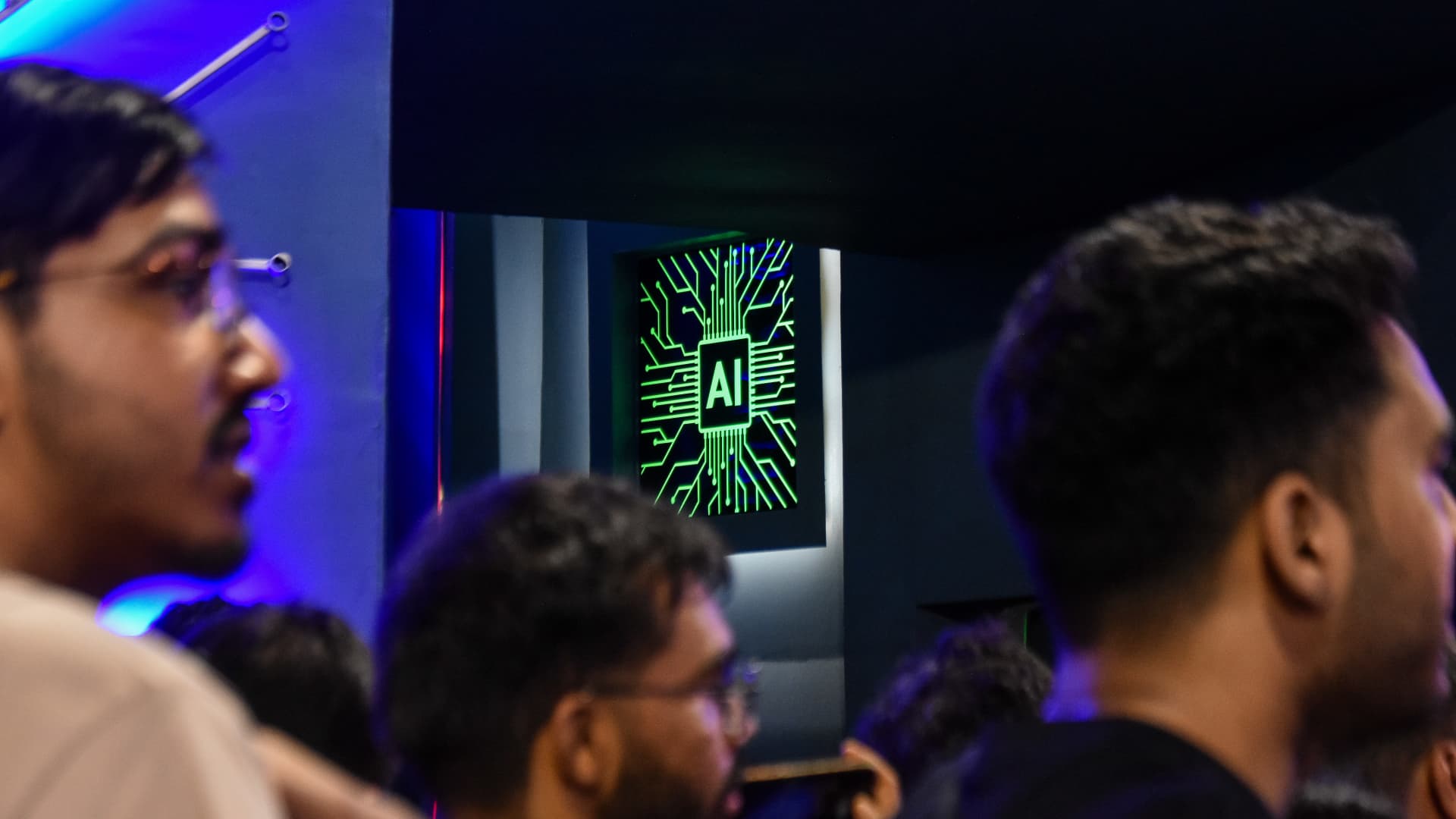
At the 54th annual World Economic Forum in Davos, Switzerland, a screen in the Intel pavilion showcased a slogan about Artificial Intelligence (AI) on January 16, 2024.
Photograph by Denis Balibouse | Reuters
Major technology firms are ramping up their investments in India, attracted by the country’s plentiful resources for establishing data centers, a vast pool of digital users and skilled workers, and promising market opportunities.
Within a span of less than 24 hours, Microsoft and Amazon committed over $50 billion to enhance India’s cloud and AI infrastructure. Concurrently, Intel revealed plans on Monday to manufacture chips in India, aiming to tap into the country’s rising PC demand and rapid AI integration.
Although India lags behind the U.S. and China in developing an indigenous AI foundational model and lacks a significant domestic AI infrastructure company, it seeks to harness its prowess in the information technology sector to create and deploy enterprise-level AI applications. This presents a significant opportunity for major tech companies.
Simply having a model or computing capacity isn’t sufficient for enterprises to effectively utilize AI. It requires companies to focus on developing application layers and necessitates a large pool of skilled talent to implement them, explained S. Krishnan, secretary at India’s Ministry of Electronics and Information Technology, in a conversation with CNBC.
Stanford University ranks India among the top four countries along with the U.S., China and the UK in the global and national AI vibrancy ranking. GitHub, a community of developers, has ranked India at the top with the global share of 24% of all projects.
India’s opportunity lies more in “developing applications” which will be used to drive revenues for AI companies, Krishnan said.
On Tuesday, Microsoft announced $17.5 billion in investment in the country, spread over 4 years, aimed at expanding hyperscale infrastructure, embedding AI into national platforms, and advancing workforce readiness.
“This scale of capex gives Microsoft first‑mover advantage in GPU‑rich data centers while making Azure the preferred platform for India’s AI workloads, as well as deepening alignment with the government’s AI public infrastructure push,” said Tarun Pathak, research Director at Counterpoint Research.
Amazon on Wednesday announced plans to invest over $35 billion, on top of the $40 billion it has already invested in the country.
Over the past few months, AI and tech majors such as OpenAI, Google, and Perplexity have offered their tools for free to millions in India, with Google also firming up its plans to invest $15 billion toward building data center capacity for a new AI hub in southern India.
“India combines a huge digital user base, rapidly growing cloud and AI demand, and a high-talent IT ecosystem that can build and consume AI at scale, making it more than just a market for users and instead a core engineering and deployment hub,” Pathak said.
Data center opportunity
India has several advantages when it comes to building data centers. Markets such as Japan, Australia, China and Singapore in the Asia Pacific region have matured. Singapore, one of the oldest data center hubs in the region, has limited room to deploy large-scale data centers due to land availability issues.
India has abundant space for large-scale data center developments. When compared with data center hubs in Europe, power costs in India are relatively low. Coupled with India’s growing renewable energy capacity — critical for power-hungry data centers — and the economics begin to look compelling.
Local demand, fueled by the rise of e-commerce — a major driver of data center growth in recent years — and potential new rules for storing social media data, strengthens the case.
Put simply: India is entering a sweet spot where global cloud providers, AI players, and domestic digitalization all converge to create one of the world’s hottest data center markets.
“India is a pivotal market and one of the fastest‑growing regions for AI spending in Asia Pacific,” said Deepika Giri, associate vice president and head of research, big data & AI, at International Data Corporation.
“A major gap, and therefore a significant opportunity, lies in the shortage of suitable compute infrastructure for running AI models,” she added. Big Tech is looking to capitalize on the infrastructure opportunity in India by investing heavily in the cloud and data center space.
Global companies are expanding capacities closer to service bases in IT cities such as Bangalore, Hyderabad and Pune from traditional centers like Mumbai and Chennai which are closer to landing cables, as they build data centers in India for the world, Krishnan said.
— CNBC’s Dylan Butts, Amitoj Singh contributed to this report.