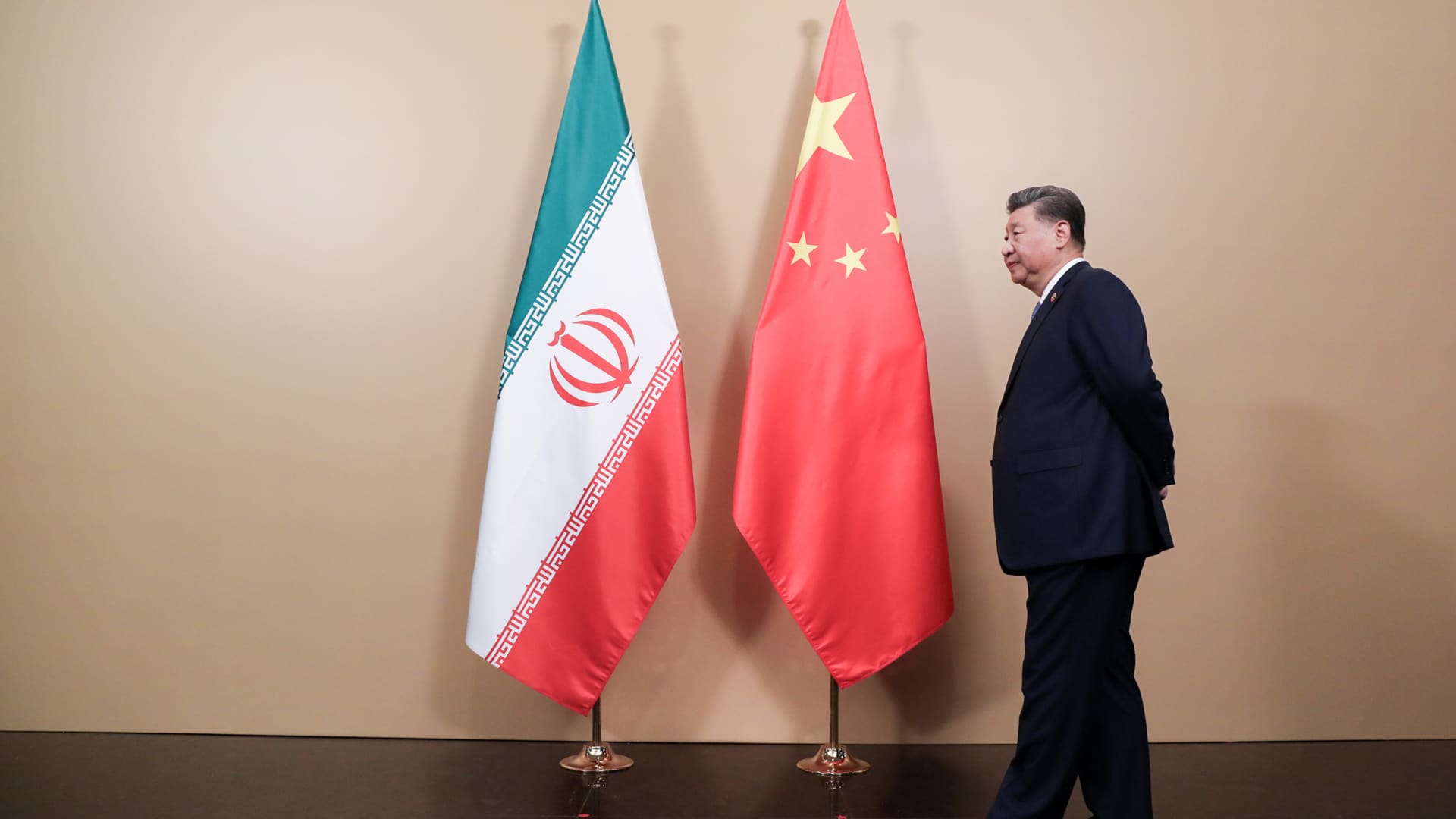

KAZAN, RUSSIA — OCTOBER 23: Chinese President Xi Jinping meets with Iranian President Masoud Pezeshkian, who is not pictured, during the 16th BRICS Summit in Kazan, Russia, on October 23, 2024.
Iranian Presidency | Anadolu | Getty Images
Chinese President Xi Jinping held a brief and notably understated meeting with Iranian President Masoud Pezeshkian at a regional security summit, underscoring Beijing’s careful balancing act with Tehran as Xi prepares for a planned visit to Washington in the coming weeks.
The exchange took place Tuesday on the sidelines of the Shanghai Cooperation Organization summit in Kyrgyzstan, Iranian state media reported. The summit convened leaders from the 10-member bloc, including Russian President Vladimir Putin and Indian Prime Minister Narendra Modi.
Iran’s semi-official Mehr News Agency said the discussion centered on “bilateral ties in line with strengthening relations between Tehran and Beijing,” but provided no additional details about the substance of the talks.
Beijing, however, appeared to take a far more restrained approach, keeping the encounter largely out of the public spotlight.
Chinese state media, including the Communist Party’s flagship outlet People’s Daily, prominently covered Xi’s meetings with other foreign leaders on Tuesday but did not mention his interaction with Pezeshkian. Modi, meanwhile, shared photos from his own meeting with the Iranian president.
“Xi is keeping Iran at arm’s length publicly while still maintaining contact privately,” said Han Shen Lin, managing director for Greater China at the Asia Group, a Washington-based strategic advisory firm.
The SCO leaders in a joint statement condemned the military strikes on Iran, while backing member states’ right to civilian nuclear development under the Nuclear Non-Proliferation Treaty. The statement stopped short of committing members to any concrete military or economic support.
The absence of Xi-Pezeshkian coverage from the state newspaper’s front page reinforces the view that Beijing is “carefully managing optics,” Lin said. China is seeking to preserve its strategic relationship with Tehran without signaling that it is siding with the country, he said, particularly ahead of Xi’s planned meeting with President Trump later this month.
China has been the largest buyer of Iran’s sanctioned oil exports, but those flows through the Strait of Hormuz have fallen sharply since the war began, as Beijing slashed imports, tapping into its massive reserves.
The Chinese embassy in Singapore did not respond to request for comment.
It remains uncertain whether Beijing will give the relationship a higher public profile once Xi’s Washington visit is behind him.
Underlying the muted treatment may be a more pointed frustration, said Alfredo Montufar-Helu, Beijing-based managing director at Ankura China Advisors.
Beijing has been consistent in what it wants from Tehran: an end to the conflict and the Strait of Hormuz reopened — while Iran’s leadership has largely moved in the opposite direction, Montufar-Helu said. “This is Beijing signaling some real dissatisfaction with Tehran.”
Still, Alfredo cautioned against reading too much into the cooler public posture, saying that the fact that Xi had even an informal conversation on the sidelines shows Beijing is keeping the door open.
Calibrated approach

Bessent didn’t name China directly, but said finance ministers had “broadly concurred” on the need to address such imbalances.
China’s exports swelled its trade surplus to a record $1.2 trillion last year, a gap that has drawn the ire of Western governments for distorting global markets and has become a central irritant in U.S.-China relations.
China and U.S. are “maximizing leverage” ahead of Xi’s visit, said Dan Wang, China director at Eurasia Group, a political-risk consultancy. “The sideline meeting with Iran is a reminder of Beijing’s influence in the Iran war and across the Global South,” she said.
Wang said the Iran war will likely dominate the agenda at the upcoming Trump-Xi summit, and that any U.S. effort to expand secondary sanctions to Chinese banks or companies could provoke a firmer response from Beijing.