
Share this @internewscast.com
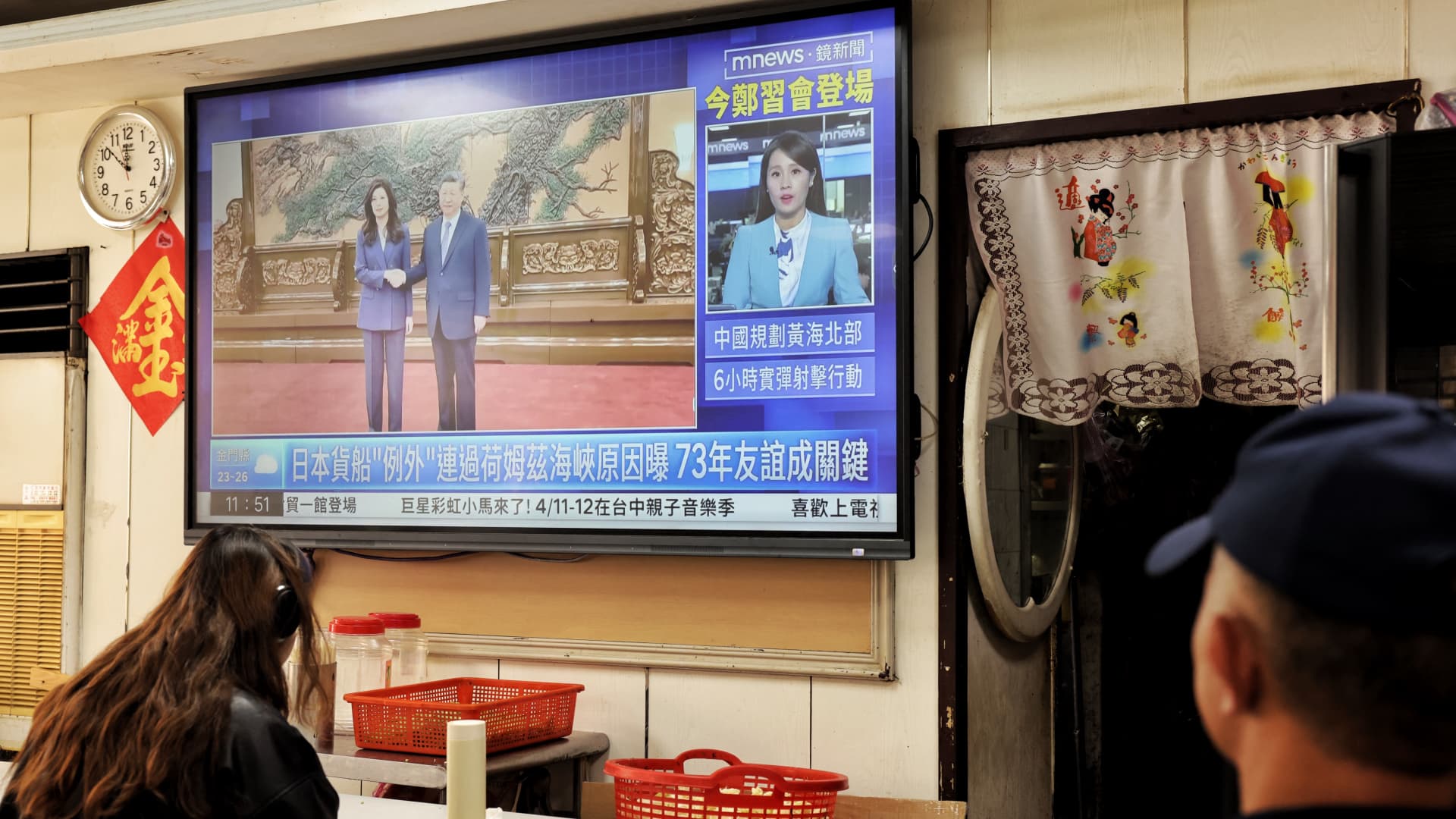
In a significant diplomatic development, Chinese President Xi Jinping engaged in talks with Cheng Li-wun, the chairman of Taiwan’s Kuomintang party, in Beijing on Friday. This meeting marks the first encounter between Xi and a current leader of Taiwan’s opposition in nearly ten years.
According to a report from Chinese state media, translated by CNBC, Xi expressed China’s openness to any proposals that would foster peaceful advancements in cross-strait relations. He emphasized that “Taiwan independence” is the primary threat to stability in the Taiwan Strait, urging leaders from both the mainland and Taiwan to stand against “separatism and foreign interference.”
Cheng, who assumed leadership of the Kuomintang last October, is navigating a landscape of heightened military and political tensions with China. Her visit to Beijing underscores the party’s efforts to establish itself as a credible mediator with the mainland, particularly as Taiwan anticipates its 2028 presidential election.
Zhiwei Zhang, president and chief economist at Pinpoint Asset Management, noted that Beijing’s statement signals a shift in tone. He remarked that this move reduces the likelihood of military conflict across the Taiwan Strait, benefiting both China and Taiwan. According to Zhang, it reflects Beijing’s inclination towards a peaceful solution in handling cross-strait relations.
In the official statement, Xi reiterated the shared ethnic and cultural ties between the mainland and Taiwan, asserting that these connections transcend political differences. He also reaffirmed that the “One China” principle remains the fundamental, non-negotiable foundation for any dialogue.
In the statement, Xi reiterated that the mainland and Taiwan share an ethnic and cultural identity that political differences cannot sever, while stressing that the “One China” principle remains the non-negotiable basis for any engagement.
The Chinese leader called for broader economic, trade and cultural exchanges, vowing to deepen “political mutual trust” and keep communication channels open.
The meeting comes ahead of a planned visit by U.S. President Donald Trump in May, where he is expected to meet Xi to discuss a broad swath of issues, including trade, fentanyl flows and Taiwan.
Beijing claims Taiwan as part of its territory and regards the matter as an internal affair, a position it has used to push back against what it characterizes as interference by Washington and its allies, including Japan.
Lawmakers from the ruling Democratic Progressive Party said Cheng has misrepresented Taiwanese public opinion in her trip to China and accused the KMT of undermining national security.
Cheng described her trip to Beijing as part of a strategy of “deterrence through dialogue,” pledging that her party would seek to resume broad cross-strait exchanges, including tourism and political engagement, if it returns to power in 2028.
“The great rejuvenation of the Chinese nation is the shared rejuvenation of people on both sides of the strait,” Cheng said during the meeting with Xi, according to Taiwanese local media. Beijing and Taipei should work on building sustainable mechanisms for dialogue and cooperation, she said, adding that both sides should move beyond political confrontation to prevent a war.
Cheng’s leadership of the KMT rests partly on an appeal to shared Chinese heritage and a calculation — held by some in Taiwan’s business community — that President Lai Ching-te’s pro-independence posture has provoked an unnecessary confrontation with Beijing at a moment when Washington’s attention is elsewhere, said Michael Feller, chief strategist at Geopolitical Strategy.
The KMT has stalled a $40 billion special defense budget proposed by Lai, which would fund a multi-layered air defense system designed to counter a potential Chinese military incursion.
Trump’s military actions in Venezuela and Iran, along with his threats over Greenland, have prompted some to draw parallels with Beijing’s posture toward Taiwan — though analysts say the risk of near-term mainland aggression remains limited.
“The risk of sudden mainland aggression against Taiwan is lower than many in Washington commonly assume,” said Gabriel Wildau, managing director at Teneo. “China’s leadership believes the balance of military power and overall strategic influence is shifting inexorably in Beijing’s favor.”
The Iran conflict has introduced fresh uncertainty, but Wildau said the more consequential inflection point lies further out. If the DPP wins a fourth consecutive presidential term in 2028 and Xi secures another term at the 2027 Party Congress, “Xi might conclude that peaceful unification is no longer viable,” he said.
— CNBC’s Evelyn Cheng contributed to this report.