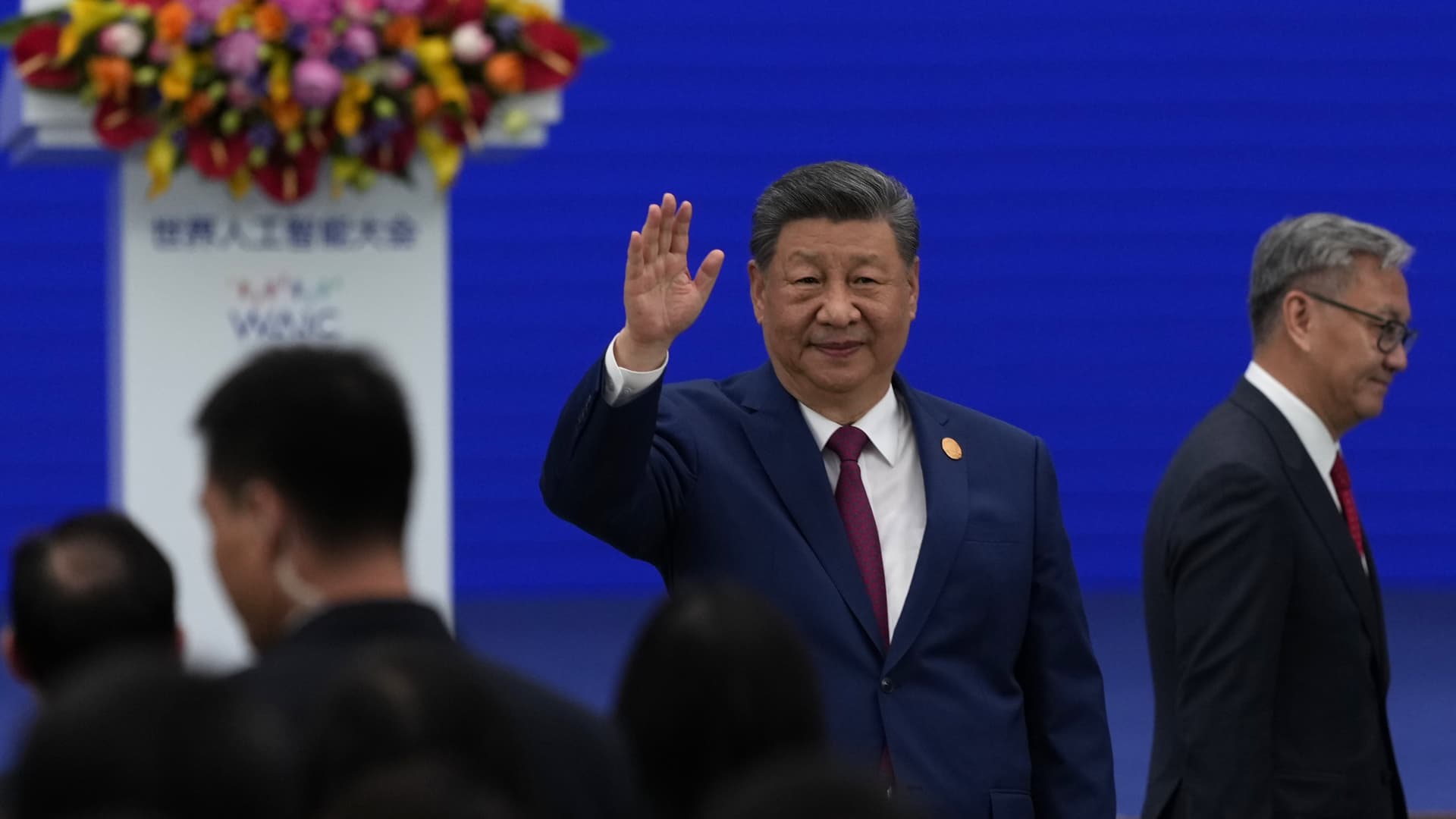

SHANGHAI, CHINA — JULY 17: Chinese President Xi Jinping waves as he arrives for the opening ceremony of the World AI Conference on July 17, 2026, in Shanghai, China. (Photo by Ng Han Guan-Pool/Getty Images)
Pool | Getty Images News | Getty Images
Chinese President Xi Jinping used a major artificial intelligence forum in Shanghai on Friday to present China as a key AI partner for the Global South, calling for countries to work together on the technology while expanding support for developing nations.
Addressing the World AI Conference, Xi said China will offer 5,000 training and seminar opportunities in artificial intelligence for developing countries. He also pledged to deepen AI cooperation with regional and international groups, including the Association of Southeast Asian Nations, the League of Arab States and the African Union.
“China is willing to work with all parties to seize and address the opportunities and challenges of artificial intelligence development with a more open attitude, more pragmatic actions, and a longer-term vision,” Xi said, according to a Google translation of his Mandarin-language remarks.
Xi argued that AI’s future should not be shaped as a “solo performance” by any one country, but rather as a “symphony of international cooperation.” He added that China was prepared to be more open, pursue more practical steps and take what he described as a more forward-looking approach.
His comments followed an agreement signed in Shanghai a day earlier by 29 countries to create the World Artificial Intelligence Cooperation Organization, or WAICO, which will be based in the city, according to Chinese state media outlet Xinhua.
Xi also called for stronger awareness of AI-related risks, saying the technology must be “secure and controllable” and “always remain under human control.” He urged countries to oppose “overstretching the national security concept in the field of AI” or putting one nation’s security interests above those of others.
While the Chinese president did not name a specific country, the U.S. has implemented various export controls measures aimed at curbing China’s access to high-end tech. The U.S. began tightening restrictions during President Donald Trump’s first term, including placing Huawei on the Commerce Department’s Entity List in 2019.
The Biden administration later introduced export controls in 2022 to restrict China’s ability to buy advanced computing chips and manufacture advanced semiconductors, citing national security risks.
Chip giant Nvidia has seen its market share in China plummet, saying in its annual report that it was unable to create and deliver a competitive product for China’s data center market that is approved by both Beijing and Washington.
“As of the end of fiscal year 2026, we were effectively foreclosed from competing in China’s data center computing/compute market, and our effective foreclosure from the China market helped our competitors build larger developer and customer ecosystems to challenge us worldwide,” it added.
At the event, Chinese tech heavyweight Huawei showcased its Atlas 950 SuperPoD supernode, which is designed to link multiple chips together to boost computing power. The company said it addresses the computing power needs of large-scale data center construction and large-scale model training.