Share this @internewscast.com
Central Australia has taken decisive action this week by culling approximately 600 feral camels. This move comes in response to an urgent meeting convened to address the disruption these animals have been causing in remote communities.
The region’s prolonged dry conditions have driven large herds of camels into Indigenous areas in a desperate search for water. In their quest, the camels have been damaging essential infrastructure, including water mains and fences.
Damien Ryan, an area manager for MacDonnell Regional Council, has witnessed the situation’s severity. “One morning last week, there was a leak from one of the buildings, and about 80 camels were crowding around to get that little bit of water,” he shared.
Ryan described the extent of the damage, noting, “They just walk through six-foot-high security fences and knock taps off outside walls. They will even break water mains buried a meter underground just to access water.”
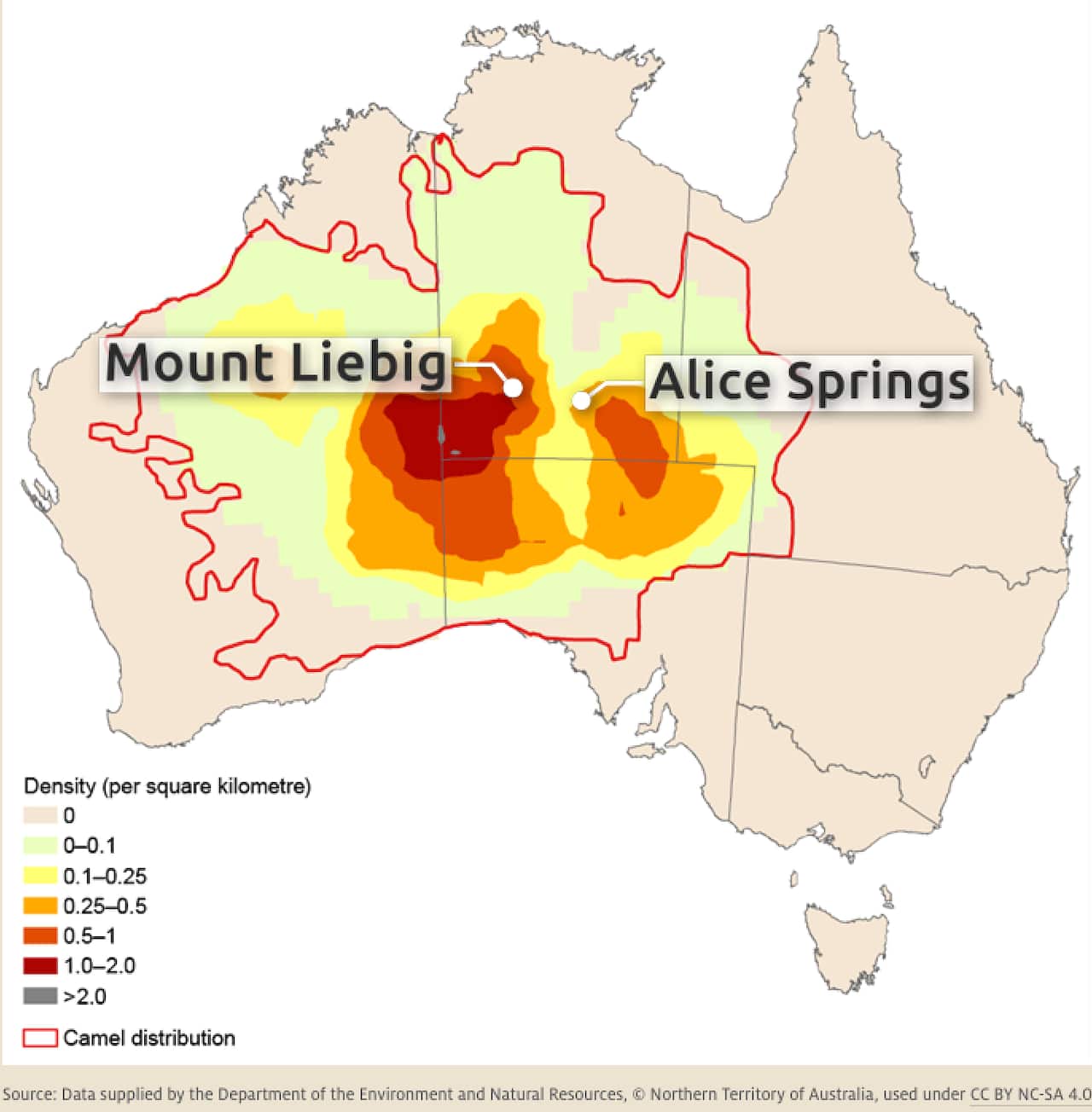
The impact has been particularly harsh in the community of Mount Liebig, located roughly 320 kilometers west of Alice Springs. Earlier this month, several homes were left without water on days when temperatures soared above 40°C due to the destruction caused by these camels.

This month, a dozen homes in the community of Mount Liebig — about 320km west of Alice Springs — were left without a water supply due to the damage, on days over 40C.
“There’s a big cleanup operation,” Ryan said.
As many as 800-1000 camels travelling in one direction — known as a ‘camel train’ — have been reported by residents, spanning 5km in length near Mount Liebig and Papunya.
According to government assessments, this can happen in summer or during droughts, when herds congregate.
We’re talking about large bull camels weighing hundreds of kilos that just want water and they’re willing to do anything.
NT Environment Minister Josh Burgoyne
Burgoyne said the issue has caused “absolute havoc”.
“Imagine waking up one morning and seeing hundreds of camels in your local community, and they can get quite aggressive”, he said.
Ryan said when water sources dry up, the camels “smell water” and find what they can.
“I’ve lived in central Australia all my life. They’re some of the biggest camels I’ve ever seen,” he said.
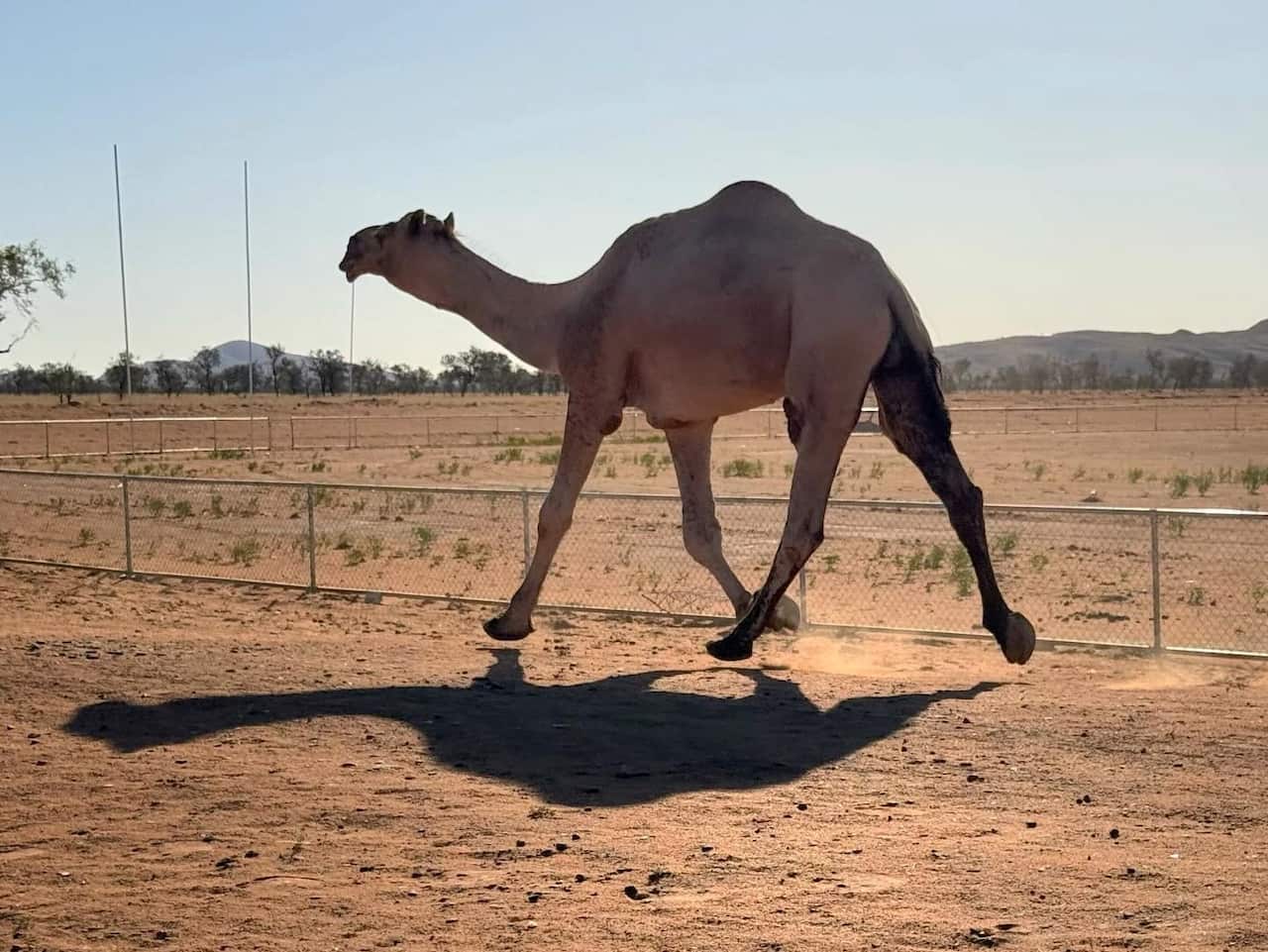
A joint taskforce has been set up between the NT government, MacDonnell Regional Council and the Central Land Council (CLC), which approved a three-day aerial cull this week to assist.
The CLC says around 150 camels are being killed each day once they’re moved from exclusion zones such as communities, outstations and roads.
When rain returns, they disappear ‘like fairy floss’
Camels were first introduced to Australia in 1840, and by 2008, around one million of them were roaming the arid lands of Western Australia, the Northern Territory, South Australia and Queensland.
According to a State of the Environment report by the federal government, the Australian Feral Camel Management Project between 2008 and 2013 removed more than 160,000 camels, at a cost of $19 million.
The project also supported the development of a commercial feral camel industry and contributed to a reduction of the feral population to around 300,000.
Experts say a severely dehydrated camel can drink 100 litres of water in ten minutes.
As soon as rain returns, Ryan said the camels move on.
“Saturday night we got a little rain and Sunday night we got a good storm, and next morning the camels had disappeared like fairy floss,” he said.
“The issue still stands, there are thousands of camels now, the camel experts say between seven and nine years, the herd doubles.”
![[NACA] Large herd of feral camels in Mt Liebig Central Australia.jpg](https://images.sbs.com.au/7e/d0/f8759b8e4f849152c2074e54f476/timephoto-20260114-064857-2.jpg?imwidth=1280)
Calls for federal support
Burgoyne says the NT government is doing what it can, but thinks “the emphasis has really gone off” solving the problem, calling for more money to undertake larger-scale culls.
“Local councils are quite literally having to hunt these camels out in the morning so that the communities can be safe,” he said.
You imagine in Sydney or Melbourne, if a mob of feral camels came in, dug up the local water supply and residents were without water for a week or two, I think we would see absolute outrage.
The federal government said states and territories have primary responsibility for the management of invasive species.
A Department of Climate Change, Energy, the Environment and Water spokesperson said in a statement: “Through the Saving Native Species program, the Australian Government has invested over $4.9 million in two projects delivered by the Northern Territory Government and Central Land Council.”
“These projects aim to improve the habitat and help threatened species recover in the MacDonnell Ranges and include activities such as feral camel control.”
Safety and looking after animal welfare
The Central Land Council (CLC), which represents 90 elected Aboriginal men and women across southern NT, said there’s a need to protect threatened species and country while keeping people safe.
CLC representative Mischa Cartwright told SBS News the council culled more than 1,400 camels in 2025.
“There’s really no other options than to go through a humane culling process,” she said.
“I think communities, as long as they’re consulted properly as part of that project, they’re quite comfortable … because it is about protecting our certain species in our country and the safety of our communities as well.”
Concerns have also been raised about the animals’ welfare as local governments can’t turn on water for huge numbers of camels.
“There maybe needs to be some outlying water points in the future for camels in that situation. And when I say outlying, they need to be a fair way away from communities,” Ryan said.
Ryan has seen camels get stuck, as damaged water taps leak and make the ground muddy.
![[JVS] Large bull camels bogged while searching for water](https://images.sbs.com.au/cb/97/a6d4695e47f6ad2a8c49970bf502/tash-hughes-via-facebook-3.jpg?imwidth=1280)
“They’re perishing because of no water,” he said.
“No matter what amount of pulling and tugging, we are not always successfully getting them out alive. They’re stuck in the mud and it’s very dangerous. They’ll swing their head around, they’ll give you a good old bite, they can damage you.
“Camel populations are not going to disappear and hopefully there’s a business opportunity for somebody, but you can’t create a business opportunity when the crisis starts. You need to do that well before.”
For the latest from SBS News, download our app and subscribe to our newsletter.