
Share this @internewscast.com

This week, forecasts indicate a slowdown in economic growth for several major economies. Australia, in particular, has experienced slower growth than anticipated due to extreme weather conditions, but it is expected to recover.
What is the current situation, and is Australia somewhat better off?
According to the Organisation for Economic Cooperation and Development (OECD) on Tuesday, the US economic growth is predicted to decrease to 1.6 percent this year, down from 2.8 percent last year. This slowdown is attributed to the disruption caused by President Donald Trump’s unpredictable trade wars, which have created uncertainty for businesses and consumers worldwide.

The OECD forecasts that Australia’s gross domestic product (GDP) will rise by 1.8 percent in 2025, surpassing the OECD index benchmark of 1.4 percent, derived from its 38 member nations.

Other major economies like the UK, South Korea and Canada are forecast to grow only around 1 per cent, while Germany and Japan are experiencing even more sluggish times.
Australia’s GDP is then expected to rise 2.2 per cent in 2026, again higher than the average 1.5 per cent.
China — the world’s second-biggest economy by total GDP per capita — is forecast to see growth decelerate from 5 per cent last year to 4.7 per cent in 2025 and 4.3 per cent in 2026.
The 20 countries that share the euro currency will collectively see economic growth pick up from 0.8 per cent last year to 1 per cent in 2025 and 1.2 per cent next year, the OECD said, helped by interest rate cuts from the European Central Bank.

In Australia, other domestic economic growth figures, released by the Australian Bureau of Statistics on Wednesday, paint a gloomy picture.

Gross domestic product slowed to 0.2 per cent in the first three months of 2025, down from a 0.6 per cent rise in the December quarter and weaker than economists had been expecting.
“There was nothing to be happy about in the national accounts numbers today,” said EY’s chief economist Cherelle Murphy.
While Treasurer Jim Chalmers said any growth was a decent outcome, given global uncertainty, a return to falling GDP per capita — a common measure of living standards — is worrying news for some analysts.
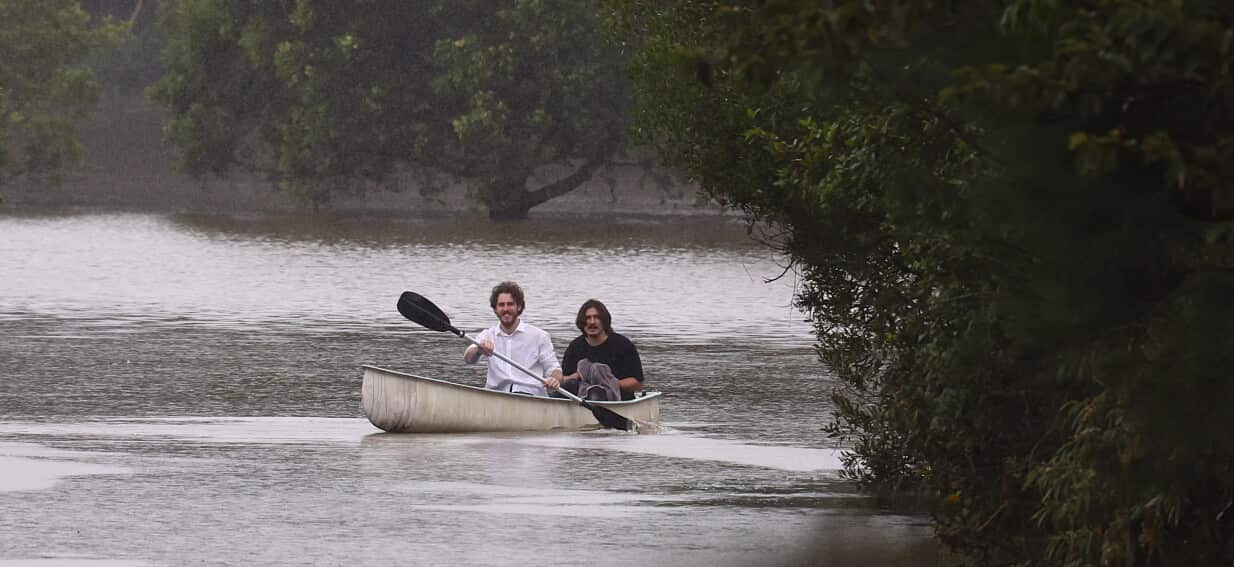
Disruptions from Cyclone Alfred and flooding in Queensland and northern NSW cut $2.2 billion from the national economy, Treasury estimates.

Mining, tourism and shipping were particularly impacted, but underlying growth remains soft, particularly household consumption.

The economy had been boosted in recent years by stronger public spending, but as state government infrastructure projects come off and energy rebates unwind, Chalmers promised momentum would shift to the private sector.
Westpac senior economist Pat Bustamante has been warning about the potential for a “shaky handover”.
“In line with our updated expectations, public demand fell and the private sector struggled to pick up the slack,” he said.
Steven Wu, a senior economist at the Commonwealth Bank, told SBS’ On the Money podcast the GDP figures suggest “a bit of a soft start to 2025”.

“We noticed some economic strength towards the end of last year, which seems to have diminished in the first quarter of 2025. However, there were likely one-time or temporary factors at play,” he explained.

“We did see the economy affected by things like extreme weather events, natural disasters, that did play a role in weighing on overall growth outcomes. But still I think the trend is quite soft, although we do expect to see a bit of a rebound through the rest of this year.”
Wu said that despite Trump placing 10 per cent tariffs on Australia, there are some positive signs in the trade relationship for Australia.
“It was pretty interesting to note that we did see actually quite strong demand for our beef exports from the United States. So that tells us that there is still some sort of ongoing positives from our trading relationships as it kind of plays out over this year.”

He mentioned that domestic consumer cautiousness has been prevalent, but anticipates a “further increase in real household disposable income” in the latter half of the year.

Global economic forecasts

Economic growth among G20 economies will slow to just 2.9 per cent this year and stay there in 2026, according to the OECD forecast. It marks a substantial deceleration from growth of 3.3 per cent global growth last year and 3.4 per cent in 2023.

The world economy has proven remarkably resilient in recent years, continuing to expand steadily in the face of global shocks such as the COVID-19 pandemic and Russia’s invasion of Ukraine.
But global trade and the economic outlook have been clouded by Trump’s sweeping taxes on imports, the unpredictable way he’s rolled them out and the threat of retaliation from other countries.
Reversing decades of US policy in favour of freer world trade, Trump has levied 10 per cent tariffs on imports from almost every country. He’s also threatened more import taxes, including a doubling of his tariffs on steel and aluminium to 50 per cent.
Without mentioning Trump by name, OECD chief economist Álvaro Pereira wrote in a commentary to accompany the forecast that “we have seen a significant increase in trade barriers as well as in economic and trade policy uncertainty. This sharp rise in uncertainty has negatively impacted business and consumer confidence and is set to hold back trade and investment.”

— With additional reporting by the Australian Associated Press.

Share this @internewscast.com
You May Also Like

Australian Women Confront Tough Decisions Amid National Crisis

in brief Experts are warning that the cost of living crisis is…
Several beaches south of Sydney have been closed after a dead whale washed up onto the shore.

Whale Tragedy: Dead Whale Prompts Closure of Several Sydney Beaches

Several beaches located just south of Sydney have been shut down after…
The Australian soldiers who fought epic battle in the 'forgotten war'

Heroic Australian Soldiers Recall Epic Battle in the Overlooked Korean War

Anzac Day falls 75 years after Australian soldiers fought a bloody battle…
Treasurer Jim Chalmers handed down the Budget on Tuesday night, boasting of a $9.3 billion surplus driven by a strong labour market and increased commodity prices

Budget 2024 Unveiled: $300 Cash Boost for Australians, Student Debt Forgiveness, Tax Cuts, and New Travel Policies by Albanese Government

In a strategic move to garner voter support ahead of elections, the…
The owner of a service station in Sydney has been left fuming after a truck driver stole close to $3000 worth of petrol in one hit.

Brazen Petrol Theft Sparks Outrage: Service Station Owner Fumes Over Fuel Heist

A Sydney gas station proprietor is up in arms after a truck…
Michelle Stalimeros (pictured) grew up in a 'chaotic' home where alcohol was woven into family life

Weekend Wine Habit Triggered Blackouts and Anxiety, Straining Marriage; Reflecting on Three Years of Sobriety

At first glance, Michelle Stalimeros appeared far from someone struggling with alcohol.…
Benjamin Netanyahu

Israeli Prime Minister Netanyahu Discloses Secret Cancer Treatment Amidst Political Turmoil

Israeli Prime Minister Benjamin Netanyahu quietly underwent treatment for prostate cancer, he…

Lebanon’s Pivotal Role: How Its Future May Shape Regional Conflict Dynamics

in brief World leaders have called for peace talks to take place…

Woolworths Executive Announces Price Reductions Amid Evolving Inflationary Challenges

In brief: The supermarket giants are before Federal Court over accusations of…

20 Years Later: Beaconsfield Mine Tragedy Celebrates Australian Resilience and Humor

Two decades have passed since the Beaconsfield mine tragedy in Tasmania, yet…

Unpacking the Key Issues in the NDIS Overhaul

In Brief Roughly 160,000 Australians are set to lose access to the…
Former New Zealand all-rounder admitted using cocaine after day one of Essex match before returning positive drug test

New Zealand Cricketer Faces Suspension for Cocaine Use During Match

Doug Bracewell, a former cricketer for New Zealand, has been given a…