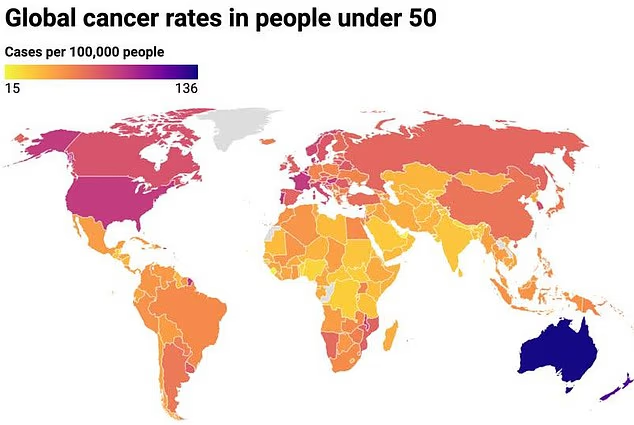

Australia has recorded the world’s highest rate of cancer diagnoses in people under 50, though specialists say the headline figure is influenced in part by the country’s strong screening programs, which are finding more cancers at earlier stages.
The ranking is based on data from a World Health Organisation map that compares cancer rates across countries worldwide.
The latest 2024 figures show Australia logged 135 cancer diagnoses for every 100,000 people aged under 50. New Zealand followed with the second-highest rate, at 119 cases per 100,000.
Among Australians in that age group, breast cancer was the most frequently diagnosed cancer, with the model recording 4,504 cases in 2024.
Consultant breast surgeon Associate Professor Sanjay Warrier told the Daily Mail that around 10 per cent of breast cancer patients receive their diagnosis before turning 40.
He said Australia’s high diagnosis rate is partly a result of wider screening, but added that earlier detection is also helping patients access treatment sooner and improving outcomes.
‘Australia and America are doing particularly well when it comes to breast cancer treatment,’ he said.
‘High levels of cases are reflective of better detection and increased awareness … one of the biggest misconceptions though is that ten per cent of breast cancer rates hit women under the age of forty, so it’s important that young people get screened.’

The map which shows Australia as a hotspot for cancer rates in under 50s

Consultant breast surgeon Sanjay Warrier was upbeat about the direction of travel for breast cancer treatment in Australia
Breast cancer now has a 92.7 per cent survival rate in Australia, while the death rate has fallen by 40 per cent since 1994.
Australia’s high cancer diagnosis rate among people under 50 is also being driven by another major culprit: skin cancer.
Scott Maggs, CEO of Skin Check Champions, told the Daily Mail that melanoma was a key contributor to the high figures.
‘Australia has the highest age-standardised skin cancer incidence rate in the world – around 37 cases per 100,000 people (2022 GLOBOCAN data), at more than 11 times the global average of 3.2,’ he said.
‘For men specifically it’s over 45 per 100,000, again the highest of any country.
‘Australia’s position at the dark end (of the WHO scale) is heavily influenced by our horrendous skin cancer rates, which pull our overall under-50 cancer burden into the danger zone.’
Skin cancer survivor and Australian Skin Cancer Foundation CEO Jay Allen OAM said complacency and the desire to chase a tan were helping make melanoma a persistent problem in Australia.
‘Sadly, one person between 20-39 dies every 5-6 hours in Australia, and one person diagnosed every thirty minutes,’ he said.

Jay Allen OAM, CEO of the Australian Skin Cancer Foundation
‘Melanoma’s the most common cancer at that age, and we need to change that.
‘The treatment only works for 55 per cent of advanced patients… it’s not a death sentence anymore but we’re not there yet.’
Maggs said excessive exposure to UV radiation, combined with Australia’s large fair-skinned population, made the country ‘unique’ when it came to skin cancer.
‘Add a strong outdoor and beach culture, a massive outdoor workforce, plus generations who grew up before sun-safety messaging existed, and you get a population carrying decades of cumulative UV damage.’
Despite the dire figures, there was also some good news.
Australia has one of the world’s best skin cancer survival rates, with melanoma survival now at 94 per cent, up from 88 per cent in the 1980s.
‘That’s a direct result of decades of investment in treatment and prevention, and hopefully thanks to our work – a strong skin-check culture,’ Maggs said.
‘Thickness at diagnosis is everything: five-year survival is close to 100 per cent for thin melanomas caught early, but falls to as low as 57 per cent for thick, ulcerated melanomas found late.

Melanoma deaths have significantly dropped in Australia due to heightened awareness, but experts are warning Aussies not to become complacent

Breast cancer is the most common cause of cancer for women under 50; experts are urging people to self-examine and get regular mammograms
‘Australia’s high incidence is largely a legacy of past sun exposure, but early detection is what’s driving our world-leading survival rates.’
Anita Dessaix, chair of Cancer Council’s Public Health Committee, said lifestyle factors were also contributing to the rise in early-onset cancers around the world.
‘One finding that may surprise people is the strong association between excess body weight and cancer risk,’ Dessaix said.
‘Research by the Daffodil Centre, a partnership between Cancer Council NSW and the University of Sydney, has shown obesity-related cancers in Australia almost quadrupled between 1983 and 2017, with a particularly sharp increase among people born after 1960.
‘Importantly, many people diagnosed with cancer have no obvious risk factors, which is why people should not ignore persistent or unusual symptoms and should see their GP promptly if they have concerns.’
She added that mortality rates among younger cancer patients had fallen substantially, while the estimated five-year survival rate for people diagnosed between the ages of 20 and 49 had reached 88 per cent.
‘Between 2000 and 2024, mortality rates for people in their forties almost halved, while mortality rates for people in their thirties also fell considerably,’ she said.
‘There have been significant advances in cancer treatment in recent years, including more personalised therapies and supportive care, that are improving survival and quality of life for people living with cancer.’


