
In brief
- Ukrainian officials say Russia launched a drone attack just hours after a truce it announced was supposed to begin.
- Russia’s Defence Ministry said Ukraine had failed to honour its own ceasefire declaration.
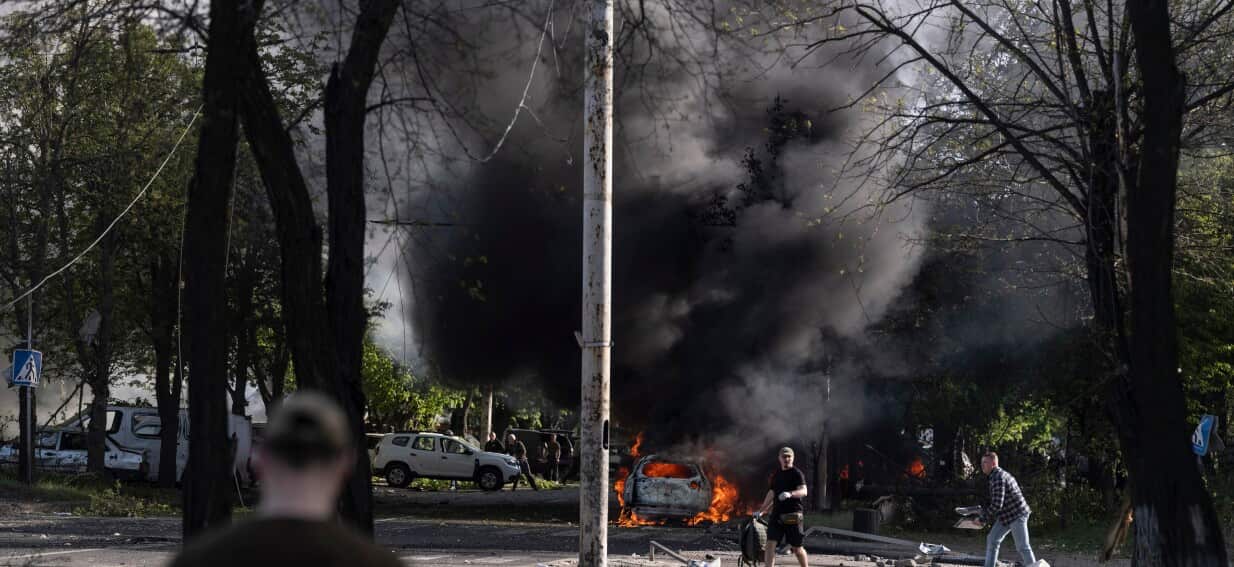
Efforts to establish a temporary ceasefire between Russia and Ukraine have rapidly deteriorated, with both nations accusing each other of breaches. Overnight and into Wednesday, drones and missiles targeted various locations, escalating tensions.
Despite Ukraine’s declaration of a unilateral truce set to begin at midnight, Ukrainian officials reported that Russia launched a series of drone attacks. This highlights the lack of trust in temporary ceasefires as the war, now in its fifth year since Russia’s full-scale invasion, continues.
In the northeastern city of Sumy, Ukraine, officials reported that two Russian drones struck a kindergarten, resulting in the death of a security guard and injuries to two other individuals.
Meanwhile, Russia’s Defence Ministry accused Ukraine of not adhering to its ceasefire commitment, asserting that Russian air defenses intercepted 53 Ukrainian drones overnight in regions including the annexed Crimean Peninsula and the Black Sea.
In Crimea, the Russian-appointed governor, Sergei Aksyonov, reported that a Ukrainian drone attack on the city of Dzhankoi resulted in five fatalities. Aksyonov confirmed the casualties shortly after midnight, following an earlier post about the incident.
Prior to these events, there were few signs that Russia planned to observe Ukraine’s proposed ceasefire.
United States-led diplomatic efforts over the past year have failed to secure a broader halt to the fighting, and the latest exchange reinforced expectations that both sides remain far apart on conditions for any truce.
Deadly attacks precede truce declaration
The renewed attacks came after a deadly escalation earlier this week, with Ukrainian interior minister Ihor Klymenko saying Russian drone and missile strikes on Tuesday killed 27 civilians and wounded 120 others across Ukraine.
On Tuesday, powerful Russian glide bombs reportedly hit the eastern city of Kramatorsk, the southern city of Zaporizhzhia and the northern city of Chernihiv, killing at least 17 civilians and wounding dozens more, according to Ukrainian officials. Overnight strikes before that killed five more people and injured 39.
Ukrainian President Volodymyr Zelenskyy condemned what he called Russia’s “utter cynicism” in launching attacks while simultaneously preparing to declare its own temporary ceasefire tied to Victory Day commemorations marking the Soviet Union’s defeat of Nazi Germany in World War Two.
“Russia could cease fire at any moment, and this would stop the war and our responses,” Zelenskyy wrote on X.
“Peace is needed, and real steps are needed to achieve it. Ukraine will act in kind.”
Victory Day on 9 May is one of Russia’s most important national holidays and a centrepiece of President Vladimir Putin’s political messaging.
Russia’s Defence Ministry announced a unilateral ceasefire for Friday and Saturday, but warned it would retaliate if Ukraine attempted to disrupt the celebrations.
The ministry threatened a “massive missile strike on the centre of Kyiv” if Ukrainian forces targeted Victory Day events, and warned civilians and foreign diplomatic staff to leave the capital if necessary.
Zelenskyy responded by saying Ukraine would begin observing a ceasefire earlier, starting at midnight Wednesday, and would respond according to Russia’s actions from that point onward. He did not specify an end date.
The back-and-forth followed a familiar pattern seen during previous attempted pauses in fighting, including around Orthodox Easter, when both sides accused each other of continued attacks and the fighting largely continued unabated.
Security fears for Victory Day in Russia
Security concerns have already reshaped this year’s Victory Day events in Russia, with officials scaling back military parades in Moscow and other cities because of fears of Ukrainian drone strikes deep inside Russian territory.
For the first time in nearly two decades, Moscow’s Red Square parade is expected to proceed without tanks, missiles and other heavy military equipment.
Speaking earlier this week at a summit with European leaders in Armenia, Zelenskyy said Russian authorities “fear drones may buzz over Red Square” during the May 9 celebrations.
“This is telling,” he said. “It shows they are not strong now, so we must keep up the pressure through sanctions on them.”
Russian authorities have also imposed cellphone internet restrictions in Moscow and St Petersburg ahead of the holiday, according to Russian media reports, in an effort to guard against potential Ukrainian drone attacks.
For the latest from SBS News, download our app and subscribe to our newsletter.


