
On a windswept plateau high above the Arabian Sea, Sena Keybani cradles a sapling that barely reaches her ankle.
The young plant, safeguarded by a makeshift barrier of wood and wire, represents a type of dragon’s blood tree â a unique species existing solely on Yemen’s Socotra Island, now facing mounting dangers from climate change.
“Seeing the trees die, it’s like losing one of your babies,” Keybani, whose family runs a nursery dedicated to preserving the species, said.
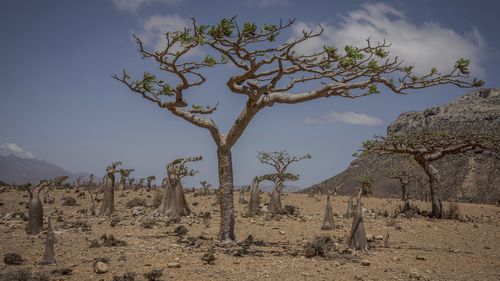
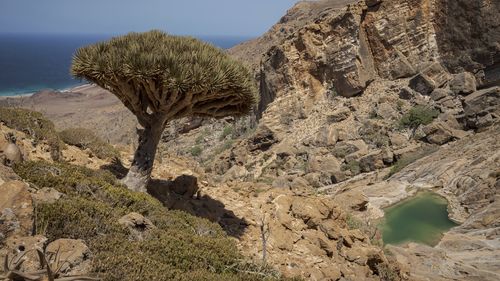
Known for their mushroom-shaped canopies and the blood-red sap that courses through their wood, the trees once stood in great numbers.
However, the dragon’s blood tree is under threat due to increasingly severe cyclones, grazing by invasive goat populations, and ongoing strife in Yemen â one of the world’s poorest nations besieged by a decade-long civil conflict â all pushing this species, along with its distinctive ecosystem, to the brink of disaster.
Often compared to the Galapagos Islands, Socotra floats in splendid isolation some 240 kilometres off the Horn of Africa.
Boasting 825 plant species, with more than a third found nowhere else globally, its ecological wealth has secured it UNESCO World Heritage recognition.
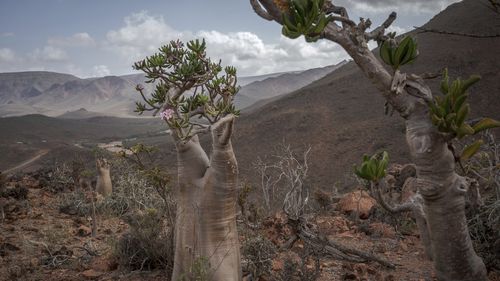
Among them are bottle trees, whose swollen trunks jut from rock like sculptures, and frankincense, their gnarled limbs twisting skywards.
But it’s the dragon’s blood tree that has long captured imaginations, its otherworldly form seeming to belong more to the pages of Dr Seuss than to any terrestrial forest.
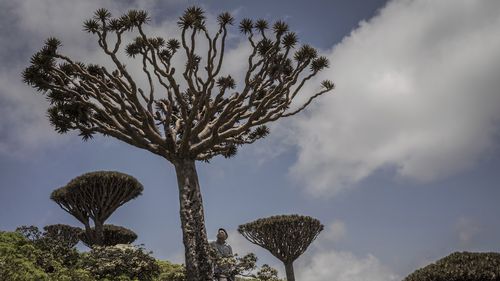
The island receives about 5000 tourists annually, many drawn by the surreal sight of the dragon’s blood forests.
Visitors are required to hire local guides and stay in campsites run by Socotran families to ensure tourist dollars are distributed locally.
If the trees were to disappear, the industry that sustains many islanders could vanish with them.
“With the income we receive from tourism, we live better than those on the mainland,” Mubarak Kopi, Socotra’s head of tourism, said.
But the tree is more than a botanical curiosity: It’s a pillar of Socotra’s ecosystem.
The umbrella-like canopies capture fog and rain, which they channel into the soil below, allowing neighbouring plants to thrive in the arid climate.
“When you lose the trees, you lose everything â the soil, the water, the entire ecosystem,” Kay Van Damme, a Belgian conservation biologist who has worked on Socotra since 1999, said.
Without intervention, scientists like Van Damme warn these trees could disappear within a few centuries â and with them many other species.
“We’ve succeeded, as humans, to destroy huge amounts of nature on most of the world’s islands,” he said.
“Socotra is a place where we can actually really do something. But if we don’t, this one is on us.”
Increasingly intense cyclones uproot trees
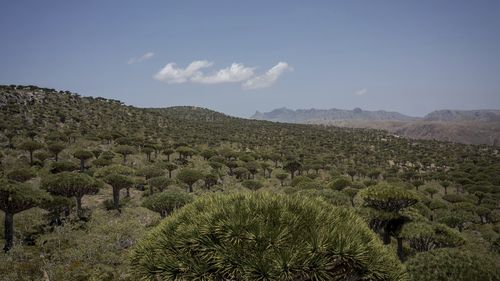
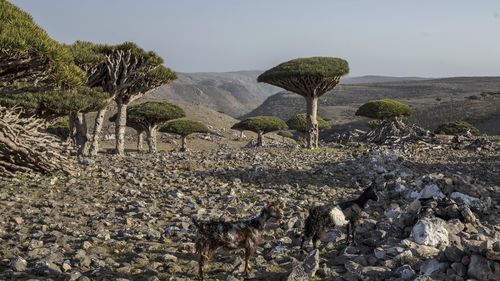
Across the rugged expanse of Socotra’s Firmihin plateau, the largest remaining dragon’s blood forest unfolds against the backdrop of jagged mountains.
Thousands of wide canopies balance atop slender trunks.
Socotra starlings dart among the dense crowns while Egyptian vultures bank against the relentless gusts.
Below, goats weave through the rocky undergrowth.
The frequency of severe cyclones has increased dramatically across the Arabian Sea in recent decades, according to a 2017 study in the journal Nature Climate Change, and Socotra’s dragon’s blood trees are paying the price.
In 2015, a devastating one-two punch of cyclones â unprecedented in their intensity â tore across the island.
Centuries-old specimens, some over 500 years old, which had weathered countless previous storms, were uprooted by the thousands.
The destruction continued in 2018 with yet another cyclone.
As greenhouse gas emissions continue to rise, so too will the intensity of the storms, warned Hiroyuki Murakami, a climate scientist at the National Oceanic and Atmospheric Administration and the study’s lead author.
“Climate models all over the world robustly project more favourable conditions for tropical cyclones.”
Invasive goats endanger young trees
But storms aren’t the only threat.
Unlike pine or oak trees, which grow 60 to 90 centimetres per year, dragon’s blood trees creep along at just 2 to 3 centimetres annually.
By the time they reach maturity, many have already succumbed to an insidious danger: goats.
An invasive species on Socotra, free-roaming goats devour saplings before they have a chance to grow.
Outside of hard-to-reach cliffs, the only place young dragon’s blood trees can survive is within protected nurseries.

“The majority of forests that have been surveyed are what we call over-mature â there are no young trees, there are no seedlings,” Alan Forrest, a biodiversity scientist at the Royal Botanic Garden Edinburgh’s Centre for Middle Eastern Plants, said.
“So you’ve got old trees coming down and dying, and there’s not a lot of regeneration going on.”
Keybani’s family’s nursery is one of several critical enclosures that keep out goats and allow saplings to grow undisturbed.
“Within those nurseries and enclosures, the reproduction and age structure of the vegetation is much better,” Forrest said.
“And therefore, it will be more resilient to climate change.”
Conflict threatens conservation
But such conservation efforts are complicated by Yemen’s stalemated civil war.
As the Saudi Arabia-backed, internationally recognised government battles Houthi rebels â a Shiite group backed by Iran â the conflict has spilled beyond the country’s borders.
Houthi attacks on Israel and commercial shipping in the Red Sea have drawn retaliation from Israeli and Western forces, further destabilising the region.
“The Yemeni government has 99 problems right now,” Abdulrahman Al-Eryani, an advisor with Gulf State Analytics, a Washington-based risk consulting firm, said.
“Policymakers are focused on stabilising the country and ensuring essential services like electricity and water remain functional. Addressing climate issues would be a luxury.”
With little national support, conservation efforts are left largely up to Socotrans.
But local resources are scarce, Sami Mubarak, an ecotourism guide on the island, said.
Mubarak gestures toward the Keybani family nursery’s slanting fence posts, strung together with flimsy wire.
The enclosures only last a few years before the wind and rain break them down.
Funding for sturdier nurseries with cement fence posts would go a long way, he said.
“Right now, there are only a few small environmental projects â it’s not enough,” he said.
“We need the local authority and national government of Yemen to make conservation a priority.”