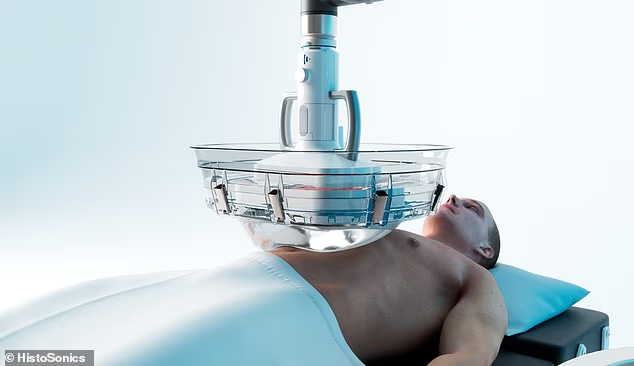

A cutting-edge cancer treatment that can destroy tumours without an operation is drawing worldwide interest and giving some patients new hope after conventional options have run out.
For Australians and New Zealanders, however, accessing the technology can mean travelling thousands of kilometres and paying tens of thousands of dollars.
Known as histotripsy, the procedure uses powerful, precisely targeted ultrasound pulses to break apart tumour tissue without surgical incisions, heat or ionising radiation.
The emerging treatment is being explored particularly in patients with difficult-to-treat liver tumours, including some who had previously been told there was little more doctors could do.
US interventional radiologist Dr Kevin Burns has performed histotripsy procedures for more than two-and-a-half years and said the technology had already delivered striking results for some patients.
‘Many of our patients have been told there is “no option” and that they should stop treatment for their cancer,’ he told Our News Outlet.
One of histotripsy’s key advantages, Dr Burns said, is its ability to reach tumours in complex locations, including growths surrounding blood vessels or buried deep inside the liver, without the large incisions required for conventional surgery.
He described the case of a young woman with bile duct cancer whose disease returned after surgeons removed around two-thirds of her liver.

A revolutionary cancer treatment that can destroy targeted tumour tissue without surgery is attracting international attention and offering new hope to patients who have exhausted conventional options – but it’s not yet available in Australia or New Zealand
Because so little healthy liver remained, doctors had warned that attempting another treatment could be too dangerous.
‘We treated five tumours in the remaining liver… and she is still doing well more than 18 months later.’
Despite the encouraging reports, researchers are still assessing histotripsy’s effectiveness and long-term effect on survival, and the procedure is not suitable for every tumour.
Dr Burns said tumour size and whether a growth can be clearly seen on ultrasound remain significant limitations, although he expects further advances to broaden the technology’s use.
Studies are also examining whether histotripsy could be used against cancers outside the liver, including pancreatic cancer, with trials currently taking place in the US and Spain.
Yet despite the growing global interest, histotripsy is not currently offered as a routine clinical treatment in Australia or New Zealand.
Patients who want to explore the procedure must therefore look overseas, often facing substantial costs and complicated travel arrangements.
For some families, though, the greatest challenge is not the expense. It is the limited time available to make a decision.

Known as histotripsy, the treatment uses powerful, precisely focused ultrasound waves to mechanically break down targeted tissue without traditional surgery, heat or ionising radiation. Pictured: US-based interventional radiologist Dr Kevin Burns, who said the technology has already made a remarkable difference to some of his patients
The Daily Mail spoke with three cancer patients from Australia and New Zealand whose families went to extraordinary lengths to pursue histotripsy.
Their accounts capture both the optimism surrounding the experimental technology and the painful reality of having no local access to it.
New Zealand grandfather, 84, spent $90,000 travelling to Hong Kong
At 84, Peter May continues to work most days and remains an important mentor to his daughter in the family business.
Earlier this year, the Palmerston North grandfather travelled thousands of kilometres to Hong Kong for histotripsy after his family searched for treatment options that were not available nearer to home.
Peter has stage four colorectal cancer that has spread to his liver. After he underwent major surgery and chemotherapy, his family began looking into alternative approaches.
His daughter, Victoria Jakob, found information about histotripsy and sent her father’s scans to overseas specialists. Their assessment suggested he might be eligible for the procedure.

At 84, Peter May (pictured) from Palmerston North, New Zealand, travelled thousands of kilometres to Hong Kong to undergo histotripsy after his family began investigating treatment options unavailable closer to home.
Treatment, medical assessments, flights and accommodation cost the family more than NZ$90,000, representing a huge financial commitment during an already distressing period.
‘We went to Hong Kong on a wing and a prayer,’ Victoria told Our News Outlet.
Doctors determined that four of the tumours in Peter’s liver could be treated, while several other lesions were unsuitable for the procedure.
He underwent histotripsy, spent one night in hospital and was released the next day. Within days, he felt well enough to explore Hong Kong as a tourist.
‘They achieved in three hours what would have taken months in New Zealand,’ Victoria said of the speed of the hospital assessments.
In the months afterward, Peter was able to spend seven months without chemotherapy and celebrated his 60th wedding anniversary — a milestone he had been determined to reach after his diagnosis.
‘To receive treatment and remain well for seven months with stage four cancer is incredible,’ Victoria said.

Peter has stage four colorectal cancer which has spread to his liver, and after enduring major surgery and chemotherapy that ‘nearly killed him’, his family began researching whether other approaches might be available
The break was especially valuable after the severe side effects of his earlier chemotherapy, which Victoria said had ‘nearly killed him’.
However, Peter’s experience alone cannot establish whether histotripsy caused the period without chemotherapy or changed his overall outlook.
His cancer has not gone away. Victoria said follow-up scans showed ongoing changes in the tumours treated with histotripsy, but other lesions became more active and Peter eventually restarted chemotherapy.
A second procedure may be considered, although Peter believes another overseas trip could be too physically and emotionally exhausting.
‘Because it isn’t available in Australia or New Zealand, he is missing out on a treatment that could potentially extend his life and improve his quality of life,’ Victoria said.
Aussie cancer patient, 68, borrowed $75,000 for treatment in America: ‘The price is the biggest obstacle’
For 68-year-old Hobart resident Rob Blakers, cancer has been a constant presence for almost 30 years.
Rob was diagnosed with a gastrointestinal stromal tumour, or GIST, a rare soft-tissue sarcoma, in 1999. Since then, the disease has progressed repeatedly despite a succession of treatments.

For Hobart man Rob Blakers, 68 (pictured), cancer has been a part of life for almost three decades. A decade ago, his cancer spread to his liver so he borrowed money (A$75,000) and flew to the US for Histrotripsy, which he believes was ‘was overwhelmingly worth it’
About a decade ago, the cancer spread to his liver. One tumour eventually became wrapped around a major blood vessel, making standard surgery particularly challenging.
After trying targeted drugs, surgery and two courses of radiation, Rob began exploring histotripsy — a treatment he had followed online for years.
‘I felt this was the right time to try it,’ he told Our News Outlet.
‘If it didn’t work, I could return to one of the other two options [radiation and chemotherapy].’
His Australian doctors were ‘mildly sceptical’ about the developing technology but did not advise him against investigating it.
Rob arranged treatment in the United States within four weeks, but the cost was daunting.
The procedure cost US$50,000, and the overall trip was just under A$75,000. Rob borrowed money and even considered taking out a reverse mortgage against his home.
‘I’m not that rich. It’s a huge amount of money, and the price is the biggest obstacle.’

Despite growing international interest, histotripsy is not yet available as a routine clinical treatment in Australia or New Zealand, leaving patients interested in the procedure facing significant financial and logistical obstacles
Doctors used histotripsy on two active liver lesions, including the tumour entangled with the major blood vessel.
Follow-up assessments suggested the two sites had responded differently. One lesion remained active, while the other showed changes Rob considered especially significant.
‘For me, it was overwhelmingly worth it because the one that was basically dissolved [by histotripsy] was the one in the most critical position,’ he said.
Recovery was more difficult than he expected, with pain and fatigue continuing for longer than anticipated. Within eight weeks, however, he was running, lifting weights and exercising at his previous level.
Although his cancer remains active and he is considering further conventional surgery, Rob described his experience with histotripsy as a ‘huge success’ and said the technology deserved further study as a possible complement to established treatments.
He is particularly concerned that patients already facing the cost of ongoing cancer care must also find tens of thousands of dollars to travel overseas.
‘If I don’t do anything about it, it will kill me. There is no question about that,’ he said of his cancer.
The grandfather given a second chance at life
When New Zealand grandfather Gerard Horgan was diagnosed with inoperable pancreatic cancer, doctors told him he might have only six months to live.
Nearly two years later, the 76-year-old is riding his bike, tending his garden and spending time with his grandchildren after travelling around the world for an experimental treatment.
The Rotorua retiree received his diagnosis in November 2024 after becoming seriously ill and developing jaundice.
Scans showed a pancreatic tumour wrapped around major blood vessels, making surgery impossible.
His health declined quickly. Dangerously high bilirubin levels — a waste product produced when red blood cells break down — meant doctors had to place a stent in his bile duct before chemotherapy could start.

When New Zealand grandfather Gerard Horgan was diagnosed with inoperable pancreatic cancer, doctors warned he might have just six months to live. But almost two years later, the 76-year-old is back riding his bike and playing with his grandchildren after travelling Barcelona, Spain, to undergo treatment
With few conventional options available, Gerard’s son David, who is a scientist, began an urgent search for treatments overseas.
That research led him to histotripsy clinical trials in Barcelona, Spain. In May 2025, the family travelled there, where Gerard underwent the experimental procedure under the care of Dr Santiago Sánchez Cabús.
Dr Santiago treated a targeted portion of Gerard’s pancreas, and the patient was well enough to go sightseeing with his family soon afterward.
The trip cost about NZ$100,000, covering the treatment, travel and accommodation. David said the expense was worthwhile.
Since returning home, Gerard has reported a major improvement in his quality of life. Three consecutive CT scans have shown no apparent progression of the disease.
His blood tests have returned to normal, and he has been able to take a lengthy break from chemotherapy.
‘I’m incredibly thankful for what David and the entire family did for me,’ Gerard told Our News Outlet.
‘I’m well at the moment — that’s the bottom line.’
David is now calling for histotripsy to be introduced in Australasia, saying it could give people with limited options valuable extra time with their families.

With conventional treatment options limited, Gerard’s son David (right), a scientist himself, began desperately researching alternatives overseas. His search eventually led him to histotripsy clinical trials in Barcelona, Spain, spearheaded by Dr. Santiago Sánchez Cabús (left)

Since returning home, Gerard has enjoyed a significant improvement in his quality of life, with three consecutive CT scans showing no apparent disease progression. His blood tests have also returned to normal levels, and he has been able to take an extended break from chemotherapy
An emerging cancer technology still undergoing research
Histotripsy is an emerging cancer treatment that uses focused ultrasound pulses to mechanically break down selected tumour tissue without incisions, heat or ionising radiation.
Its developer, HistoSonics, says the treatment generates microscopic bubbles that rapidly expand and collapse, disrupting cells while real-time ultrasound imaging helps doctors direct the energy.
The system is intended to concentrate its effect on a defined area while reducing injury to nearby tissue, although risks and outcomes differ between patients.
The HistoSonics Edison System received US FDA marketing authorisation in 2023 to destroy liver tumours. Research into its long-term results and possible use against other cancers is continuing.
Importantly, histotripsy has not been proven to cure cancer, extend survival or improve quality of life. It is not appropriate for every patient and is not a substitute for established treatments.
For Peter, Rob and Gerard, however, the issue is about more than the developing evidence.
Their stories reveal the financial, physical and emotional pressure placed on Australians and New Zealanders who investigate experimental treatments, with some spending huge sums while others face the risk that time will run out.
The long-term medical value of histotripsy remains uncertain, but these patients’ experiences show the extraordinary distances some people are willing to travel when searching for another possible path.


