Share this @internewscast.com
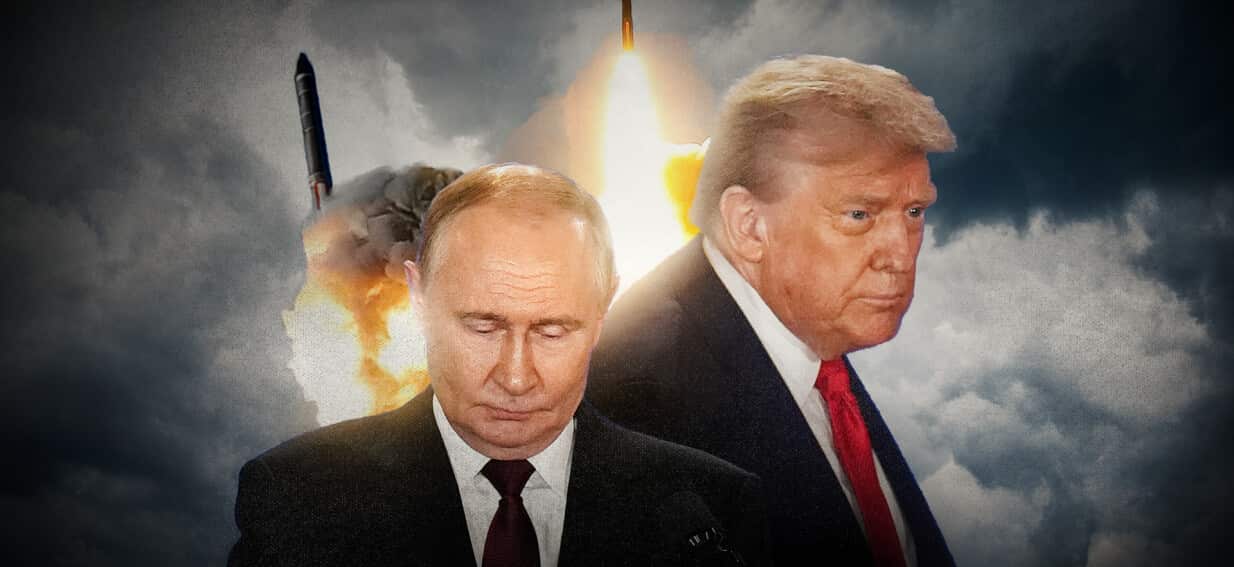
For the first time in many years, the United States and Russia, the two most formidable nuclear powers, are no longer bound by any mutual arms control agreement. The expiration of their last such treaty marks a significant shift in global nuclear dynamics.
While it’s not unprecedented for major arms control agreements to lapse, experts are expressing concern that this could trigger a new arms race involving not only Russia and the United States but potentially China as well.
The 2010 Strategic Arms Reduction Treaty, known as ‘New START’, was originally signed to prevent nuclear escalation and avert potential catastrophe between these two nuclear giants. This treaty capped each nation at 1,550 deployed strategic nuclear warheads. However, it has now expired, and the likelihood of a new agreement emerging seems slim.
Russia has indicated that the United States failed to respond to President Vladimir Putin’s proposal to continue observing existing limits on missiles and warheads for an additional year.
Meanwhile, former U.S. President Donald Trump has suggested that China should be included in any future arms control discussions. He has also questioned the rationale behind Russia and the United States expanding their nuclear arsenals when they already possess enough weapons to annihilate the planet multiple times.
US President Donald Trump has said he wants China to be part of arms control and questioned why the United States and Russia should build new nuclear weapons given that they have enough to destroy the world many times over.
The White House said this week that Trump would decide the way forward on nuclear arms control, which he would “clarify on his own timeline”.
The two countries will will both be free to increase missile numbers and deploy hundreds more strategic warheads, although this poses logistical challenges and will take time.
“If they really decided they’ve had enough and it’s gonna be an all-out arms race, then we are in for a very dangerous, sick and hopeless situation,” Paul Dibb, emeritus professor of strategic studies at the Australian National University (ANU), told SBS News.
“These are the weapons that mean Armageddon, the end of the bloody world,” Dibb said.
“Each side has got a couple of thousand strategic nuclear warheads, any one of which is capable of wiping out any one of their major cities.”
United Nations Secretary-General Antonio Guterres on Wednesday called the treaty’s expiration a grave moment for international peace and security and urged Russia and the United States to negotiate a new nuclear arms control framework without delay.
However Stephan Fruehling, professor at the Strategic and Defence Study Centre at ANU, said the treaty ending likely won’t change anything in the short term.
“I do expect that the Americans will now increase the number of deployed warheads, which is largely a reaction though to the Chinese buildup of nuclear weapons, but in the overall scheme of things, I don’t expect radical changes.”
‘Fundamental to global security’
The original START treaty barred the US and the then Soviet Union from deploying more than 6,000 nuclear warheads.
It expired but was succeeded some months later by the New START treaty which had even stricter controls on armament, signed in 2010 in Prague by the US and Russia, and although Russia suspended the treaty three years ago as tensions grew over the Ukraine war, it was believed both countries were abiding by it.
Courtney Stewart, the deputy director of the Defence Strategy Program at the Australian Strategic Policy Institute, called the treaty “fundamental”.
“A nuclear arms race was prevented because of this treaty. It is fundamental to global security,” she told SBS News.
“It had four different pillars, and one of the key pillars was to reduce the role of nuclear weapons in US security and globally. It was a very ambitious agenda, and the completion of the treaty was a huge milestone.
“In a way, [it] required them to declare openly their deployed strategic nuclear weapons … Before that, this, this was all classified, nobody had actual numbers.”
Alongside nuclear warheads, the treaty also set caps on the number of deployed and non-deployed intercontinental ballistic missile launchers, submarine-launched ballistic missile launchers, and heavy bombers.
The agreement was signed in 2010 by Barack Obama, then US president, and Dmitry Medvedev, then president of Russia.
“It’s a reflection of the times that it was born from,” Stewart said.
“It really signalled warmer relations between two strategic rivals, coming out of the Cold War, moving on to something after the expiration of the original START Treaty.”
Does the treaty matter?
Those behind the New START have already warned about what its absence could mean for global security.
Obama said that the end of the pact would “pointlessly wipe out decades of diplomacy, and could spark another arms race that makes the world less safe”, while Medvedev said the expiration should “alarm everyone”.
The US and Russia are the world’s largest nuclear powers, possessing about 86 per cent of the world’s inventory of nuclear weapons, according to the Federation of American Scientists.
Stockholm International Peace Research Institute (SIPRI) estimates that both countries have more than 5,000 nuclear warheads as of January 2025.
Dibb said that the strategic nuclear arms treaty is a better option compared to having an “all-out nuclear arms race”.
“A lot of people will say, ‘Does [the treaty] matter?’ Well, that is the typical sarcastic, ‘I don’t care’ sort of attitude, but of course it effing well matters,” he said.
‘Extremely dangerous’
The Nuclear Threat Initiative, a US-based nonprofit organisation, has warned that “unless the two countries agree to maintain limits on their forces, the world will enter a period of potentially unconstrained nuclear build-ups, one that is more complex than the Cold War nuclear arms race.”
Experts warn that Russia’s full invasion of Ukraine could increase the risk of countries threatening each other.
Stewart said that “if the conflict in Ukraine is not wrapped up, there’s potential that Russia could use threats of expanding certain elements of its nuclear arsenal”.
“It could threaten to create those warheads or those systems, and then if they wanted, they could actually carry out the production and manufacturing,” she said.
‘End of an era’
While the treaty expired on Thursday, Stewart said “the writing has been on the wall” for years.
In 2023, Russia announced suspending participation in the New START treaty, blaming the US support for Ukraine.
Fruehling said “the Russians are not interested in genuine arms control at the moment”.
“[Vladimir] Putin is using nuclear threats and the fear of nuclear escalation as a way of trying to undermine Western unity over Ukraine. He’s been doing that for a number of years,” he told SBS News.
Russia claims the US had not responded to Putin’s proposal to keep observing the missile and warhead limits for another 12 months.
“This approach appears mistaken and regrettable,” the Russian foreign ministry said in a statement.
In January, US President Donald Trump told The New York Times that “if the treaty expires, it expires”.
“We’ll just do a better agreement,” he said.
Dibb said it is important that either Trump “extends [New START] or goes for a renewed strategic nuclear arms treaty”.
“It’ll tell us a lot about what his thoughts are, if he has any at all,” he said.
US officials have previously said that any forthcoming arms control agreement ought to involve China as well, given the expansion of its nuclear stockpile.
SIPRI estimates that China possessed 600 nuclear warheads by January 2025, making it the third largest stockpile in the world.
Fruehling said no matter what happens next, even if the treaty gets replaced or extended, it’s “an end of an era”.
“We’re now in an era where you really have three large nuclear powers that are going to all deter each other. That’s Russia, the US, and now also China,” he said.
“In the end, arms control only works if there is a shared interest in actually increasing predictability and transparency.
“At the moment, we just do not see that certainly from the Russian or the Chinese side, and one would probably suspect also not from the current Trump administration.”
For the latest from SBS News, download our app and subscribe to our newsletter.