
Share this @internewscast.com
Abbott, a global leader in healthcare solutions, has initiated an extensive recall of its continuous glucose monitoring sensors across numerous countries. The recall is prompted by reports of potentially fatal inaccuracies in blood sugar readings.
This week, Abbott detailed the recall of specific models of its FreeStyle Libre 3 and FreeStyle Libre 3 Plus sensors, which are used by type 1 and type 2 diabetics for blood sugar monitoring. The sensors have been found to provide falsely low readings, a defect that has been linked to the deaths of seven individuals and 736 serious health issues, including 57 incidents within the United States.
In the U.S. alone, approximately three million of these faulty sensors were distributed, with additional millions sold in countries like Austria, Belgium, Canada, Denmark, and several others throughout Europe, as well as New Zealand and the UK.
Accurate blood sugar measurement is critical for diabetics to maintain their health. Incorrectly high readings pose a significant risk; if individuals believe their glucose levels are stable or elevated when they are actually low, they may neglect to consume necessary carbohydrates, leading to hypoglycemia, a dangerously low blood sugar condition.
Conversely, a falsely low reading can mislead someone into thinking their blood sugar is perilously low when it is normal, prompting unnecessary insulin intake, which could significantly reduce their actual blood sugar levels.
If genuine high blood sugar levels are not identified and treated, it can result in dangerously elevated glucose levels, potentially leading to diabetic ketoacidosis, a severe and life-threatening condition.
The sensor issue stemmed from a single production line among many that make the Libre 3 and Libre 3 Plus sensors, according to Abbott. Anyone with an impacted device should stop using it, Abbott and the FDA said.
Abbott added: ‘The company continues to produce Libre 3 and Libre 3 Plus sensors to fulfill replacement and new orders and does not expect significant supply disruptions.’

Inaccurate glucose readings pose direct risks. A falsely high reading may cause a diabetic to miss a dangerous low reading, while a falsely low reading can prompt an insulin overdose and severe hypoglycemia (stock)
Roughly 1.8million Americans have type 1 diabetes and 34million have type 2. Around 2.5million of them use glucose monitors to keep track of their blood sugar peaks and valleys.
To use the sensors, a tiny, flexible filament coated with a special enzyme is inserted just under the skin in the interstitial fluid, not blood.
Glucose from the interstitial fluid diffuses into the sensor. The enzyme glucose oxidase catalyzes a reaction between glucose and oxygen in the fluid, producing gluconic acid and a small electrical current.
The sensor’s electronics measure this tiny electrical current. The strength of the current is directly proportional to the glucose level, in which more glucose equates to a stronger current.
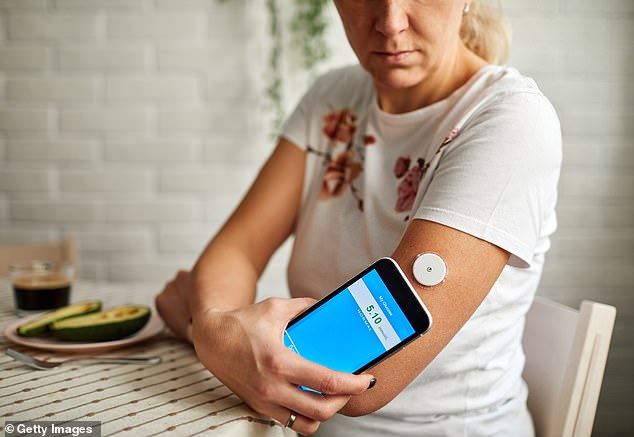
People can monitor their levels on their smartphones.
According to Abbott, sampling of products from a single production line gave inaccurately low readings.
The company said: ‘If undetected, incorrect low glucose readings over an extended period may lead to incorrect treatment decisions for people living with diabetes, such as excessive carbohydrate intake or skipping or delaying insulin doses.
‘These decisions may pose serious health risks, including potential injury or death, or other less serious complications.’

The above graph shows estimates for global diabetes cases. It is predicted that the number of people with the condition will more than double by the year 2050 compared to 2021

According to Abbott, seven people have reportedly died due to inaccurate readings from the devices, while hundreds, including 57 Americans, have been injured in some way
A person might eat more sugar than they need, causing their blood sugar to spike dangerously high. Or, they might skip or delay their insulin dose because they’re scared of going low, which also lets their blood sugar rise too high.
Over time, these mistakes from faulty data can lead to severe long-term health damage, including nerve damage, kidney disease and cardiovascular risk, and increase the risk of emergencies, such as seizures, loss of consciousness and coma.
The company did not elaborate on the kinds of injuries, including the 57 reported in the US, that people suffered in relation to the faulty sensors.
Abbott added: ‘Abbott has identified and resolved the cause of the issue, which relates to one production line among several that make Libre 3 and Libre 3 Plus sensors.
‘The company continues to produce Libre 3 and Libre 3 Plus sensors to fulfill replacement and new orders and does not expect significant supply disruptions.’
The model numbers for the affected FreeStyle Libre 3 sensors are 72081-01 and 72080-01, and the unique device identifiers are 00357599818005 and 00357599819002.
The model numbers for the affected FreeStyle Libre 3 Plus sensors are 78768-01 and 78769-01, and the unique device identifiers are 00357599844011 and 00357599843014.
Abbott has created a site that allows people to see if their monitors are affected.