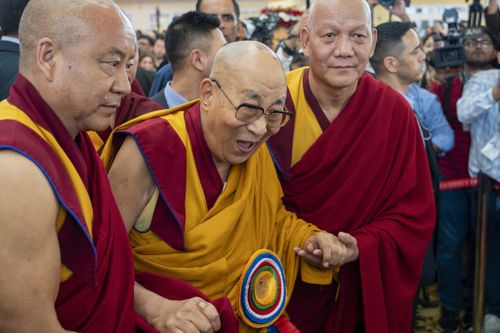

Dalai Lama ends years of speculation with move set to annoy China
The Dalai Lama has announced that he will have a successor after his death, continuing a centuries-old tradition that has become a flashpoint in the struggle with China’s Communist Party over Tibet’s future.
Tibetan Buddhism’s spiritual leader made the declaration on Wednesday in a video message to religious elders gathering in Dharamshala, India, where the Nobel Peace laureate has lived since fleeing Tibet after a failed uprising against Chinese communist rule in 1959.

“I am affirming that the institution of the Dalai Lama will continue,” the Dalai Lama said in the pre-recorded video, citing requests he received over the years from Tibetans and Tibetan Buddhists urging him to do so.
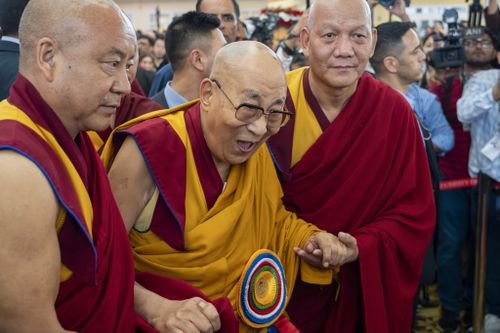
Attendant monks help Tibetan spiritual leader the Dalai Lama to leave after presiding over an event celebrating his 90th birthday according to a Tibetan calendar at the Tsuglakhang temple in Dharamshala, India, Monday, June 30, 2025, ahead of his birthday according to the Gregorian calendar on July 6. (AP Photo/Ashwini Bhatia)

“The Gaden Phodrang Trust has sole authority to recognise the future reincarnation; no one else has any such authority to interfere in this matter,” he added, using the formal name for the office of the Dalai Lama.

The office should carry out the procedures of search and recognition of the future dalai lama “in accordance with past tradition”, he said, without revealing further details on the process.

The Dalai Lama has previously stated that when he is about 90 years old, he will consult the high lamas of Tibetan Buddhism and the Tibetan public to re-evaluate whether the institution of the dalai lama should continue.

Wednesday’s announcement – delivered days before his 90th birthday this Sunday – sets the stage for a high-stakes battle over his succession, between Tibetan leaders in exile and China’s atheist Communist Party, which insists it alone holds the authority to approve the next dalai lama.
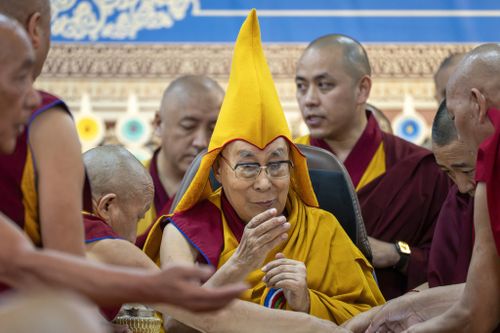
Tibetan spiritual leader the Dalai Lama presides over an event celebrating his 90th birthday according to a Tibetan calendar at the Tsuglakhang temple in Dharamshala, India, Monday, June 30, 2025, ahead of his birthday according to the Gregorian calendar on July 6. (AP Photo/Ashwini Bhatia)

Asked about the Dalai Lama’s statement, a spokesperson for the Chinese Foreign Ministry reiterated Beijing’s long-held stance that the spiritual leader’s reincarnation must comply with Chinese laws and regulations, with search and identification conducted in China and approved by the central government.

In a memoir published in March, the Dalai Lama states that his successor will be born in the “free world” outside China, urging his followers to reject any candidate selected by Beijing.

That could lead to the emergence of two rival dalai lamas: one chosen by his predecessor, the other by the Chinese Communist Party.

“Both the Tibetan exile community and the Chinese government want to influence the future of Tibet, and they see the next dalai lama as the key to do so,” said Ruth Gamble, an expert in Tibetan history at La Trobe University in Melbourne, Australia.

Samdhong Rinpoche, a senior official at the Dalai Lama’s office, told reporters on Wednesday that any further information about the procedures or methods of the Dalai Lama’s reincarnation would not be revealed to the public until the succession takes place.
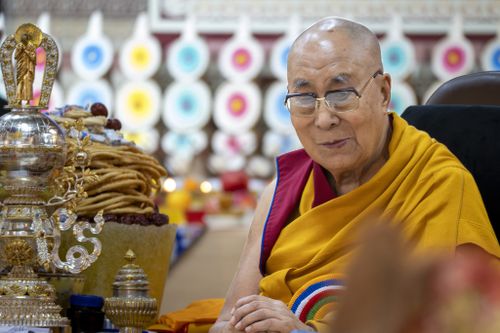
Tibetan spiritual leader the Dalai Lama attends an event celebrating his 90th birthday according to a Tibetan calendar at the Tsuglakhang temple in Dharamshala, India, Monday, June 30, 2025, ahead of his birthday according to the Gregorian calendar on July 6. (AP Photo/Ashwini Bhatia)

Over a lifetime in exile, the 14th Dalai Lama, Tenzin Gyatso, has become synonymous with Tibet and its quest for genuine autonomy under Beijing’s tightening grip on the Himalayan region.

From his adopted hometown of Dharamshala, where he established a government-in-exile, the spiritual leader has unified Tibetans at home and in exile and elevated their plight onto the global stage.

That has made the Dalai Lama a persistent thorn in the side of Beijing, which denounces him as a dangerous “separatist” and a “wolf in monk’s robes”.

Since the 1970s, the Dalai Lama has maintained that he no longer seeks full independence for Tibet, but “meaningful” autonomy that would allow Tibetans to preserve their distinct culture, religion and identity. His commitment to the nonviolent “middle way” approach has earned him international support and the Nobel Peace Prize in 1989.
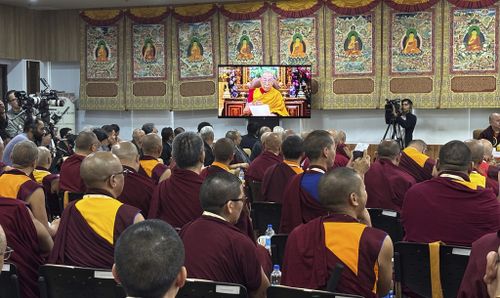
Buddhist monks of various schools of Tibetan Buddhism watch a recorded video message by Tibetan spiritual leader the Dalai Lama in Dharamshala, India, Wednesday, July 2, 2025, ahead of his birthday according to the Gregorian calendar on July 6. (AP Photo/Ashwini Bhatia)

The Dalai Lama has long been wary of Beijing’s attempt to meddle with the reincarnation system of Tibetan Buddhism.

Tibetan Buddhists believe in the circle of rebirth, and that when an enlightened spiritual master like the Dalai Lama dies, he will be able to choose the place and time of his rebirth through the force of compassion and prayer.

But the religious tradition has increasingly become a battleground for the control of Tibetan hearts and minds, especially since the contested reincarnation of the Panchen Lama, the second-highest figure in the religion.

In 1995, years after the death of the 10th Panchen Lama, Beijing installed its own panchen lama in defiance of the Dalai Lama, whose pick for the role – a six-year-old boy – has since vanished from public view.

Under Tibetan tradition, the dalai lamas and the panchen lamas have long played key roles in recognising each other’s reincarnations. Experts believe Beijing will seek to interfere in the current Dalai Lama’s succession in a similar way.

“There’s a whole series of high-level reincarnated lamas cultivated by the Chinese government to work with it inside Tibet. (Beijing) will call on all of those to help establish the Dalai Lama that they pick inside Tibet,” Gamble said.

“There’s been a long-term plan to work toward this.”

A “resolution of gratitude” statement released by Tibetan Buddhist religious leaders gathering in Dharamshala on Wednesday said they “strongly condemn the People’s Republic of China’s usage of reincarnation subject for their political gain” and “will never accept it”.

For his part, the current Dalai Lama has made clear that any candidate appointed by Beijing will hold no legitimacy in the eyes of Tibetans or followers of Tibetan Buddhism.

“It is totally inappropriate for Chinese Communists, who explicitly reject religion, including the idea of past and future lives, to meddle in the system of reincarnation of lamas, let alone that of the Dalai Lama,” he writes in his latest memoir, Voice for the Voiceless.

You May Also Like
Iran reveals 'draft deal' that would unlock world's oil crisis

Iran’s Proposed Draft Deal Aims to Alleviate Global Oil Shortage

Iran‘s state TV says it has obtained a draft of an initial,…
Lauren Huxley is a name most Australians will always remember.

Shocking Parole Denial: Lauren Huxley’s Attacker Remains Behind Bars

Robert Black Farmer, infamous for a brutal and nearly deadly assault on…
Shoppers at Pitt Street Mall in Sydney.

Australians Poised for Temporary Respite Amid Current Challenges

Encouraging inflation statistics might provide relief to borrowers weary of potential rate…

Aussies Turn to Extreme Measures: Bin Diving and Thinning Meals to Survive Economic Strain

In Brief More Australians are taking ‘desperate’ measures as they battle food…
More than 17.2 million Aussies are enrolled to vote in the election on Saturday May 21, with thousands already having their say in pre-polling centres (pictured, voters in Sydney in 2019)

Australia Election 2022: The Financial Penalty for Non-Participation in Voting

Australians are navigating some of the most stringent compulsory voting regulations worldwide,…

Iran Accuses US of Ceasefire Breach Amid Intensified Israeli Strikes on Lebanon

In brief Iran says US strikes represent a “gross violation” of a…
'I'm still shaking': Villagers found alive after week trapped in cave

Survivors Rescued After Week-Long Ordeal Trapped in Cave

Five villagers stuck in a flooded cave in central Laos for more…

Labor Drives Controversial Tax Reforms Amidst Growing Public Dissent

In brief Treasurer Jim Chalmers has introduced a bill to legislate changes…

Discover How Major Global Cities Have Tackled Heatwaves Amidst the UK’s Rising Temperatures

In brief As the UK swelters, its residents have turned to tried…

Solomon Islands’ New Prime Minister to Make Landmark Visit to Australia

Stay informed about the world with our reliable coverage. Receive complimentary daily…
The husband, wife, and three children who were inside this Sapphire Place home at Eagle Vale have been left terrified.

Terrifying Case of Mistaken Identity Shakes Local Family

A family residing in Sydney’s south-west is reeling from shock after their…
In a special episode of the Daily Mail's Palace Confidential, royal editor Rebecca English tours an exhibition which charts Queen Elizabeth's historic reign through clothes, guided by its curator, Caroline de Guitaut. To mark what would have been the monarch's centenary, Queen Elizabeth II : Her Life in Style puts many of her most iconic outfits and accessories on public display for the first time at The King's Gallery, Buckingham Palace. Among the pieces visitors can study up close is the historic gown from the Queen's 1953 coronation, created by royal couturier and longtime collaborator Sir Norman Hartnell. Hartnell was given around eight months to realise his vision for the outfit, eventually presenting the monarch with eight separate designs to choose from.

Queen Elizabeth’s Unique Coronation Dress Request Revealed

In a unique episode of the Daily Mail’s Palace Confidential, royal editor…