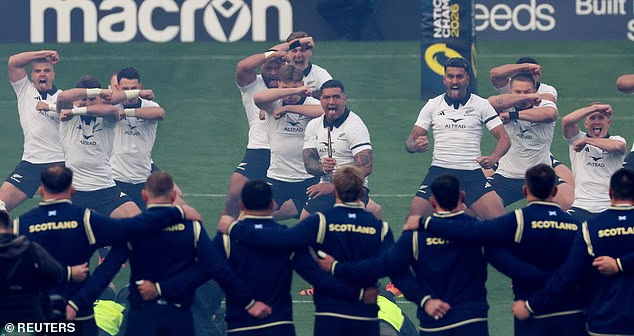

The hope was that Scotland might finally make history. Instead, the afternoon offered another familiar chapter.
Scotland have still never defeated the All Blacks. That remained true when I pushed my sizeable nose into Ryrie’s bar at precisely 11am, and it was no different when I returned roughly eight hours later.
The morning carried a faint sense of anticipation, although the blend of rye and barley may have helped create it. By the evening, that optimism had vanished. The foundations for some distinctly sombre Sunday-morning hangovers were being laid with impressive determination.
Even so, there was broad acceptance that the better side had won. Supporters also recognised that, ultimately, it was only sport. ‘We have a near-perfect record against the All Blacks,’ one fan joked, perhaps after another rye. ‘It has only been damaged by two draws.’
The gulf between sporting disappointment and genuine tragedy was made clear at Murrayfield, where silence and mournful pipes marked the memory of war. It was a powerful reminder that defeat on a rugby field is little more than a temporary nuisance, softened by a drink and the passing of time.
From a Scottish standpoint, it is better to focus on the positive and even uplifting aspects of the day. They included the respect shown by players and supporters from both teams in a fiercely competitive setting, the journeys undertaken by the travelling fans, and the reflections of a former player who treasured facing the All Blacks despite the results.

New Zealand look menacing as they perform a pre-match Haka before setting about Scotland
It was also a privilege to see one of rugby’s great sporting institutions stride on to the Murrayfield pitch in fluorescent boots, even if the sight of the All Blacks performing the Haka before a match against Possil YM was faintly amusing. That encounter might have produced an eruption of blood and snotters beyond anything normally seen on a rugby field.
Once play began, however, the familiar history returned, despite Scotland’s determined attempt to rewrite it during a breathless first half. Sione Tuipulotu, the Scotland captain, offered the neatest summary: ‘The pursuit continues.’
Peter Wright, BBC commentator and a Scotland prop between 1992 and 1996, is among those who have taken part in that 121-year pursuit. He can now view his encounters with New Zealand in perspective. ‘I played against them twice,’ he said. ‘I was excited because they were the best team in the world, and I wanted to test myself against the best.’
Those matches came at the 1995 Rugby World Cup in South Africa, when New Zealand won 48-30, and in a Dunedin test the following year, which the All Blacks took 62-31.
‘I played against Craig Dowd and Richard Lowe, but Christian Cullen was in his prime and Jonah Lomu was always in his prime,’ Wright recalled. ‘It was exciting. We scored more than 60 points, unfortunately they scored 100.’
Facing New Zealand carried a distinctive psychological burden. ‘In almost every other match, there is a spell when you feel in control, when you are on the front foot,’ Wright said. ‘Against New Zealand, you never really felt that. You were always chasing the game. There was a mental element too. You had never beaten them and, frankly, some players believed we never would.’

Peter Wright relished his outings against New Zealand but suffered like every other Scot has
Wright toured New Zealand with Scotland and the British and Irish Lions, experiences he always valued. ‘I’m told the culture has changed a little, but in the 1990s it was rugby, rugby, rugby,’ he said. ‘The supporters really knew the game. They recognised you and spoke to you with genuine insight. I loved that. Rugby was the central thing, perhaps the only thing, and it was fascinating to be part of that environment.’
He also remembered how warmly rugby players were received. ‘The All Blacks were gods,’ he said. ‘But the rest of us were treated very well and were always bought a beer.’
His first memories of New Zealand’s team date back to the inaugural World Cup in 1987, co-hosted by New Zealand and Australia and won, with little surprise, by the All Blacks. ‘I suppose that was when they first entered my consciousness,’ Wright said. ‘They became the team I wanted to play against and, naturally, the team I wanted to beat.’
He never achieved that particular ambition, but his career produced plenty of other lasting memories.
‘I remember staying in New Zealand after the Dunedin test and being invited on to a sports television programme with Paul Henderson and Zinzan Brooke,’ he said. ‘It was great fun and we went out for dinner afterwards. I was surprised that nobody asked Zinzan for an autograph. He was the best player in the world at the time, and he was sitting in his own country.’
Henderson later explained the unusual lack of attention. ‘Apparently Zinzan had argued with an autograph hunter the previous week and it had been reported in all the papers. The fans had decided to give him some space for a while.’

Damian McKenzie enjoys a selfie with some of the travelling New Zealand fans at Murrayfield
The New Zealand supporters gathered in Edinburgh were more than happy to share their own stories. Some had travelled from New Zealand through Porto. Another had arrived after competing at a rowing championship. One had made the journey to Murrayfield directly from, rather improbably, Stornoway.
Amanda Puddle, a world champion masters rower, had travelled to Slovenia with her husband for the championships before embarking on a wider European tour. ‘We left New Zealand at the beginning of September and went to Slovenia, Italy and then Paris,’ she said.
‘This is my first time at Murrayfield and it has fulfilled a lifelong dream. The atmosphere is incredible. Good whisky, good rugby and the All Blacks — what more could you want?’
Angela and Michael, from Dunedin, were equally enthusiastic about that combination. Porto had been the highlight of their European travels until they reached Edinburgh. ‘This is better,’ Angela said before kick-off. ‘I’m excited because I think the All Blacks are coming together nicely, and we could be in for a big win.’
Jo and Michael had travelled south from Stornoway. Jo emigrated from New Zealand four years ago, worked in England and later became a radiographer on Lewis. Michael, who is English, works as head engineer for the search-and-rescue helicopter service.
They were expecting an enjoyable afternoon. ‘I’m neutral,’ Michael said. ‘But I expect New Zealand to win.’
Jo was less hesitant. ‘I think we’ll win as well, although I love the spirit of the Scotland supporters. They have a great deal of heart, and so do we.’
The supporters maintained their good humour. The teams, understandably, did not. Scotland’s wait for a first victory over the All Blacks continues, and there is little evidence that the long-standing drought will end any time soon.