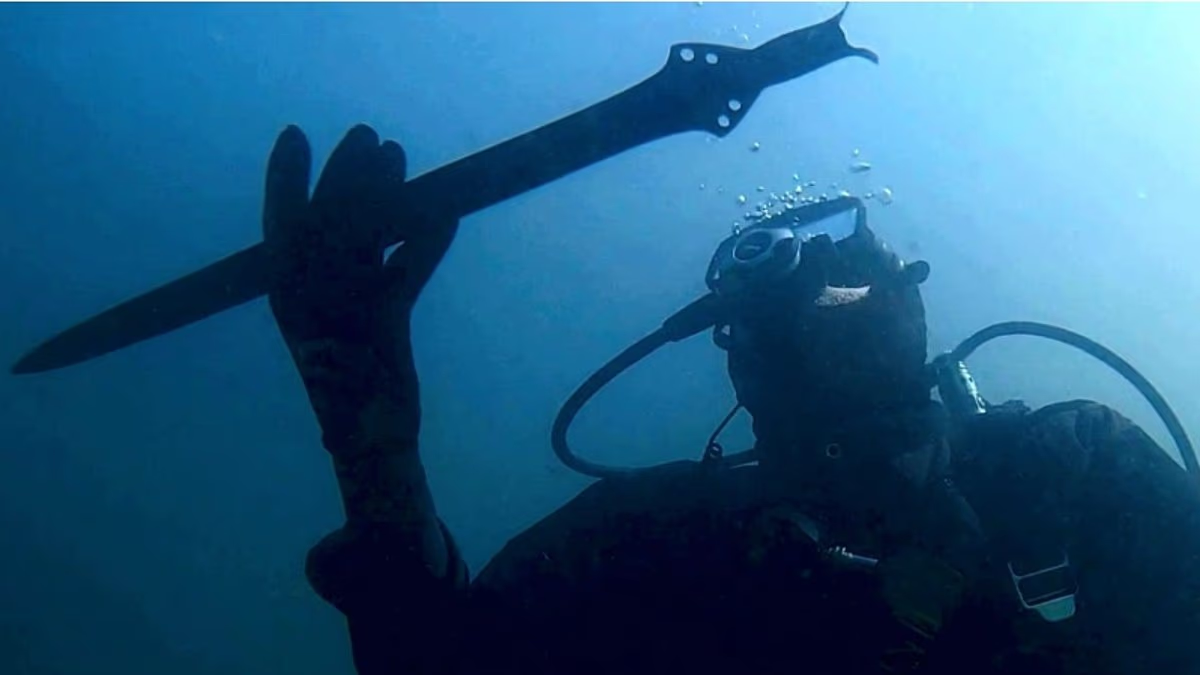

Archaeologists have recovered a 3,300-year-old sword from the bottom of a lake in Italy—a discovery that could be described as an Italian cousin of Excalibur.
The weapon was found during an underwater excavation at Lake Mezzano, a small volcanic lake in central Italy. It had remained submerged for thousands of years, yet its blade was still sharp.
Dating to around 1300 BC, the sword may have been intentionally placed in the lake as part of a ritual offering. Similar practices have been documented at several Bronze Age sites across Europe.
The discovery was announced by Italy’s Superintendence of Archaeology, Fine Arts and Landscape for the Province of Viterbo and Southern Etruria.
The authority said: ‘The artefact, preserved in excellent condition and still bearing a sharp edge, represents an important addition to our understanding of the communities that visited the lake basin more than 3,000 years ago.
‘Considering its typological and chronological features, the sword fits clearly within the tradition of central Italian weapons produced during the Late Bronze Age. It demonstrates the high level of metallurgical expertise achieved by communities of that period.’

A researcher exploring Lake Mezzano displays the weapon, which dates to around 1300 BC

After millennia underwater, the remarkable blade remains in exceptionally good condition and is still very sharp
It is the third sword discovered at the site in the past 50 years, strengthening Lake Mezzano’s status as an archaeological treasure trove.
Researchers believe the lake once surrounded a thriving Bronze Age settlement built on wooden stilts above the water.
As a pile-dwelling community, its inhabitants would have been protected from flooding while enjoying convenient access to fishing grounds.
The latest excavation also recovered intact pottery and a collection of bronze objects, including axes, daggers, spearheads and a razor.
The sword’s position beside a bronze razor particularly intrigued experts. Similar combinations have been found among the grave goods and personal possessions of elite Bronze Age warriors elsewhere in Europe.
‘In this context, bronze weapons were more than instruments of combat: they were also symbols of prestige, identity and power,’ they said.

Researchers believe the lake, pictured, once contained a thriving Bronze Age settlement built on wooden stilts above the water

The sword may have been intentionally placed in the lake as part of a ritual offering, a practice documented at several Bronze Age sites across Europe

The discovery marks the third sword found at the site in 50 years, adding to the area’s archaeological importance
The Late Bronze Age was a period of extensive trade and cultural exchange, linking communities across central Italy, the wider peninsula and the Mediterranean.
Archaeologists say weapons such as this sword served not only as tools of warfare but also as powerful markers of status, identity and influence.
‘The latest discoveries confirm the important role this settlement played in the cultural developments and relationships between communities in protohistoric central Italy,’ the experts said.
‘This new evidence deepens our understanding of the populations that lived in Tuscia more than 3,000 years ago.’
The sword may have been deliberately deposited in the lake as part of a broader Bronze Age ritual, in which valuable objects—including jewellery, weapons and other prized possessions—were offered to the water.
Such traditions continued for centuries. Later Etruscan communities placed artefacts, and in some cases human remains, in wells and other sacred locations during religious ceremonies.


