
Key Points
  • Donald Trump says he’ll decide within two weeks on potential US military action against Iran.
  • Israeli airstrikes hit nuclear sites; Iran retaliates with drones and missiles, reported cluster munitions.
  • Trump’s envoy and Iran’s foreign minister have reportedly held secret talks during the conflict.
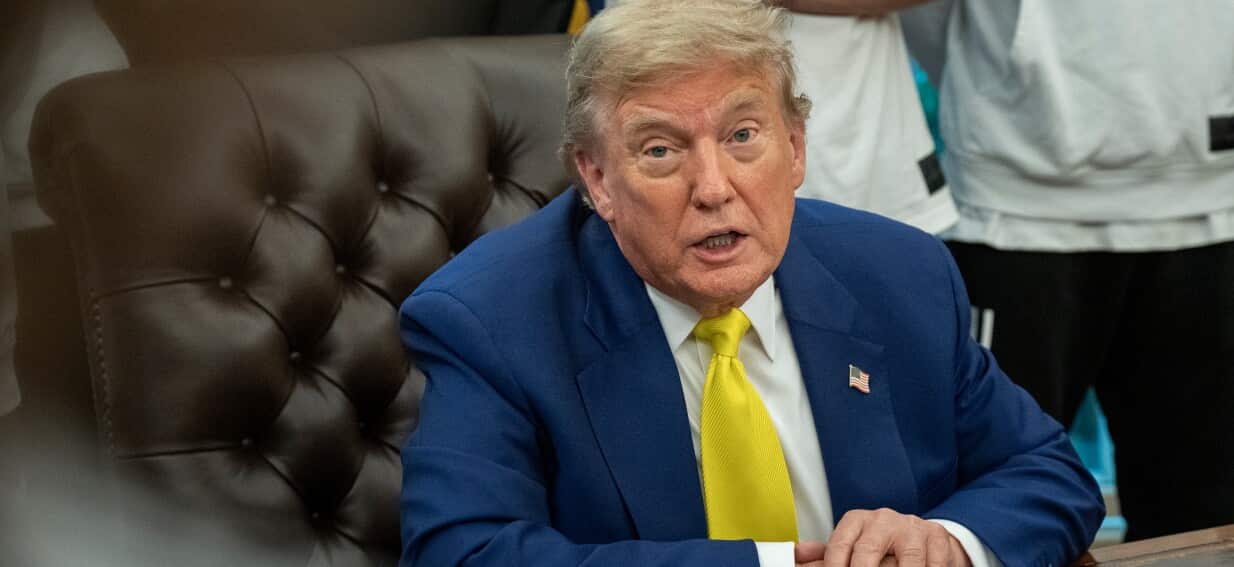
United States President Donald Trump will decide in the next two weeks whether the US will get involved in the Israel-Iran conflict, the White House said, raising pressure on Iran to come to the negotiating table.
Citing a message from Trump, White House press secretary Karoline Leavitt told reporters: “Based on the fact that there’s a substantial chance of negotiations that may or may not take place with Iran in the near future, I will make my decision whether or not to go within the next two weeks.”
Trump has kept the world guessing on his plans, veering from proposing a swift diplomatic solution to suggesting the US might join the fighting on Israel’s side. Earlier this week, he said nobody knew what he would do.
A day earlier, he mused on social media about killing Ayatollah Ali Khamenei, then demanded Iran’s unconditional surrender.

The threats have caused cracks in Trump’s support base between more traditional Republicans and the party’s more isolationist elements.

But critics noted that in the five months since returning to office, Trump has issued a range of deadlines — including those to Russia and Ukraine, as well as to other countries in trade tariff negotiations — only to suspend or allow them to lapse.
“I think going to war with Iran is a terrible idea, but no one believes this ‘two weeks’ bit,” Democratic senator Chris Murphy said on the social media platform X.
“He’s used it a million times before to pretend he might be doing something he’s not. It just makes America look weak and silly.”
As the BBC’s North America correspondent, Anthony Zurcher, highlighted, Trump has previously threatened Russia with a two-week deadline to demonstrate its willingness to end the war in Ukraine or face new sanctions, but has yet to announce his decision, despite the deadline passing.

In May, he also set a two-to-three-week timeframe for trading partners to respond to new import duties, only for that deadline to pass without action.

‘Always interested in a diplomatic solution’

Leavitt told a regular briefing at the White House, Trump was interested in pursuing a diplomatic solution with Iran, but his top priority was ensuring Iran could not obtain a nuclear weapon.
She said any deal would have to prohibit enrichment of uranium by Iran and eliminate its ability to achieve a nuclear weapon.

“The president is always interested in a diplomatic solution … if there’s a chance for diplomacy, the president’s always going to grab it,” Leavitt said. “But he’s not afraid to use strength as well, I will add.”

Leavitt declined to say if Trump would seek congressional authorisation for any strikes on Iran. Democrats have raised concerns over reports on CBS and other outlets that Trump has already approved a plan to attack Iran, bypassing Congress, which has the sole power to declare war.
Leavitt said US officials remained convinced Iran had never been closer to obtaining a nuclear weapon, saying it would take Iran just “a couple of weeks” to produce such a weapon.
Leavitt’s assessment contradicted congressional testimony in March from Trump’s intelligence chief Tulsi Gabbard. She said then that the US intelligence community continued to judge that Iran was not working on a nuclear warhead.
This week, Trump dismissed Gabbard’s March testimony, telling reporters: “I don’t care what she said. I think they were very close to having one.”
On Wednesday, Trump lieutenant Steve Bannon urged caution about the US joining Israel in trying to destroy Iran’s nuclear program.

Israel bombed nuclear targets in Iran on Thursday, and Iran fired missiles and drones at Israel after hitting an Israeli hospital overnight, as a week-old air war escalated and neither side showed any sign of an exit strategy.

Leavitt said Trump had been briefed on the Israeli operation on Thursday and remained in close communication with Israeli Prime Minister Benjamin Netanyahu. She said Iran was in “a deeply vulnerable position” and would face grave consequences if it did not agree to halt its work on a nuclear weapon.
Iran has been weighing wider options in responding to the biggest security challenge since its 1979 revolution.

Three diplomats told Reuters Trump’s special envoy Steve Witkoff and Iranian foreign minister Abbas Araghchi have spoken by phone several times since strikes started last week.

Israel reports Iranian cluster munitions, says regime change not a ‘goal’

Netanyahu said the change or fall of Iran’s leadership was not a goal of Israel’s attacks, but could be a result.
“The matter of changing the regime or the fall of this regime is first and foremost a matter for the Iranian people. There is no substitute for this,” he said in an interview with Israel’s Kan public television.
“And that’s why I didn’t present it as a goal. It could be a result, but it’s not a stated or formal goal that we have,” Netanyahu said.
He said Israel had the power to remove all of Iran’s nuclear facilities, whether Trump decides to join in or not.

Military analysts believe Israel might need the help of US military bunker-busting bombs to destroy the Fordow Fuel Enrichment Plant, the crown jewel of Iran’s nuclear program buried beneath a mountain near the city of Qom.

Meanwhile, the Israeli military and Israel’s Washington embassy said Iran launched a missile at Israel on Thursday that scattered small bombs with the aim of increasing civilian casualties, the first reported use of cluster munitions in the seven-day-old war.
“Today, the Iranian Armed Forces fired a missile that contained cluster sub-munitions at a densely populated civilian area in Israel,” the embassy said in an email to Reuters that did not identify the area.
“Cluster weapons are designed to disperse over a large area and maximise the chances of a harmful strike,” the email continued. “Iran unlawfully fired deliberately at civilian population centres, and seeks to maximise the damage to civilians in them by using wide-dispersal munitions.”
Iran’s mission to the United Nations did not immediately respond to a request for comment.
Both Iran and Israel declined to join a 2008 international ban on the production, stockpiling, transfer and use of cluster bombs that has been signed by 111 countries and 12 other entities.

You May Also Like

Revolutionary Shark-Spotting Drones Deployed in Honor of Beloved Surfer: A New Era in Beach Safety

A new initiative is equipping surfers with the skills to operate drones…

Grandfather of Kumanjayi Little Baby Urges Community for Peace Amidst Tensions

WARNING: Aboriginal and Torres Strait Islander readers are cautioned that this article…

Urgent Call to Action: Scientists Demand End to Cruel Lobster Boiling Practices Amidst New Pain Sensitivity Findings

Recent research suggests the longstanding practice of boiling lobsters alive inflicts significant…

No Campaign Sets Sights on New Objective Following Voice Defeat; Leader Claims: ‘Australia Delivered a Lasting Blow

The No campaign against the Voice to Parliament has unveiled a new…

Albanese Highlights Growing Concerns Over Intensifying Fuel Crisis

In an interview with 9News marking the first anniversary of his re-election,…

NRL Scandal: Footy Legend Slams Coach’s Explosive Dressing Room Outburst Caught on Camera

In a dramatic turn of events, former Warriors star and now television…

Trump to Evaluate Iran’s Latest Proposal, Cautions Against Potential US Military Action

IN BRIEF Trump said he was going to review a new Iranian…

Trump Considers Iranian Offer to Halt Ongoing Conflict

President Donald Trump announced he is currently evaluating a fresh proposal from…

Melbourne Arson Case: Bail Refused for Duo Charged in Restaurant Blaze

Two individuals have been refused bail following charges related to the alleged…

Discover the Common Fridge Staple That May Lower Alzheimer’s Risk

IN BRIEF Eating seafood twice a week may decrease the risk of…

Jacinta Nampijinpa Price Slams Government Decision, Demands Justice for Indigenous Children Amid Rejected Royal Commission

Jacinta Nampijinpa Price has issued a fierce critique of the government’s decision…

Skyrocketing Drug Costs Leave Families Struggling to Afford Essential Medications

Jade Hlucshniow faced a heartbreaking decision—selling her home to afford the necessary…