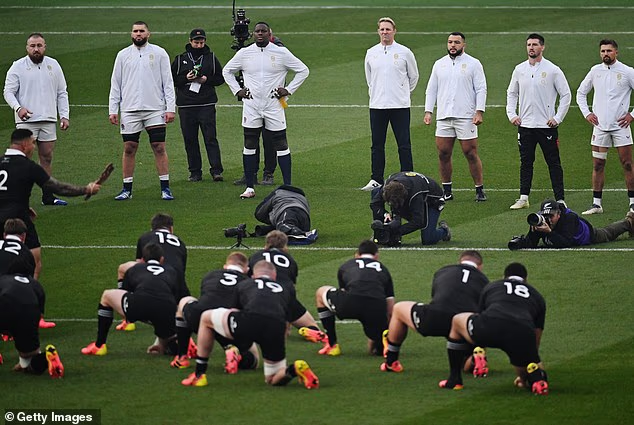
The significance of the occasion was clear from the moment Maro Itoje took Lewis Moody by the arm and guided him to the centre of the Twickenham pitch. England were preparing to face the haka, and it was obvious that nothing would easily shake their resolve.
Moody, affectionately known as Mad Dog during England’s 2003 World Cup triumph, stood at the heart of the squad as the players formed a V in front of the All Blacks. It was a striking piece of rugby theatre and a deeply emotional moment that sent a shiver through the stadium.
Now living with motor neurone disease, Moody continues to display the same extraordinary courage that defined his playing career. His presence seemed to flow through England as they claimed consecutive victories over New Zealand for the first time since, fittingly, 2003.
England controlled almost every department, but their lineout was especially impressive. It is one of Steve Borthwick’s areas of expertise and, with Jamie George throwing in, the set piece operated with world-class precision. England shifted swiftly, lifted their jumpers high and launched into mauls with the relentless rhythm of a well-drilled machine.
Their attacking game was just as polished. With Lee Blackett overseeing the detail, England’s set-piece moves repeatedly unsettled New Zealand. The partnership between Fin Smith and Seb Atkinson at 10 and 12 carved open the defence, while England’s runners found space with an urgency the struggling All Blacks could not match. At 33, and after some had questioned his future, Henry Slade once again looked every inch the outstanding international centre.
Slade struck after only five minutes, with Jack van Poortvliet adding another soon afterwards. England produced a performance of complete authority. There was a time when the All Blacks seemed to possess the aura of James Bond: untouchable, stylish and impossible to defeat. At Twickenham, that mystique disappeared. Ben Earl powered through Cameron Roigard as if the tackle were made of wet paper, giving England a 19-0 lead after 36 minutes. This was no 007 operation; even Robert Pattinson’s Batman would have fancied England’s chances against these Kiwis.

Lewis Moody (England, fourth right) joined the team before the victory over New Zealand and led their response to the haka

England’s attack clicked throughout the match, while their lineout proved particularly dominant
‘The most important thing is how you start against New Zealand,’ England captain Maro Itoje said. ‘Teams have used different formations and different approaches to the haka.
‘Having Lewis and his family with us gave everyone an additional lift. The idea of him joining us for the haka was suggested, and the senior players were completely behind it.
‘I remember watching England, especially around 2011, and seeing his heroic performances. He threw his body around and played with incredible inspiration. He was one of the players I looked up to as a young boy. Welcoming him onto the field is a memory I will carry for the rest of my life.’
The previous evening, Moody and his 2003 teammates had gathered for a lavish reunion at the Dorchester on Park Lane. Sir Clive Woodward and Jonny Wilkinson were among those present, while Mike and Zara Tindall even took turns on the microphone during a lively singalong.
The 2003 group remains fiercely patriotic, but even they were divided over England’s prospects against New Zealand. Borthwick’s side had already beaten Fiji, Argentina, Australia and Japan, yet none of those opponents appeared to offer a test comparable to the All Blacks.
This was the clearest examination yet of the Class of 26’s development, and England passed it in emphatic fashion. They suffocated New Zealand’s attack, hunted in groups and forced uncharacteristic handling mistakes from Damian McKenzie, Will Jordan and Jordie Barrett. The All Blacks managed only two line breaks in 80 minutes, a statistic that reflected the work of England defence coach Richard Wigglesworth.
England claimed 74 per cent of the territory. New Zealand struggled to create turnovers, lacked defensive line speed and repeatedly misfired in possession. Their performance was so poor that, by the end of the match, head coach Dave Rennie was being asked whether his position was under threat.
‘We were miles off the required standard,’ Rennie said. ‘We were well short. The statistics show that we were beaten in almost every area. I’m not going to hide from the fact that we weren’t good enough, and I’m a major part of that. Against Wales, the only thing we lacked was the final finish. Last week I said we had let the country down, but tonight was considerably worse. We have to understand why.’

Ben Earl carried 20 times in the first half; by the final whistle, he had beaten eight defenders and covered 138 metres
New Zealand had averaged more than 250 running metres per half under Rennie. At Twickenham, they produced only 74 metres in the opening 40 minutes. Earl alone made 20 carries in that period, and finished with eight defenders beaten and 138 metres gained. He also helped compensate for the absence of England’s first-choice wingers after Tommy Freeman withdrew shortly before kick-off with a thigh problem.
Cadan Murley came into the side alongside Will Joseph on the wings. Murley delivered one of his finest performances in an England shirt, while Joseph offered further evidence of the depth quietly emerging ahead of next year’s World Cup.
England’s lineout dominance continued after half-time. Alex Coles intercepted Codie Taylor’s throw, before Ollie Chessum finished a move down the left wing.
Following last week’s defeat by Wales, there had been fears that New Zealand would respond angrily. ‘Born to Dare,’ declared the All Blacks advertisement outside Twickenham station. Beauden Barrett’s breakaway try in the 52nd minute was a moment of individual brilliance, but it proved to be an isolated highlight.
Borthwick then turned to his powerful replacements. Ellis Genge, George Martin and Greg Fisilau brought fresh physicality from the bench, adding even more force to a performance the All Blacks could not withstand.
Fin Smith left the field with cramp, but Marcus Smith seamlessly took over. He converted penalties and created the opportunity for Atkinson to score. As he celebrated by drawing a thumb across his throat, England transformed the match into a ruthless exhibition.
If Moody’s appearance had provided the emotional centrepiece, the late image of Chessum driving Scott Barrett into the Twickenham turf captured England’s ferocity. The All Blacks had been comprehensively put to the sword.


