
Share this @internewscast.com
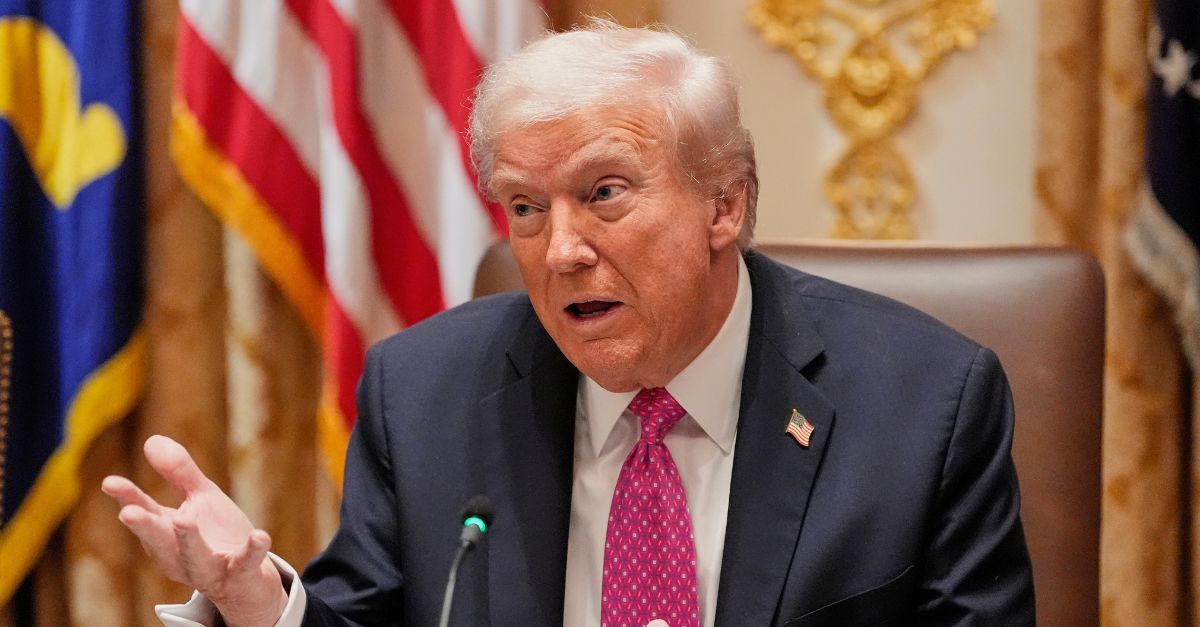
President Donald Trump speaks in the Cabinet Room of the White House, Friday, Oct. 17, 2025, in Washington (AP Photo/Alex Brandon).
A prominent First Amendment advocacy group from one of the country’s leading law schools has reached out to the U.S. Supreme Court, seeking to establish free speech rights for immigration judges. This week, they filed a cross-petition for certiorari, aiming to address this pressing issue.
Although the petition is a recent development, the case itself has a long history.
The legal battle began during the first Trump administration when the National Association of Immigration Judges (NAIJ) challenged a policy that forbids immigration judges from publicly discussing immigration law or policy in a personal capacity.
After nearly six years of legal conflict, the Knight First Amendment Institute at Columbia University is calling for decisive action.
“The policy that initiated this lawsuit categorically bans immigration judges from speaking publicly in their personal capacities about immigration law, policy, or the agency that employs them,” states the cross-petition. “It represents a classic example of prior restraint—a type of speech restriction that this Court acknowledges as suppressing voices and necessitating swift judicial intervention.”
Interestingly, this renewed effort to secure free speech rights for immigration judges now has a pathway to the Supreme Court, thanks in part to the legal maneuvers of the second Trump administration, which has consistently opposed allowing these judges to publicly express their views.
Since the lawsuit was filed, a district court dismissed it by saying immigration judges had to rely on an administrative scheme for internal redress as civil servants before they could ask district courts to intervene. Last summer, the U.S. Court of Appeals for the 4th Circuit revived the case. The appeals court, however, did not disagree with the district court’s merits arguments. Rather, the appeals court expressed concern about the facts; namely, that the systems undergirding the administrative scheme — like the Merit Systems Protection Board — are not working as Congress intended.
On remand, the 4th Circuit asked the district court to conduct a “factual inquiry” into whether or not the relevant internal systems under the Civil Service Reform Act (CSRA) still “provide a functional adjudicatory scheme” under the current circumstances.
The Trump administration pushed back on the 4th Circuit’s ruling. In an application for a stay filed late last year, the U.S. Department of Justice asked the justices to intervene. This request, though directly tied to the underlying case, reflects the Trump administration’s current efforts to exercise strong executive power over the inner workings of quasi-independent agencies.
In the recently filed cross-petition, the Knight First Amendment Institute is latching onto the DOJ’s stay motion and leapfrogging by asking the justices to directly answer the basic question.
“The question presented is whether the CSRA impliedly strips federal district courts of jurisdiction over a preenforcement challenge to a broad prior restraint on the speech of federal employees,” the motion reads.
To hear the group tell it, the CSRA scheme “does not guarantee any—let alone meaningful—judicial review” of alleged First Amendment injuries. That’s because the “availability of judicial review” depends “entirely on agency officials’ unfettered and unreviewable discretion.”
“Federal employees shouldn’t have to go through a cumbersome administrative process to challenge sweeping prior restraints on their speech,” Ramya Krishnan, senior staff attorney at the Knight First Amendment Institute, said in a press release. “The Supreme Court should make clear that public servants can get immediate relief from gag orders by challenging them directly in court.”
To be clear, the immigration judges at the heart of the dispute could always take a chance by exercising speech or religious practice that gets them in trouble, the group admits. Under those circumstances, review by a district court would be more likely to occur. The group, however, wants immigration judges to be able to challenge prior restraints on their otherwise First Amendment-protected activity.
“Without the assurance of judicial review, federal employees would be left with a Hobson’s choice—suppress their own speech and religious exercise to avoid the penalty of non-compliance, or violate the policy and incur the kind of serious sanction that would give rise to a guarantee of judicial review,” the cross-petition goes on. “This is no real choice at all.”
Pressing the issue, the group says the 4th Circuit’s ruling — which held that a well-functioning CSRA would preclude immediate district court review — creates a circuit split because the U.S. Court of Appeals for the District of Columbia Circuit reached the opposite conclusion in a similar case.
In fact, the D.C. Circuit doubly contradicts the 4th Circuit.
In that other case, Voice of America employee Carolyn Weaver challenged a rule requiring prepublication review for all speaking, writing, and teaching material on matters of “official concern.” After violating the rule and being punished, she challenged both her punishment and the rule itself.
From the cross-petition, at length:
In Weaver, the D.C. Circuit expressly rejected the argument that the CSRA impliedly stripped district court jurisdiction over a prior-restraint challenge…The court dismissed Weaver’s challenge to the admonishment, reasoning that it was remediable under the CSRA as a “prohibited personnel practice.” But the court treated her challenge to the policy differently, holding that the district court had jurisdiction over “a simple pre-enforcement attack on a regulation restricting employee speech.” In the court’s view, that challenge “st[ood] independently” of any covered sanction for non-compliance, and so it could be filed directly in district court.
In other words, the 4th Circuit says agency punishment can “be brought directly in district court,” but the underlying policy cannot. By contrast, the D.C. Circuit says the agency-issued punishment remains under the CSRA while the policy itself can be challenged in district court.
“The circuit split created by the Fourth Circuit warrants this Court’s intervention now,” the cross-petition argues. “A substantial percentage of the nation’s federal employees live in the D.C. and Fourth Circuits, and yet they are now subject to two radically different regimes for challenging unconstitutional prior restraints on their speech. Those in the D.C. Circuit may proceed directly to district court. Those in the Fourth Circuit, however, must attempt to navigate an administrative process that does not guarantee judicial review.”