Share this @internewscast.com
The Australian government has announced that the first group of Australians caught in the Middle East conflict has left Dubai. In response to the crisis, new teams are being sent to the region to assist.
Air travel worldwide has faced disruptions due to Iranian bombings in nine countries, which were retaliatory measures following weekend strikes by the US and Israel. The airspace over Iran, Iraq, and Israel remains closed.
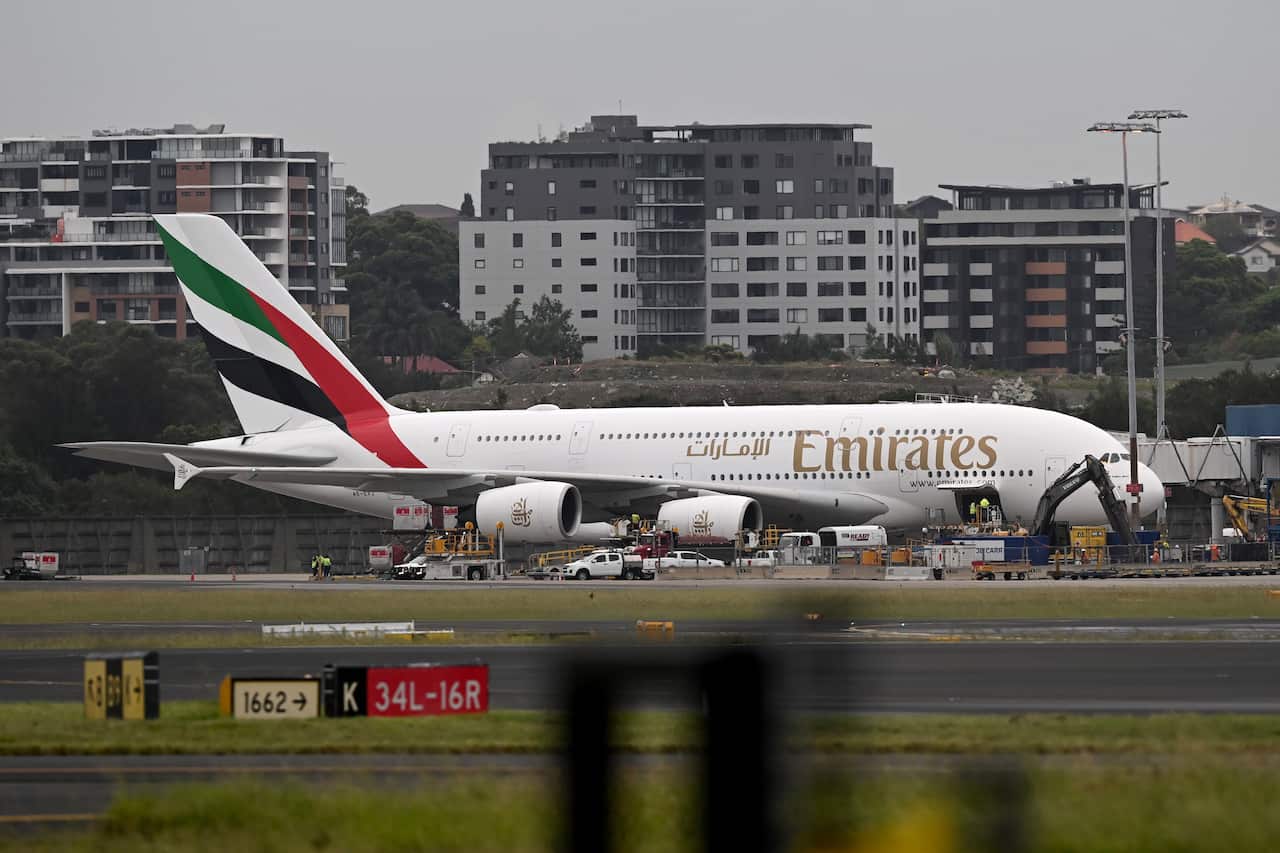
Foreign Minister Penny Wong confirmed that a flight carrying 200 Australians departed from Dubai to Sydney on Wednesday morning.
Addressing reporters in Canberra, Wong assured, “We will continue to do everything possible to bring Australians home and ensure their safety.”
Wong revealed that six crisis center teams will be dispatched to support consular staff and manage extensive repatriation efforts.
In a conversation with her UAE counterpart, Wong requested the resumption of commercial flights but acknowledged that the ongoing attacks are complicating contingency plans.
Foreign Minister Penny Wong revealed there are 115,000 Australians in the region, with at least 24,000 located in Dubai. This includes expats or people transiting through.
“This is a consular crisis that dwarfs any Australia … has had to deal with in terms of numbers of people,” she told ABC’s RN.
Following strikes in the region on Sunday, Smartraveller updated its advice, urging Australians not to travel to Bahrain, Israel, Kuwait, Lebanon, Qatar or the United Arab Emirates.
It continues to advise Australians not to travel to Iran, Iraq, Palestine, Syria or Yemen.
A limited number of airlines have resumed operations for stuck travellers, with Wong stressing commercial flights were the best avenue to leave the region.
“That volume of traffic will really need to see commercial flights resume, even if only sporadically, to get people home,” she said.
“Obviously given that the hubs are being attacked, this has made this crisis much more difficult for everyone to navigate, and we’re very conscious of how distressing this is,” she said.
Wong expressed her gratitude to Foreign Minister Sheikh Abdullah Bin Zayed for the “friendship of the UAE people” during the time of crisis.
The same sentiments were echoed by Prime Minister Anthony Albanese during his call with UAE President Sheikh Mohammed Bin Zayed Al Nahyan overnight.
The pair discussed the volatile situation in the Middle East and the importance of resuming commercial flights as soon as possible.
Wong says troops won’t be deployed
Wong said that while the government continues to engage with countries in the region, it is not deploying military assistance.
“We’re not considering sending Australian troops,” she said on Wednesday afternoon.
Wong spoke hours after a speech by Canadian Prime Minister Mark Carney in Sydney, during which he revised his position towards US-Israeli strikes on Iran.
Carney conceded they may break international law, calling it a “failure of the international order” as he urged a “rapid de-escalation in hostilities”.
“It appears that these actions are inconsistent with international law,” he said, adding that it was up to the US and Israel to determine the legality.
Under the United Nations charter, which governs the US as a founding member state, the use of military force is justified under self-defence if a country is under attack, or if the United Nations Security Council has authorised it.
The US and Israel have argued that their attacks on Iran are to prevent the country from acquiring nuclear weapons.
Wong continued to avoid questions about the legality of US-Israeli strikes on Iran, dubbed Operation Epic Fury.
“I have made clear that this is a matter for Israel and the US, the legal basis for those two parties to respond,” she said.
She previously highlighted Iran’s failure to comply with UN Security Council resolutions over its nuclear program.
For the latest from SBS News, download our app and subscribe to our newsletter.