
Share this @internewscast.com
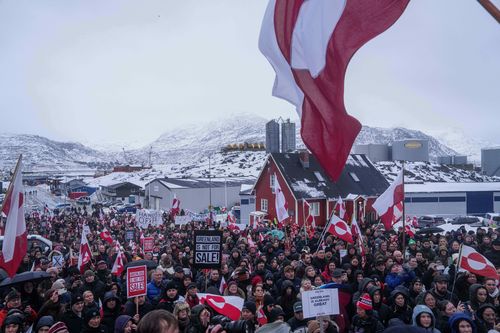
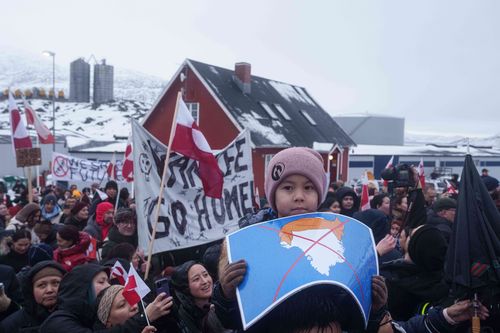
Tensions are rising over US-European relations as former President Trump’s recent threat poses a significant challenge to transatlantic partnerships. This comes in the wake of several European nations deploying troops to Greenland for Arctic security exercises. The announcement was made by Trump on Saturday, just as thousands of Greenlanders concluded a protest outside the US Consulate in Nuuk.
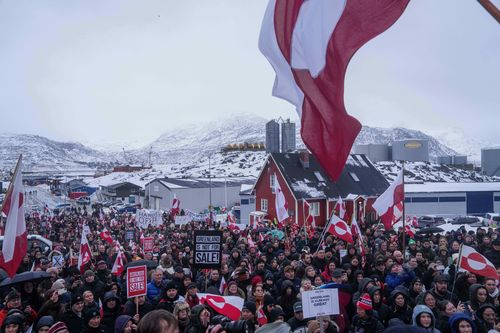
The former president appeared to suggest that these tariffs were a strategic maneuver to initiate discussions with Denmark and other European countries about Greenland’s status. Greenland, a semiautonomous entity under Denmark, is considered vital to US security interests. The countries potentially facing these tariffs include Denmark, Norway, Sweden, France, Germany, the UK, the Netherlands, and Finland.
The feasibility of implementing these tariffs is already under scrutiny, as highlighted by an anonymous European diplomat. The EU functions as a unified trade bloc, which complicates any unilateral tariff imposition by the US. Furthermore, Trump’s ability to enforce such tariffs under US law is uncertain, although emergency economic powers could be invoked, pending a Supreme Court review.
Kaja Kallas, the EU’s foreign policy leader, warned of the geopolitical consequences, noting that such rifts could benefit China and Russia. She suggested these security concerns with Greenland could be addressed through NATO and argued that tariffs would harm both European and American economies, threatening mutual prosperity.
Back in the US, the response to Trump’s proposal was largely negative.
Senator Mark Kelly, an Arizona Democrat and ex-Navy pilot, criticized the idea, stating that imposing tariffs on allies would unnecessarily burden Americans financially for a territorial acquisition he deemed unnecessary.
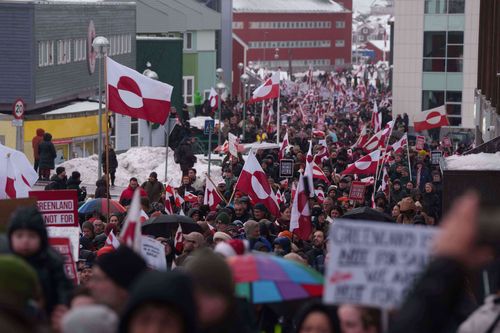
“Troops from European countries are arriving in Greenland to defend the territory from us. Let that sink in,” he wrote on social media. “The damage this President is doing to our reputation and our relationships is growing, making us less safe. If something doesn’t change we will be on our own with adversaries and enemies in every direction.”
‘Risk a dangerous downward spiral’
Norway and the UK are not part of the 27-member EU, which operates as a single economic zone in terms of trading. It was not immediately clear if Trump’s tariffs would impact the entire bloc. EU envoys scheduled emergency talks for Sunday evening to determine a potential response.
António Costa, president of the European Council, and Ursula von der Leyen, president of the European Commission, pledged to continue their full solidarity with Denmark and Greenland.
“Tariffs would undermine transatlantic relations and risk a dangerous downward spiral. Europe will remain united, coordinated, and committed to upholding its sovereignty,” they wrote in a joint statement.
The tariff announcement even drew blowback from Trump’s populist allies in Europe.
Italy’s right-wing Premier Giorgia Meloni, considered one of Trump’s closest allies on the continent, said on Sunday she had spoken to him about the tariffs, which she described as “a mistake”.
The deployment to Greenland of small numbers of troops by some European countries was misunderstood by Washington, Meloni told reporters during a two-day visit to South Korea. She said the deployment was not a move against the US but aimed to provide security against “other actors” that she didn’t name.
Jordan Bardella, president of Marine Le Pen’s far-right National Rally party in France and also a European Parliament politician, posted that the EU should suspend last year’s tariff deal with the US, describing Trump’s threats as “commercial blackmail”.
Trump also achieved the rare feat of uniting Britain’s main political parties â including the hard-right Reform UK party â all of whom criticised the tariff threat.
“We don’t always agree with the US government and in this case we certainly don’t. These tariffs will hurt us,” Reform UK leader Nigel Farage, a longtime champion and ally of Trump, wrote on social media. He stopped short of criticising Trump’s designs on Greenland.
Meanwhile, UK Prime Minister Keir Starmer, who leads the centre-left Labour Party, said the tariffs announcement was “completely wrong” and his government would “be pursuing this directly with the US administration”.