
Share this @internewscast.com
Australia is confronting the potential of a population decline where deaths surpass births, potentially impacting the labour force and economy in the long run.
According to a data analysis by financial firm KPMG, although 2024 saw an increase in births compared to the previous year, the numbers have not reached pre-pandemic levels.

This indicates that Australia faces an ageing population and is at a “tipping point” for sustaining its lifestyle.

Australia’s changing birth rates

The KPMG analysis examined birth data from the Australian Bureau of Statistics and analysed Australia’s fertility rate, which is the average number of children born to a woman over her lifetime.

According to KPMG, Australia’s fertility rate now sits at 1.51 in 2024, well below the 2.1 replacement rate needed to sustain population growth.

There were 292,500 births nationally in the last year, up from 285,000 the previous year. But birth rates are well below those in previous years, with more than 300,000 births recorded each year between 2013 and 2019.
The analysis found that birth rates are declining more in metropolitan areas compared to regions, with the number of births in capital cities declining by 6.5 per cent between 2019 and 2024.
KPMG urban economist Terry Rawnsley said finances and the cost of living, particularly in major cities, are key factors driving this reduction.
“Rising rents, mortgage payments and childcare costs in the metro areas are putting a handbrake on people’s plans to start or grow their family,” he said.

“Conversely, regional areas continue to gain popularity as places to live, work, and raise families, as affordability becomes a priority for many Australians.”
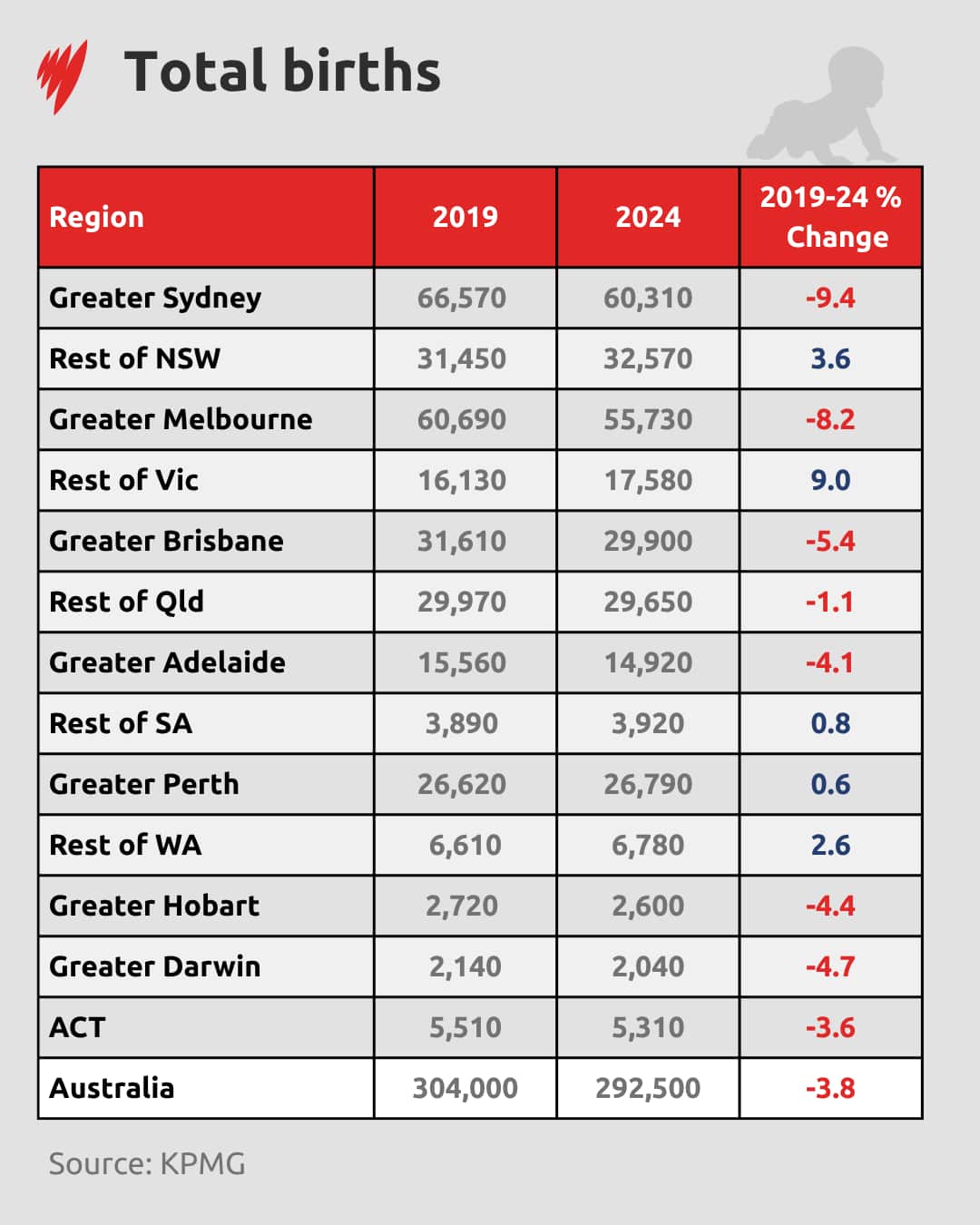
A data table showing number of births in 2019 and 2024 in various areas of Australia.

The number of births in Australia has declined by 3.8 per cent between 2019 and 2024. Source: SBS News

Liz Allen, demographer at the ANU Centre for Social Policy Research, said while the analysis is based on preliminary data, not official statistics, it is concerning for Australia’s population.

She said Australia’s fertility rate has been trending toward below-replacement levels since the 1970s, and is now getting toward “critical territory”.
“We’ve essentially hit rock bottom, and trying to come back from that is going to be incredibly difficult,” she said.
“It will be a task that requires enormous policy and political intervention.”

Allen noted that numerous young Australians may wish to have children, however, they are altering their plans or choosing not to due to the difficulties associated with having children, amid economic or environmental worries.

Allen describes this as a “constrained choice”.
“At the heart of all of this is a lack of hope, dwindling hope, and a deep uncertainty and fear about tomorrow,” she said.

“There are a number of very big issues confronting Australians; housing affordability, economic insecurity, gender inequality and climate change come together and weigh quite heavily on people and are at the forefront of people’s decision-making processes when considering having a child or having a subsequent child.”

Why do birth rates matter?

The key concerns surrounding birth rates are linked to population growth and an ageing population.
Allen said by the mid-2050s, the number of deaths in Australia could exceed the number of births, which could lead to population decline becoming a “real prospect”.

This could mean fewer people in the labour force working and paying taxes in Australia, which could put pressure on healthcare systems and government services.
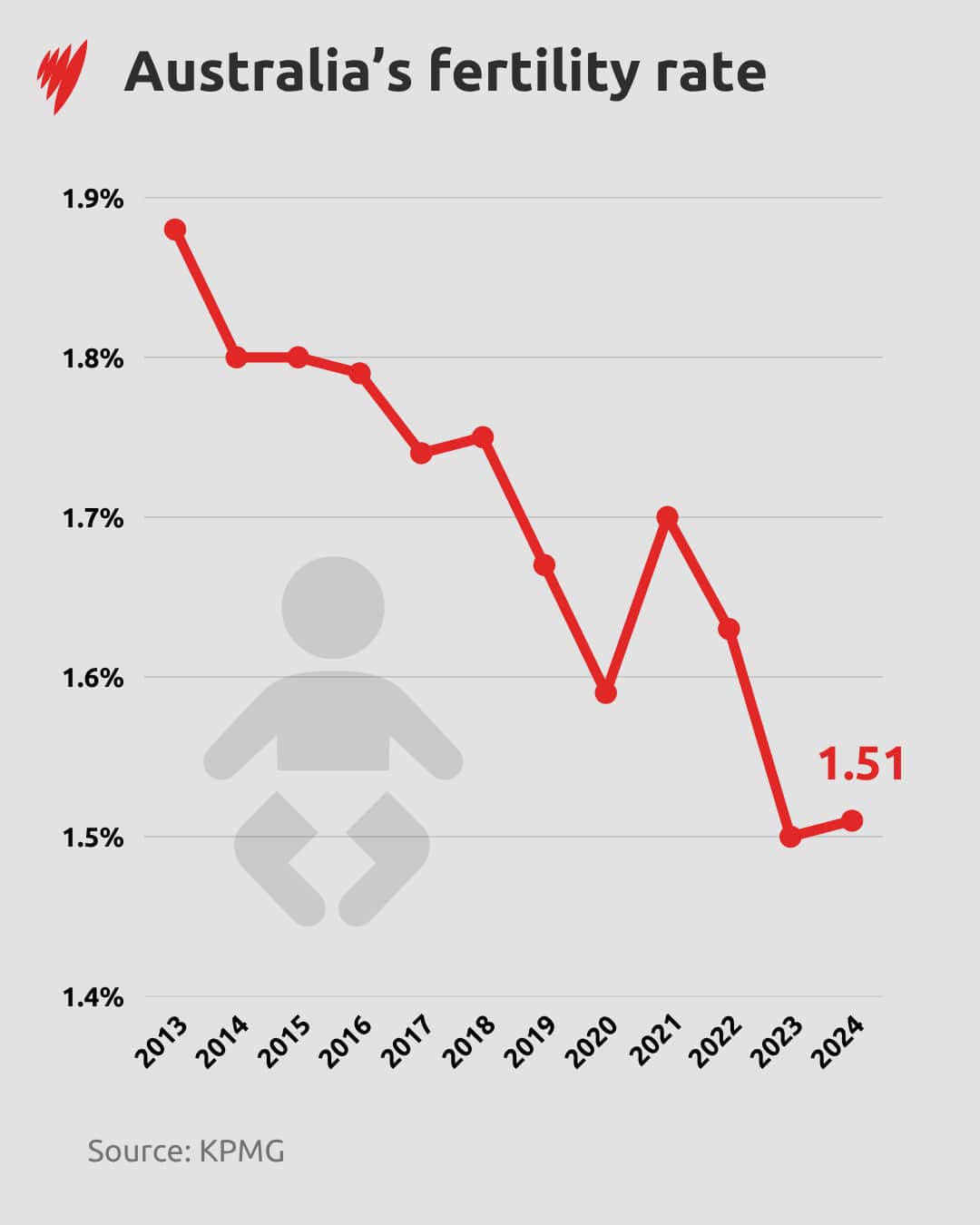
Line graph illustrating Australia's declining birth rate from 2013 to 2024.

Australia’s fertility rate has increased slightly since 2023, but remains below its 2013 level. Source: SBS News

“Currently, Australia’s government funds are largely fuelled by individual income tax,” Allen said.

“That means that if we were to see an ageing population and fewer people ageing into the workforce, our bottom line by way of the government budget will be reduced.
“We will have to do more with less government money going forward.”

Allen believes it is unlikely Australia will witness a “bounce back” in the average number of births per woman without “drastic and very swift” policy changes in areas such as housing affordability, economic security, gender equality, and climate action.

But Rawnsley said the data indicated “cause for optimism” that birth rates could recover further if there is growth in disposable income.
“While many Australians are still holding back due to cost-of-living pressures, those with a little more cash in the bank are now turning their attention to having a family again. The baby bounce back is absolutely on, with the birth rate set to reach 300,000 over the next year,” he said.

“However, it will still be some time before we exceed the magic 350,000 figure needed to sustain our way of life well into the 21st century.”

Birth rate across the world

Australia is not the only country facing the challenges of an ageing population.
According to a 2024 report from the Organisation for Economic Co-operation and Development (OECD), the fertility rate dropped from 3.3 to 1.5 between 1960 and 2022 across all OECD countries.
The country with the lowest fertility rate at the time was South Korea, which had an average of 0.7 children per woman in 2023.
“Australia, like much of the world, is facing a human catastrophe,” Allen said.
“The trouble is that we have kicked the can down the road so far now that we are confronted with multiple crises.
“We’re now at a tipping point and we either fall into the precipice … or we do something and we bridge a path forward [but] I’m not seeing any effort really to get us across this tipping point.”

Share this @internewscast.com
You May Also Like
Emma Sleep mattress

Mattress Industry Leader Faces $15 Million Penalty for Deceptive Online Advertising

Mattress company Emma Sleep has been ordered to pay a $15 million…

Australian Women Confront Tough Decisions Amid National Crisis

in brief Experts are warning that the cost of living crisis is…

Unpacking the Key Issues in the NDIS Overhaul

In Brief Roughly 160,000 Australians are set to lose access to the…
Benjamin Netanyahu

Israeli Prime Minister Netanyahu Discloses Secret Cancer Treatment Amidst Political Turmoil

Israeli Prime Minister Benjamin Netanyahu quietly underwent treatment for prostate cancer, he…
Ed Sheeran's LOOP world tour got off to a flying start, raking in a staggering £5million per show during its opening leg

Ed Sheeran’s LOOP Tour: Unveiling the £5 Million Per Show Phenomenon!

Ed Sheeran’s LOOP world tour has started with remarkable success, earning an…

Lebanon’s Pivotal Role: How Its Future May Shape Regional Conflict Dynamics

in brief World leaders have called for peace talks to take place…

Woolworths Executive Announces Price Reductions Amid Evolving Inflationary Challenges

In brief: The supermarket giants are before Federal Court over accusations of…
Treasurer Jim Chalmers handed down the Budget on Tuesday night, boasting of a $9.3 billion surplus driven by a strong labour market and increased commodity prices

Budget 2024 Unveiled: $300 Cash Boost for Australians, Student Debt Forgiveness, Tax Cuts, and New Travel Policies by Albanese Government

In a strategic move to garner voter support ahead of elections, the…
James Comer is planning on investigating the Biden administration.

Shocking Twist: Congress Considers Controversial Ghislaine Maxwell Pardon

There is a growing number of US members of Congress pushing for…
Jade Elston

Adelaide Family Turns to Crowdfunding for Son’s Urgent Cancer Treatment: A Community’s Call to Action

An Adelaide family has found themselves seeking help from the kindness of…
The Australian soldiers who fought epic battle in the 'forgotten war'

Heroic Australian Soldiers Recall Epic Battle in the Overlooked Korean War

Anzac Day falls 75 years after Australian soldiers fought a bloody battle…

Fluctuating Fuel Costs, Employment Trends, and a New Tax Incentive: Key Insights You Need to Know

This week has been a whirlwind of events. Global markets experienced heightened…