Share this @internewscast.com
IN BRIEF
- Israel has warned Iranian officials in Lebanon to leave immediately.
- Iran says it has selected new leader to replace Ayatollah Ali Khamenei.
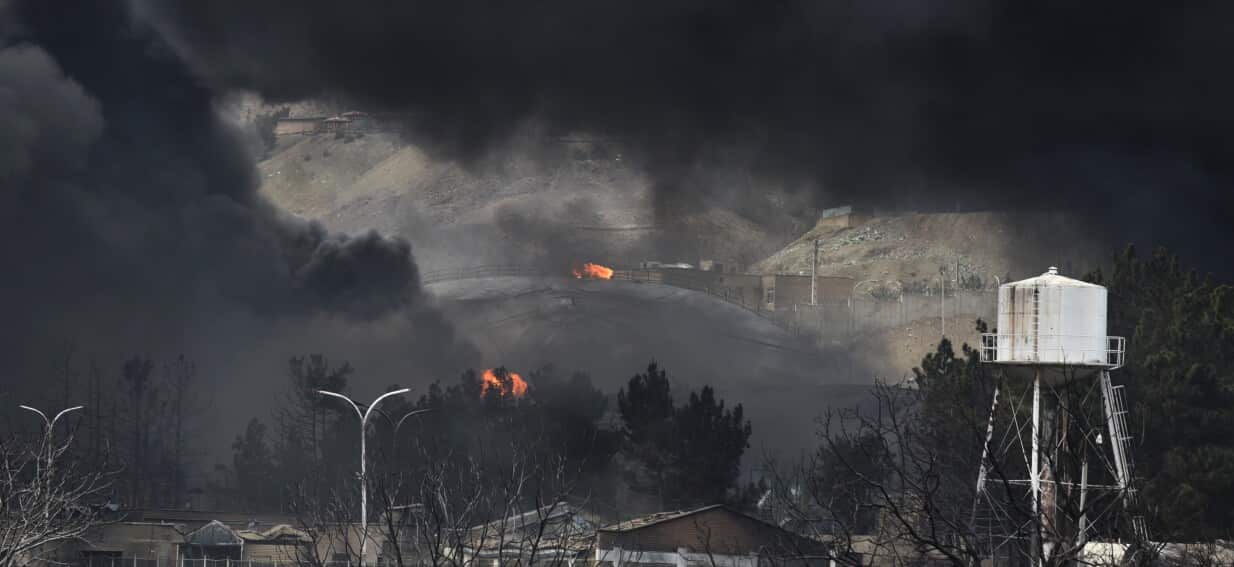
Israel’s military has announced a significant expansion of its operations by targeting Iranian commanders within Beirut, marking a pivotal shift in its ongoing conflict. This recent strike, which is the first to penetrate the capital’s boundaries since hostilities with Hezbollah reignited last week, underscores the escalating tensions in the region.
Amid a barrage of attacks concentrated on Beirut’s southern suburbs as well as southern and eastern Lebanon, the Israeli forces executed a drone strike aimed at high-ranking members of Iran’s elite Quds Force, part of the Revolutionary Guards. While specific identities have not been disclosed, these commanders are reportedly integral to orchestrating activities against Israel.
“The commanders of the Quds Force’s Lebanon Corps were engaged in planning terrorist actions against the state of Israel and its citizens, while also operating in conjunction with the IRGC in Iran,” stated an official release from the Israeli military, emphasizing the perceived threat.
In response, Lebanese authorities report the death of four individuals due to this strike, contributing to a mounting death toll that has already claimed the lives of 394 people. According to the country’s health ministry, this number includes at least 83 children and 42 women, painting a grim picture of the conflict’s human cost.
Israel has issued a stern warning to Iranian representatives in Lebanon, urging them to vacate the country to avoid being targeted. Earlier in the week, Israeli forces also launched an attack in the vicinity of the Iranian embassy in Beirut, further highlighting the severity of the situation.
Israel has warned any representatives of Iran in Lebanon to leave immediately or risk being targeted, and struck an area near the Iranian embassy in Lebanon earlier this week.
New supreme leader named in Iran
Iran on Monday named Mojtaba Khamenei to succeed his father Ali Khamenei as supreme leader.
Mojtaba, a cleric with influence inside Iran’s security forces and vast business networks under his father, had been viewed as a frontrunner in the lead-up to Sunday’s vote by the Assembly of Experts, a body of 88 clerics tasked with choosing Ali Khamenei’s successor.
“By a decisive vote, the Assembly of Experts, appointed Ayatollah Seyyed Mojtaba Hosseini Khamenei as the third Leader of the sacred system of the Islamic Republic of Iran,” the Assembly said in a statement issued just after midnight Tehran time.
The position gives Mojtaba the final say in all matters of state in the Islamic Republic.
The White House did not immediately respond to a request for comment on the announcement of Iran’s new supreme leader.
Mojtaba’s appointment will likely draw the ire of US President Donald Trump, who said on Sunday that Washington should have a say in the selection. “If he doesn’t get approval from us, he’s not going to last long,” he told ABC News. Israel, ahead of the announcement, threatened to target whoever was chosen.
Mojtaba’s father, Supreme Leader Ali Khamenei, was killed in one of the first strikes launched against Iran more than a week ago.
Israel said it continued to target senior Iranian figures, including Abolqasem Babaian, the recently appointed head of the military office of the supreme leader, killed in a Saturday strike.
As fighting escalated on day nine of the US-Israeli campaign against Iran, thick black smoke hung over Tehran on Sunday, residents said, after strikes on oil storage facilities had lit up the night sky with plumes of orange flame.
Iran’s foreign ministry spokesperson Esmaeil Baghaei said the large-scale attack marked a “dangerous new phase” of the conflict and amounted to a war crime.
Trump told reporters on Air Force One that he was not seeking negotiations to end the conflict, which has driven up global energy prices, disrupted business and snarled air travel.
Seventh US soldier dies in war
The US military on Monday AEDT announced that a service member had died after being wounded in Saudi Arabia by an Iranian attack, the seventh American combat death since the war began.
US Central Command (CENTCOM), which oversees American military forces in the Middle East, said in a statement that the service member died Saturday night “from injuries received during Iran’s initial attacks across the Middle East” on 1 March.
It did not provide further details about the circumstances of the attack and said the service member’s identity was being withheld until 24 hours after notification of the person’s family.
The six other US service members killed so far were all in Kuwait and also struck in the initial wave of retaliatory attacks from Iran.
Trump has justified the biggest US military operation in the Middle East since the 2003 invasion of Iraq by saying Tehran posed an imminent threat to the United States, without providing evidence.
The US and Israel have discussed sending special forces into Iran to secure its stockpile of highly enriched uranium at a later stage of the war, Axios reported, citing sources.
Asked on Saturday about sending ground troops to secure nuclear sites, Trump said it was something they would only do if the Iranians were “so decimated that they wouldn’t be able to fight at the ground level.”
The US-Israeli attacks have killed at least 1,332 Iranian civilians and wounded thousands, according to Iran’s UN ambassador.
Iranian attacks have killed 10 people in Israel.
For the latest from SBS News, download our app and subscribe to our newsletter.