Share this @internewscast.com
A year since Syria’s regime was toppled by rebels, there’s been social and political change both in the country and on the international stage. But for the dozens of Australian citizens detained in camps there, life remains much the same.
When Syria’s new president Ahmed al-Sharaa, a former al-Qaeda insurgent who fought against US forces in Iraq and once had a US$10m bounty on his head, met with US President Donald Trump in the White House in November, there were smiles and handshakes.

Trump has decided to relax some sanctions, aiming to offer Syria “an opportunity for greatness.”
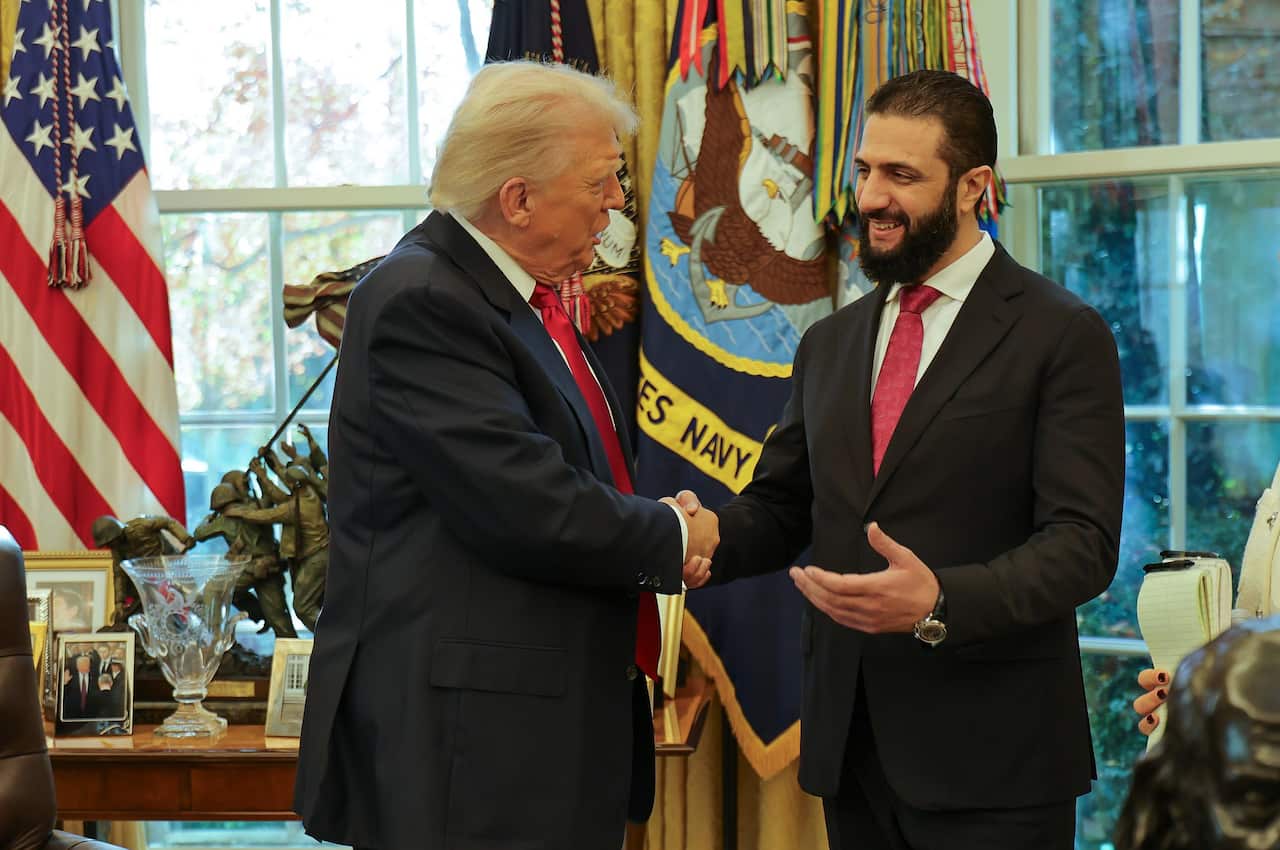
Donald Trump and Ahmed al-Sharaa shake hands in the Oval Office. They are both wearing suits, and appear to be mid-conversation.

In November, Syria’s President Ahmed al-Sharaa visited the White House for discussions with U.S. President Donald Trump. Source: AP / AAP / Syrian Presidency Press Office

Meanwhile, the political shifts have yet to impact the daily existence of the Australian women and children residing in the al-Roj detention camp, located in the Kurdish-controlled northeastern region of Syria, an area beyond the Syrian government’s reach.
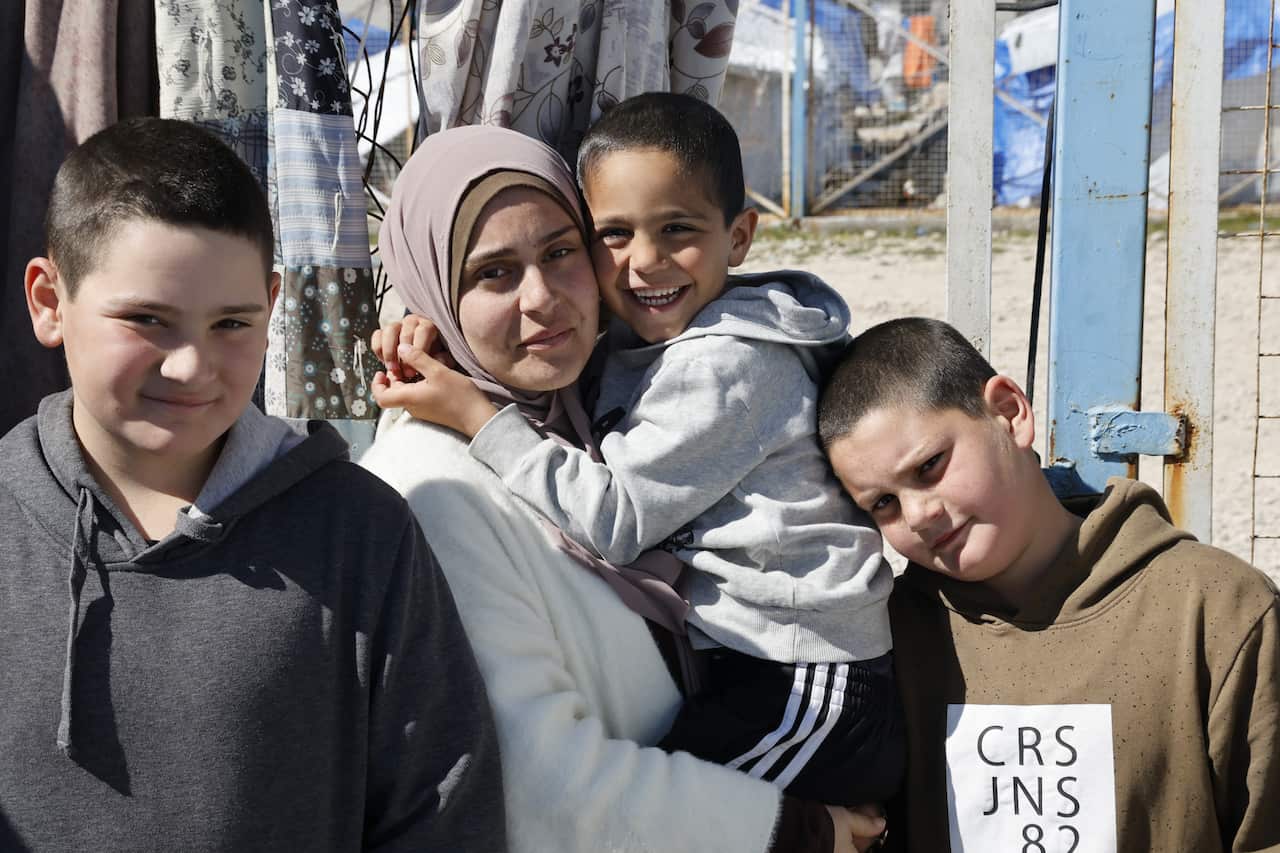
A woman in a hijab holds a young boy, who is grinning. To her left and right are two older boys. One has a slight smile, and one has a neutral facial expression.

Last February, Dateline ventured to Syria and encountered Zahra Ahmad, who, along with her three sons, is part of a group of 37 Australians detained in al-Roj since the collapse of the Islamic State (IS) group’s self-declared ‘caliphate.’

Zahra and her children remain in the Kurdish-administered al-Roj detention camp. Credit: SBS Dateline / Colin Cosier

When the IS group was defeated in Syria in 2019, tens of thousands of foreigners suspected of being IS group members and their relatives were detained. Women and children were sent to detention camps. Men and teenage boys were sent to prisons.
None of the Australians left in the camp or prisons have been charged or allowed legal process.
Mat Tinkler, the Australian aid boss spearheading the push to repatriate the Australians, said it’s “depressing” that they’re still there.
Tinkler is Save the Children Australia’s chief executive. He told Dateline there’s no active conflict around the camp and “if the government wanted to, they could bring them home any time”.
“These kids haven’t even seen a tree,” he said.

This camp serves as a holding area for individuals suspected of having connections to IS members, whether real or perceived.

The fight to free Australians held in Syria

Tinkler visited the detained Australians in 2022. A year later, his organisation tried to force the Australian government to repatriate the detained Australians through court action. But the Federal Court dismissed the case.
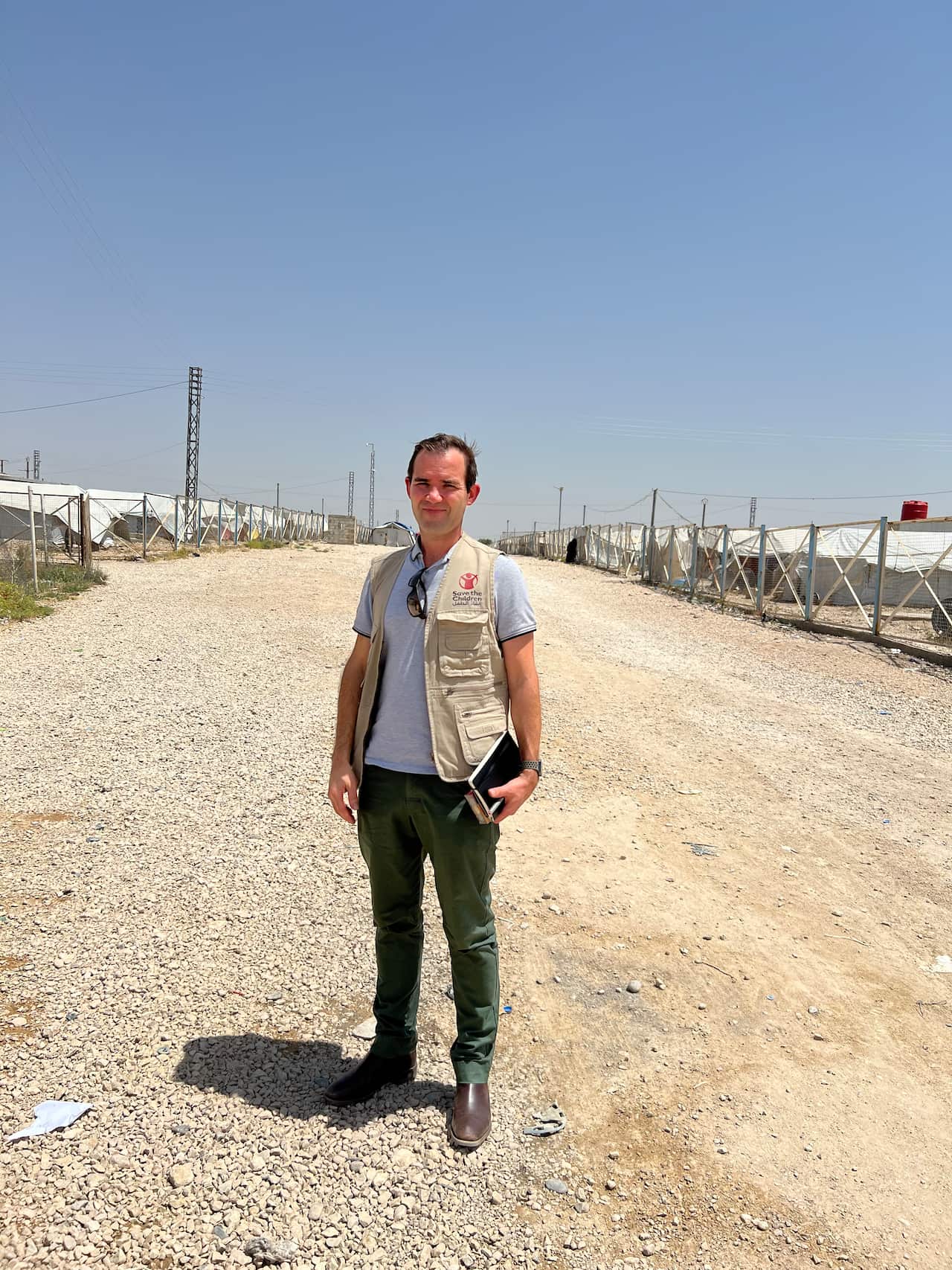
A man in a beige 'Save the Children' vest stands on a gravel pathway. To his left and right are high fences with white tents behind them.

Save the Children Australia CEO Mat Tinkler travelled to al-Roj camp in June 2022. Credit: Supplied / Save The Children Australia

It’s not just the human rights organisation calling for Australia to take home its people. The US government wants it too.

In a speech to the UN in September, the top US commander in the Middle East, Admiral Brad Cooper, called on “every nation with detained or displaced personnel in Syria to return your citizens”.

“Repatriating vulnerable populations before they are radicalised is not just compassion —it is a decisive blow against ISIS’s ability to regenerate,” he said.

To facilitate this, the US military’s Central Command, which Cooper heads, said it would establish a “joint repatriation cell in northeast Syria to coordinate the return of displaced or detained persons to their home countries”.
“The United States will continue supporting … all nations committed to bringing their citizens home,” Cooper said.
In a response to a SBS Dateline query about the US position on countries repatriating their citizens, a spokesperson from the Department of Foreign Affairs and Trade (DFAT) said: “The Australian Government is not providing assistance and is not repatriating individuals … ” from Syria.

The US-backed Kurdish forces who detain the Australians have also long called for countries such as Australia to take their citizens back.

Australia’s approach to repatriating its citizens

Prime Minister Anthony Albanese raised the issue of Australian children in detention when he was in opposition in 2019.
“These children didn’t make choices,” he said during a visit to Lakemba in western Sydney for National Mosque Open Day in October that year.
“Children who are Australian citizens, who have made no choices about where they are and the circumstances in which they find themselves, are deserving of Australia’s protection.”

Once elected in 2022, the Albanese government repatriated four women and 13 children from the camp. But it hasn’t explained why Australia has yet to bring the remaining 37 Australians home.

Greens senator David Shoebridge visited the al-Roj camp in September this year, telling SBS News at the time that it’s in the “capacity of the Commonwealth government to … safely bring Australian children home”.
And the US government, which has troops and diplomats in the region, says it “stands by to assist countries in repatriating their nationals”.
Tinkler says that the reason the Albanese government hasn’t done so is due to “a lack of political will”.

In early September, The Australian newspaper reported of a “top-secret operation” to return the Australians before Christmas, but this was denied by the Albanese government.

Why it’s so difficult to escape Syria

In September, six Australian women and children who were detained in another camp, al-Hol, made their own way back to Australia by smuggling themselves to Lebanon first. The government has said they were not assisted or repatriated by Australian officials.
But it’s unlikely the Australian women and children held in al-Roj camp would be able to escape the same way.
Their camp is located deep inside Kurdish-controlled territory and would require Kurdish permission to leave (and who in turn want Australian permission to let them leave).
Al-Hol camp, in contrast, borders an Arabic area where it’s possible to access and pay for people smugglers.
Under Syria’s previous regime, seeking an escape this way would have meant travelling through government territory that was hostile to IS group.
But the change in Syria’s leadership last year to an Islamist-rebel group would have made the smuggling route more viable.
While much has changed in the rest of Syria over the last year, the Kurdish-held north-east is still negotiating its relationship with the new government in Damascus.

In March, the Syrian government signed a deal with the Kurdish authorities who control north-east Syria to merge their forces into the Syrian army, but the implementation has stalled over unresolved issues and continued clashes.

Detainees may not know Syria has a new president

Reporting from a Kurdish prison for men with alleged links to IS group, The Wall Street Journal recently found inmates didn’t know that former dictator Bashar al-Assad is gone. The reporter wasn’t allowed to tell them any new news.

Yusuf Zahab, a young Australian who is detained in a men’s prison, likely wouldn’t know that former Islamist rebels now control Syria either.

A young man wearing a red long-sleeved top while standing next to a window inside

Yusuf Zahab, now in his 20s, sat down for an interview with SBS Dateline in 2024, his first with the Australian media. Credit: SBS Dateline

The now-22-year-old from Bankstown in Sydney was taken to Syria by his family when he was 12 and was thought to have died in prison until SBS Dateline found him alive in 2024.
In al-Roj camp – where Yusuf’s mother is — Australian women and children aren’t so cut off from the outside world, with access to TV and limited phone communication with family back home.
But they are facing new challenges in the form of Trump’s foreign aid cuts, which have slashed US$117m ($179m) from humanitarian programs in the region, and terminated education, nutrition, sanitation and security programs in al-Roj camp, the regional peak aid body, NES NGO Forum, reported in March.
Save the Children’s Mat Tinkler says that some funding was picked up by others, but points out that countrywide, “something like 17 million people are still in need of human assistance in Syria and the humanitarian appeal is only about 12 per cent funded”.
He said his organisation will continue to advocate for the Australian women and children detained in north-east Syria “as we’ve done for six years”.
“I don’t think we will see them home before Christmas at this stage. I’d be very happy if we’re proven wrong with that.”
Share this @internewscast.com
You May Also Like
Vance, Rubio respond after Cuban forces kill four on boat with US plates

Senators Vance and Rubio Demand Justice After Cuban Forces Kill Four on US-Registered Boat

US Secretary of State Marco Rubio has pledged to find out “exactly…
A testosterone cream has offered new hope for women with low libido.

Breaking Ground: Revolutionary Australian Trial Offers New Hope for Boosting Women’s Libido

In a groundbreaking Australian study, researchers are testing a testosterone cream on…

Evelyn Araluen Honored with Victoria’s Premier Literary Award for Her ‘Uncompromising’ Poetry Collection

In brief Araluen’s work, The Rot, was described as “formally bold, emotionally…
Melissa Vincenty, from Worldwide Migration Partners, says there has been a surge in Americans wanting to move to Australia.

Exploring Cultural Perceptions: Why Exhausted Americans Envy Australia’s Lifestyle

In recent times, an increasing number of Americans are contemplating a move…
Video shows cyclist attacked by e-bike riders at Gold Coast sports ground

Shocking Assault: Cyclist Targeted by E-Bike Riders at Gold Coast Sports Venue

Long-running tensions between local sports clubs and young e-bike riders have reached…

Key Takeaways from Trump’s State of the Union: Immigration and Iran Policies in Focus

In Brief: Trump spoke on foreign policy, the cost of living, tariffs,…
Bill Gates apologises to staff over Epstein links

Bill Gates Addresses Staff Concerns Over Epstein Connections

Bill Gates has reportedly spoken about his ties to Jeffrey Epstein in…

Essential Guide: Do You Need a UK Passport for Your Trip to Britain?

In brief From 25 February, British and Irish citizens will need a…
Samsung's new phone feature blocks prying eyes

Revolutionary Samsung Feature: Safeguard Your Screen from Prying Eyes

Samsung‘s flagship smartphone for 2026 will launch with an industry-first privacy feature…
faceless hooded hacker showing silence gesture. Hacker attack. Dangerous Hooded Hacker Breaks into Government Data Servers. Cybersecurity, computer hacker with hoodie. Hacking and malware concept.

Australian National Sentenced to 7 Years in U.S. Prison for Illicit Trade Secrets Scheme

Peter Williams, aged 39, confessed to exchanging eight vital pieces of software…

South African Recruits Allegedly Deceived into Ukraine Conflict Make Triumphant Return Home

In brief The men were trapped fighting in Ukraine’s Donbas region after…

Watchdog Report: Israel Accountable for Majority of Record 129 Journalist Fatalities in 2025

IN BRIEF Gaza, Yemen, Sudan and Mexico were the deadliest regions for…