Share this @internewscast.com
In Brief
- Gulf countries have invested in alternatives long before the Hormuz blockade.
- Some play key roles in oil supply as the war drags on.
As a month has passed since conflict erupted in the Middle East, Iran’s decision to obstruct oil shipments through the Strait of Hormuz has left Australia struggling with surging fuel costs during an already challenging economic period.
This crucial maritime route’s closure has sparked questions about alternative pathways for global oil distribution.
Speaking at the National Press Club in Canberra on Monday, International Energy Agency (IEA) chief Fatih Birol compared the current Middle Eastern crisis to past oil shocks of the 1970s and the repercussions of the Russia-Ukraine conflict on gas supplies.
Birol further highlighted a global shortfall of 11 million barrels of oil daily.
The Strait of Hormuz, stretching 167 kilometers and linking the Persian Gulf with the Gulf of Oman, serves as a vital artery for the world’s oil trade.
According to the IEA, approximately 25% of the world’s seaborne oil passes through this channel.
While at its narrowest point it’s just 54km wide, it’s used to transport oil produced by countries including Saudi Arabia, the United Arab Emirates and Qatar.
How is Iran maintaining a block on the Strait of Hormuz?
After the US and Israel launched strikes against Iran on 28 February, Iran launched retaliatory actions, including threatening to attack ships that travel through the Strait of Hormuz.
Tina Soliman-Hunter, a professor of energy and resources law at Macquarie University, told SBS News that the threats effectively formed a blockade on the strait.
“Unlike the US that has very large ships like aircraft carriers and destroyers, Iran has opted for small, fast nimble, armed ships,” she said.
“They’re able to seek out and attack any ship that they don’t want coming through the Strait of Hormuz and then retreat back into Iranian waters.”
“As a result, there’s this real fear of ships being attacked and being sunk by Iran if they try to traverse the Strait of Hormuz. And because it’s such a narrow area, it’s easy for the Iranians to control.”
Throughout the years, the Strait of Hormuz has been at crisis points several times due to regional conflicts, and there have been long calls to seek alternatives to ensure the stability of the maritime route for oil.
What are the alternative routes?
During the Iran-Iraq War in the 1980s, with the possibility of an oil blockade in the Strait of Hormuz, Saudi Arabia built the East-West Crude Oil Pipeline, connecting its oil tankers to the port of Yanbu in the Red Sea.
In 2012, the UAE completed the Habshan-Fujairah Pipeline — also known as the Abu Dhabi Crude Oil Pipeline. It was expected to carry 10 per cent of oil that passed through the Strait of Hormuz.
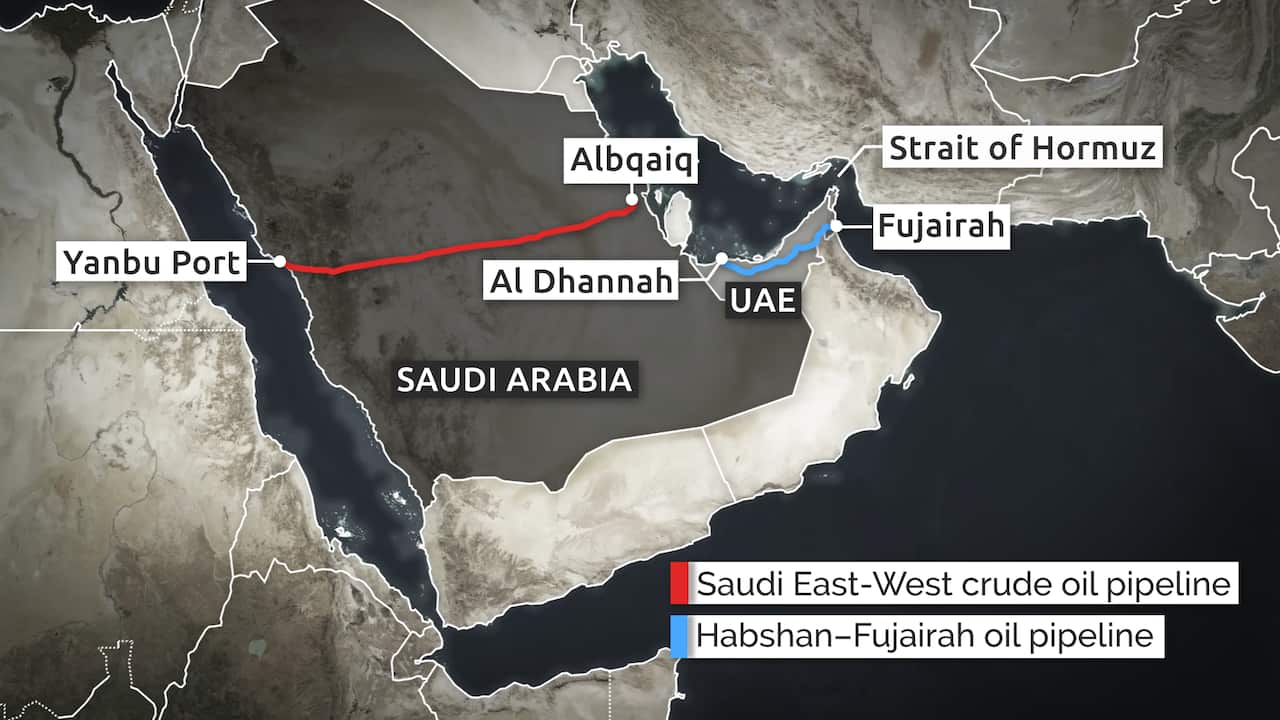
As Iran now effectively blocks the Strait of Hormuz, the two pipelines have been easing the pressure on global oil supply, but they won’t be able to completely fill the void left by its closure, Soliman-Hunter said.
“The other thing is the fact that these pipelines are land-based infrastructure that is just as susceptible to bombing,” she said.
“It’s still very vulnerable to drone and missile attacks. So, although it’s acting as a bit of a relief valve, it can’t carry as much volume, and it’s still vulnerable to attack.”
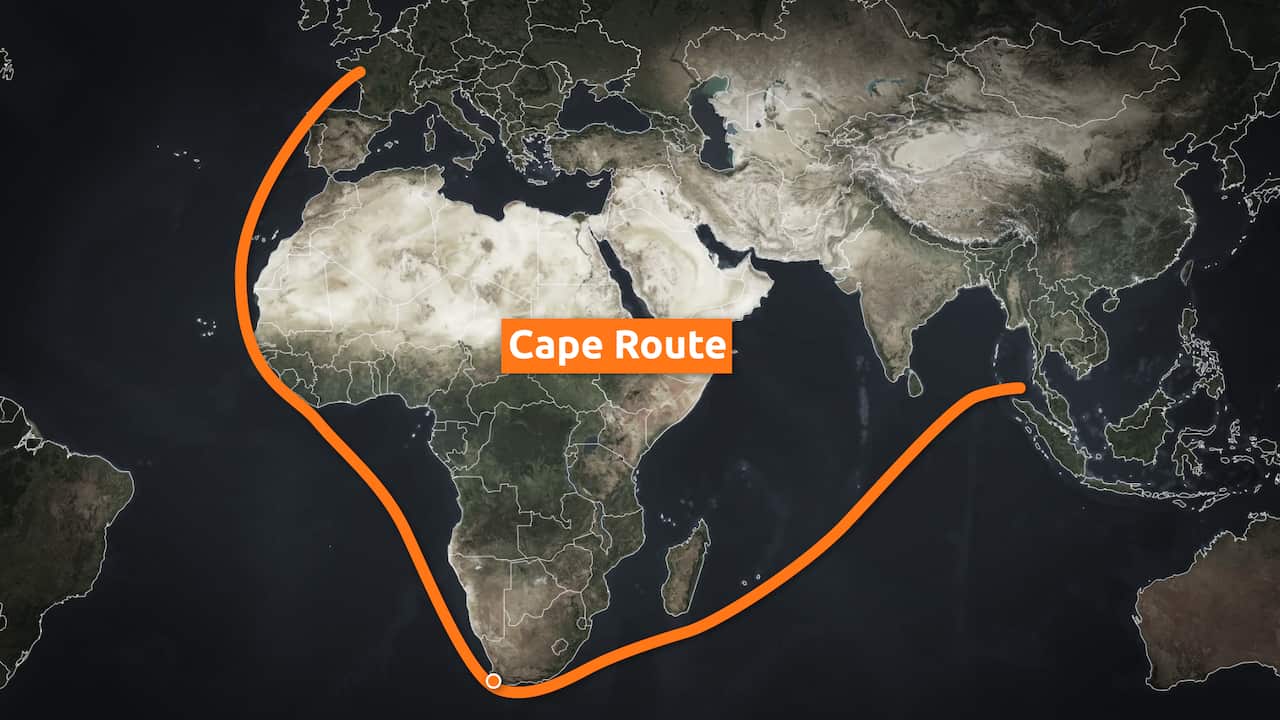
Another alternative route that’s been discussed is the Cape of Good Hope route, where commercial ships redirect to South Africa before heading to their destinations in Asia.
But the route is much longer and with rougher seas than the Strait of Hormuz, which can lead to higher costs and larger risks, Soliman-Hunter said.
She said countries may consider the Northern Sea Route, which runs across the Arctic Ocean north of Russia to reach the North Pacific, as the weather gets warm.
Jessie Moritz, senior lecturer at the Australian National University’s Centre for Arab and Islamic Studies, told SBS News that besides oil, the conflict has also disrupted the trade route between the region and the rest of the world.
She said it would be worth considering focusing more of the world’s attention on the India-Middle East-Europe Economic Corridor, as the conflict unfolds.
That corridor, announced in 2023, is in development but is not yet fully operational. It was launched as an alternative to China’s Belt and Road initiative, which aims to strengthen China’s connection to the world and bolster trade.
“[The corridor] was really about an alternative to the China Belt & Road initiative, and it would need to be adjusted to avoid the Strait of Hormuz,” she said.
“But it has also driven Saudi investment in their railway corridors to the Levant and other alternatives to the Strait of Hormuz, which are actively being used to transport food and other goods in the current crisis.”
What does that mean to Australia?
After producing raw crude oil, Gulf countries export it to Asian countries. Those countries then export refined oil to Australia.
The disruption of the Strait of Hormuz has driven a rise in crude oil prices by more than 34 per cent compared to 2025, due to the shortage of supply and insurers spreading the increased costs through the supply chains.
This has led to a surge in refined oil prices globally, including in Australia, with regular unleaded fuel in Sydney reaching $2.44 per litre by 23 March, according to NRMA.
Australia’s low refining capacity also means Australia heavily relies on imported oil from Asia, according to Sanjoy Paul, an associate professor of strategic supply chain management at the University of Technology Sydney.
He said in order to manage supply problems, governments ought to look to “establish or build our refining capabilities and diversify our oil sources and import crude oil from those countries and refine them here,” he told SBS News.
Moritz said Australia also needs to reduce dependence on imported fuel, including having a serious discussion on ensuring Australians receive a fair share of revenue from the country’s own natural resources.
“The government has a critical opportunity, especially given the upcoming budget, to strongly push for Australia to become a world leader in homegrown renewable energy. I hope they take full advantage of it,” she said.
Prime Minister Anthony Albanese on Friday acknowledged the impact of the war on Australians and announced six tankers of jet fuel will arrive in Australia between tomorrow and 8 April from China and other suppliers.
“Our government is undertaking every practical measure required to shield our nation from the worst of the global uncertainty, which is out there,” he said.
“This war is real. This war is having an impact on Australians like it’s having an impact right around the world.”
The prime minister reiterated that a National Cabinet meeting would be convened with state leaders next week to discuss a united approach to fuel shortages.
“While Australia’s fuel supply outlook remains secure over the near term due to the actions that the government’s taken to date, the government has been clear that the longer this war goes on, the greater the impact will be. But we continue to act to prepare and shield Australians from the worst of it.”
—With additional reporting from the Reuters news agency.
For the latest from SBS News, download our app and subscribe to our newsletter.