Share this @internewscast.com
A handful of sick and injured residents from Gaza have begun to cross into Egypt to receive medical care, thanks to a limited reopening of the Rafah border crossing authorized by Israel. This move marks a significant development for the besieged region.
According to Egyptian authorities, approximately 150 individuals were expected to depart from Gaza on Monday, while 50 others were anticipated to enter. This reopening comes after more than 20 months of closure following Israeli military operations in Gaza.
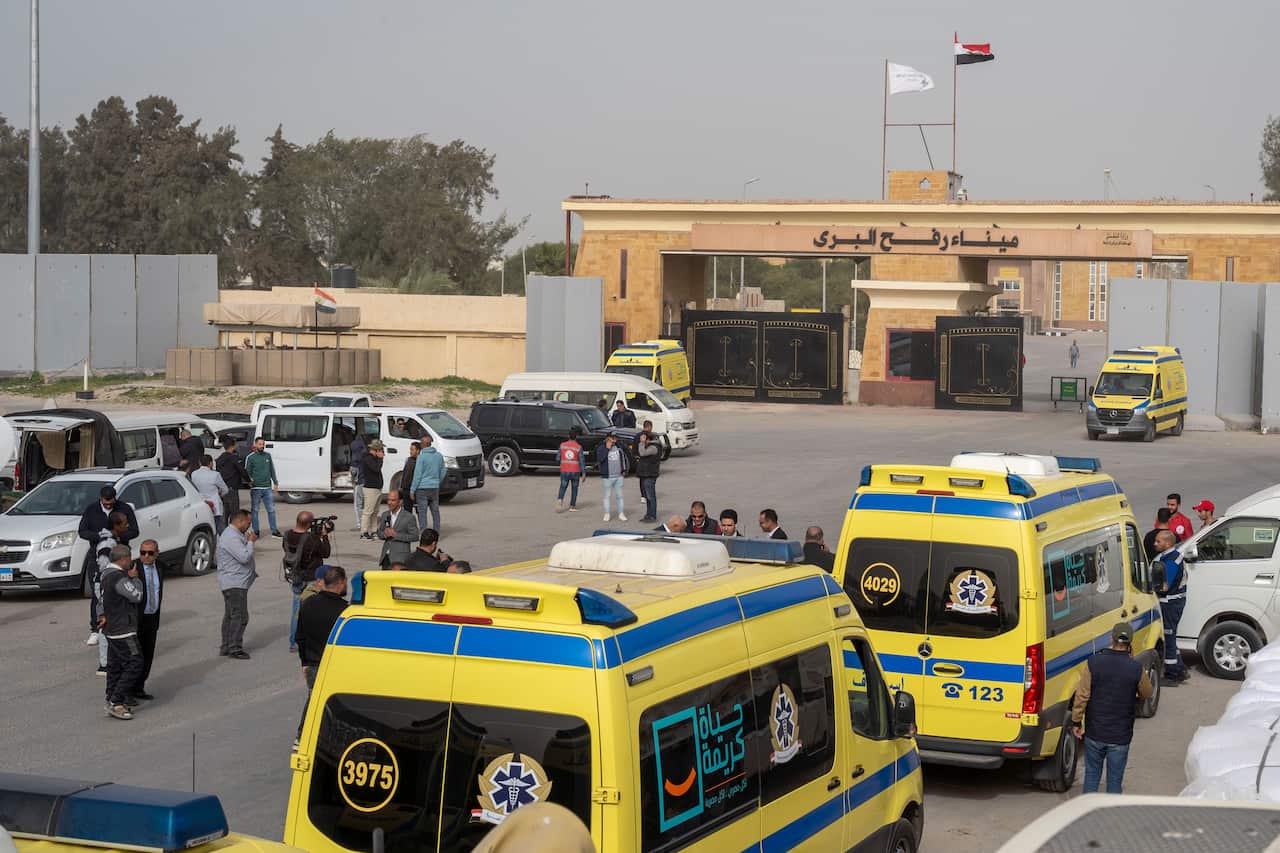
An Egyptian health official informed Agence France-Presse (AFP) that “three ambulances have arrived so far, transporting a number of the sick and injured. They were immediately screened upon arrival to determine the hospitals to which they would be transferred.”
The Rafah border crossing serves as Gaza’s sole link to the outside world that doesn’t route through Israel, making it a crucial passageway for both people and goods.
This partial reopening follows a weekend of violence where Gaza’s civil defense reported numerous casualties from a series of Israeli airstrikes. These strikes were described by the Israeli military as a response to Hamas fighters allegedly breaching the October truce agreement by emerging from a tunnel in Rafah city.
Since the US-brokered ceasefire took effect, both Israel and Hamas have been trading accusations of violating the delicate peace agreement, underscoring the ongoing tensions in the region.
A ‘window of hope’
Mahmud, a 38-year-old leukaemia patient from Gaza City, said he felt lucky to be able to travel to Egypt for treatment after receiving approval from Israel to go with his sister.
“In Gaza, there is no treatment and no life … Of course, I am lucky, but I am still sad because my father and mother are still in Gaza,” he told AFP.
Ali Shaath, the head of a Palestinian technocratic committee established to oversee the day-to-day governance of Gaza, said Rafah’s reopening offered a “window of hope” for the territory.
The partial resumption began on Sunday in a tightly restricted pilot phase that did not involve travel of people, and came after months of appeals from aid groups.
Khaled Mogawer, governor of North Sinai — which includes the Egyptian side of Rafah — said on Egypt’s state-linked AlQahera News that 50 Palestinian patients and 84 of their companions were expected to enter Egypt on Monday.
Israeli state broadcaster Kan reported that the crossing would be open for about six hours daily, while AlQahera News said the Egyptian side would remain open “round the clock”.
‘I will hug my mother’
Abdul Rahim Mohamed, 30, said he was eagerly awaiting the return to Gaza of his mother, who had left for cancer treatment in Egypt in March 2024.
“Two days ago, she was informed she could return to Gaza and told me on the phone, ‘Come and wait for me at the crossing,’” he told AFP.
“I am very happy today … I will hug my mother,” he added.
Rafah lies in an area held by Israeli forces following their withdrawal behind a so-called “Yellow Line” under the terms of the US-brokered ceasefire, in effect since 10 October.
Israeli troops still control more than half of Gaza, while the rest remains under Hamas authority.
The EU’s top diplomat Kaja Kallas said the opening of the crossing “marks a concrete and positive step in the peace plan” for the territory, where humanitarian conditions remain dire.
The Rafah crossing had been briefly opened in early 2025, but has been largely shut since it was seized by Israeli forces in May 2024.
Steve Witkoff, the US envoy to the Middle East who had a hand in negotiating the ceasefire deal, will meet with Israeli Prime Minister Benjamin Netanyahu on Tuesday, an Israeli official said, without confirming the location or subject of the talks.
Witkoff and fellow envoy Jared Kushner met with Netanyahu in late January and reportedly pushed for Rafah’s reopening.
No aid entry
The director of Gaza City’s Al-Shifa Hospital, Mohammed Abu Salmiya, said there were 20,000 patients in the territory in urgent need of treatment, including 4,500 children.
AlQahera News, citing Egypt’s health ministry, reported that 150 hospitals and 300 ambulances had been prepared to receive Palestinian patients.
It said 12,000 doctors and 30 rapid deployment teams had been allocated to work with those transferred.
The Coordinator of Government Activities in the Territories (COGAT), the Israeli military unit that oversees humanitarian coordination, made no mention of allowing in a long-hoped-for surge of aid for Gaza.
Israel had previously tied Rafah’s reopening to the return of the remains of Ran Gvili, the last Israeli hostage held in the territory. His body was recovered and buried last week, prompting Israel to announce the phased reopening.
For the latest from SBS News, download our app and subscribe to our newsletter.