
New Zealand’s rugby media are not accustomed to seeing the All Blacks lose. So, after their first defeat by Wales in 73 years was followed by a record thrashing by England, difficult questions have understandably been raised.
‘Physically and emotionally, they looked drained,’ said former All Blacks wing and pundit Jeff Wilson. ‘They had no energy. They didn’t look as though they were ready for the fight.’ Legendary World Cup-winning coach Sir Graham Henry offered an equally stark assessment: ‘They’ve just run out of petrol.’
Those are fair observations. Yet another obvious factor has been largely missing from the post-match discussion, which has concentrated on England’s excellence and New Zealand’s wastefulness.
Having watched the All Blacks over the past fortnight, I believe it is clear that the squad’s grief following the death of long-serving head of security Logan Cadwallader has played a significant role in their poor performances. That would be entirely understandable.
Cadwallader’s death in Edinburgh at the beginning of the month came as a devastating shock. He had worked with the All Blacks for more than a decade, travelling around the world with the team and supporting the players. Over that time, he had formed close bonds with them and their families.
New Zealand drew on a powerful wave of emotion before facing Scotland, when Cadwallader’s son and brother joined the team for the pre-match anthems. The All Blacks produced an excellent performance at Murrayfield and were clearly determined to honour him with a victory.

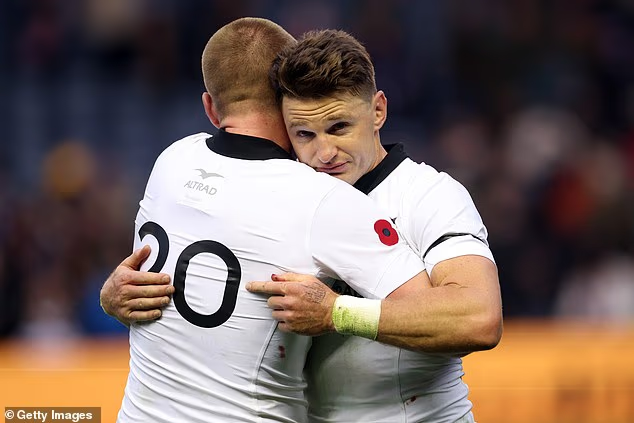
Beauden Barrett was visibly emotional as he paid tribute to the late Logan Cadwallader after New Zealand’s win over Scotland earlier this month

The death of the All Blacks’ long-serving head of security, Cadwallader, has deeply affected the squad

Cadwallader’s son and brother stood alongside the All Blacks during the pre-match anthems against Scotland
Following that match, New Zealand released an emotional video featuring star player Beauden Barrett. ‘This week was bigger than rugby,’ Barrett said as he fought back tears. ‘In my entire career, it’s been the most challenging.’
‘It took days before I could focus. Training didn’t feel right. We felt guilty enjoying the simple things. We went out there to do our best to honour him. This has hit me like a ton of bricks.’
Professional sport often demands that athletes behave like machines: step onto the field and perform at the highest level, regardless of what is happening in their lives. That expectation is deeply unfair.
Elite sportsmen and women are extraordinarily talented, but they are human beings too. Like anyone else, their work can be affected by events in their personal lives. That is what appears to be happening to New Zealand now.
Sports psychologist Don Macpherson examines this subject in his book How To Master Your Monkey Mind. He has worked with England rugby players including George Ford and Anthony Watson, as well as prominent figures in other sports.
‘The human side of professional sport is so often overlooked,’ Macpherson told Daily Mail Sport. ‘Every athlete, no matter how gifted or successful, has personal problems to manage. And regardless of how well they believe they are coping, the reality can be very different.
‘After Saturday, the headlines focused on how poor the All Blacks were. Some people even suggested this was their worst team ever. They may say, “You’re simply making excuses for them,” but this is a completely valid point.
‘I could see from the All Blacks’ faces on Saturday that they were not fully present emotionally. They made unusual decisions and errors that were out of character. They simply never arrived. It is easy to criticise them for that, but asking why it happened is the more important question.’
Tragedy has also affected dressing rooms in other sports. I was surprised that Liverpool’s decline in form after winning the Premier League was only occasionally discussed in the context of the death of their forward Diogo Jota, who was killed in a car crash in July last year. Former Liverpool defender Andy Robertson has spoken at length about the effect losing his friend and team-mate had on the squad.

New Zealand’s Fabian Holland appeared dejected after the All Blacks’ emphatic defeat by England

Liverpool players paid tribute to former forward Diogo Jota, who was killed in a car crash just before the start of last season
To be clear, Cadwallader’s death and its impact are not excuses for New Zealand’s performances. The same applies to Liverpool and Jota. But in both situations, grief and loss should be recognised as important contributing factors.
After the defeat by England, I asked New Zealand head coach Dave Rennie whether Cadwallader’s death had affected his players more than he had initially understood. He replied: ‘I don’t want to go there. I felt we prepared well. I guess that’s for others to judge.’
Macpherson added: ‘The All Blacks are human beings trying to cope with emotional upheaval. It does not matter how talented you are; that will affect confidence and the most important mental skill of all: concentration.
‘When someone is grieving, the brain’s chemistry is disrupted. In my experience, no matter how much people tell themselves they can put their emotions aside long enough to play their best rugby, the issue continues to surface subconsciously. In Test rugby, being just five or 10 per cent below your mental best can seriously damage concentration.’
Rennie may have been reluctant to make excuses or reopen painful wounds. That is understandable. He was right to underline the quality of his players and coaching staff, and New Zealand have indeed looked better under his leadership than they did during the Scott Robertson era.
This All Blacks side has not suddenly become a poor team. It is a group coping with exceptional and tragic circumstances, and that must be taken into account when assessing its performances. Against England, New Zealand made a string of errors, struggled badly at the line-out and looked physically unable to match their opponents. But given what they have been experiencing, was that really surprising?
The emotions surrounding Cadwallader’s death may have intensified when Lewis Moody joined England’s line-up for the haka. The blank expressions on the All Blacks’ faces as Moody, who is living with motor neurone disease, walked onto the field suggested a group that had recently been confronted with life’s wider realities.

The All Blacks’ emotional burden may have intensified when Lewis Moody joined England’s line-up for the haka
‘Twickenham was a cauldron of emotion on Saturday,’ Macpherson said. ‘England were drawing on positive feelings and wanted to perform for Lewis. Emotion can work in your favour — it can create the determination to say, “Let’s do this for someone.”
‘I think New Zealand harnessed that emotion for their win over Scotland, but a siege mentality cannot last indefinitely — perhaps one or two matches. The All Blacks’ body language certainly suggested they were less confident than usual. They were present, but not fully present. Vacant is the right word. They are a very special group, but they are clearly suffering emotional distress.’
After a long, bruising year filled with enormous physical and emotional demands, New Zealand’s players must somehow summon the energy for one final effort. Their final match of 2026 is a rematch with England this Saturday.
It is difficult to imagine a different result. The All Blacks remain one of rugby’s leading teams and will recover in time. But they need an extended break — for their mental wellbeing as much as for any other reason.


