Share this @internewscast.com
In recent days, hundreds have been lining up outside retailers across Australia, but not for the latest iPhone or a flash sale.
Instead, they’re waiting hours to buy and sell gold.

Recent surges in gold prices have led to long lines outside gold retailers nationwide. The cost of gold reached an unprecedented level on Friday, with the price per ounce soaring to more than $6,700. This marks a remarkable 70% increase in just this year.
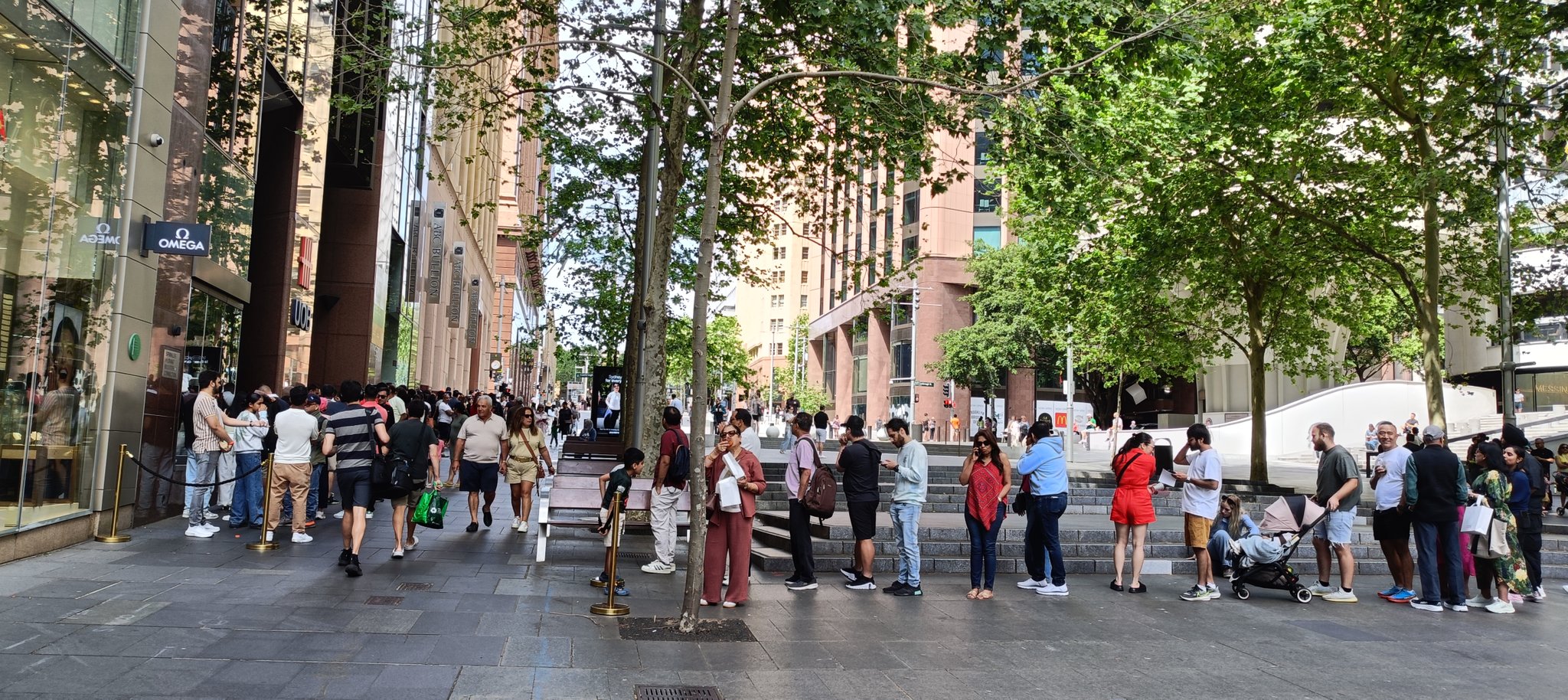
A line of people queue outside a commercial building with an Omega sign, with other pedestrians walking past.

These queues reflect the growing demand for gold, driven by its record-breaking price, as seen across the country.

Earlier in 2025, acquiring an ounce of gold would have been approximately $2,500 cheaper. Notably, nearly half of this price increase occurred in the last month alone.

This upward trend isn’t limited to gold. Silver has also seen significant growth, shattering a 45-year record on Tuesday by reaching $80.77 per ounce.

Various explanations have been put forward to explain the rise in gold prices.
Isaac Poole, the global chief investment officer at Oriana Private Wealth, told SBS News: “When you look at what’s really been pushing demand in gold at the moment, it’s been ETFs (exchange-traded funds).”
ETFs are funds that own a group of assets like stocks or bonds and are bought and sold like individual shares on stock markets. According to the World Gold Council, September was the strongest month on record for gold ETF flows.
“You are seeing this huge financialisation of gold bullion through ETFs and retail investors racing out to buy after the market’s already up 70 per cent,” Poole said.

“This year’s price movements, particularly over the past month, have been the major talking point,” commented a market analyst.

According to some experts, economic uncertainties around government debt levels and the US government shutdown are part of the picture.
Some also suggest that central banks are turning to gold to replace currency assets like the US dollar.
In 2023 and 2024, central banks demonstrated an unprecedented appetite for gold, purchasing over 1,000 tonnes of gold each year, according to the World Gold Council.
Poole is suspicious about this narrative.

“I would caution buying into the narrative that it’s been central bank buying. I think that was a story in 2022, 2023, and 2024,” he said.

“This is not about central banks: That buying has slowed down. What I think you’re seeing now is a trickle-down effect to retail buyers.”
While people in China and India buying gold jewellery has been one of the main reasons behind the gold surge in the last decade, “at these prices, at these levels, they’re not buying anymore”, Poole said

“So the traditional driver of demand has dropped away, which really leads to that point that it is retail demand. It’s investors racing to buy bullion from shops.”

Will gold prices fall?

There are differing predictions of where gold prices will go from here.
In an analysis earlier this month, the World Gold Council said it’s “confident that gold will hold its ground” and would “perhaps see further uplift” if share prices declined.
Earlier this month, Goldman Sachs, the largest investment bank in the world by revenue, also raised its December gold price prediction to US$4,900 ($7,545) per ounce, from US$4,300 ($6,621).

In an article in The Conversation, Luke Hartigan, a lecturer in economics at the University of Sydney, noted that “ongoing demand from Russia and China” could also lead to further increases in prices.

However, Poole said, the public “should really approach [the gold market] with caution”.
“I think there’s a warning here. I would put this down to momentum and sentiment.”
While momentum and sentiment can drive commodity prices up, “it’s really critical to remember that gold can go down and stay down for a very long period of time,” he cautioned.
“I’m not going to be able to pick a turning point, but it feels like a melt-up over the last month. When you see a melt-up like that, it means that prices can fall.
“What is really critical to remember for gold is that if you go back over the last 40 years, there have been at least three periods where gold has fallen 50 per cent from its peak and then stayed at those lower prices for up to a decade.”

Share this @internewscast.com
You May Also Like

Rediscovery of ‘Tous’: Ancient Marsupial Thought Extinct for 6,000 Years Resurfaces

Mammals, despite their popularity, are not the most diverse group in the…

Parliament Launches Inquiry into Racism and Violence Faced by First Nations Communities

An inquiry into racism against First Nations people has been set in…

Matildas Show Sportsmanship: Swap Jerseys with Iranian Team Following Gold Coast Victory

In brief Australia has won its group-stage match against Iran on the…

Stranded in Dubai: Australians Share Harrowing Experience Upon Safe Return

In brief More than 200 Australians arrived home Wednesday evening on the…
Cash stock image of cash person holding cash Australian money

Cash or Card? Major Decision Looms as Concerns Rise Over Cashless Society Shift

The Reserve Bank of Australia (RBA) has backed calls to keep cash…
'Save your lives and evacuate': Dire warning for city's south

Urgent Evacuation Alert: Life-Saving Warning Issued for Southern City Residents

Azerbaijan is reeling after a drone incident that has stirred accusations of…
An email sent to a parent at the college.

Sydney School Sparks Controversy with CCTV Monitoring of Student Bathroom Visits

A private school on Sydney‘s upper north shore has begun keeping an…
Trump sacks the public face of his immigration crackdown

Trump Dismisses Key Figure in His Immigration Policy Team

US President Donald Trump said embattled Homeland Security Secretary Kristi Noem will…
Donald Trump was reportedly increasingly frustrated with Kristi Noem.

Kristi Noem’s Dismissal Unveils Early Cracks in Trump’s Second Term Leadership

Kristi Noem is the first cabinet member to be fired in the…

Aussies Struggle to Secure Flights Home as Middle East Conflict Disrupts Travel Plans

Key Points Iranian strikes have now hit 11 Middle Eastern countries after…
Prime Minister Anthony Albanese during Question Time at Parliament House in Canberra on Thursday 5 March 2026. fedpol Photo: Alex Ellinghausen

Australia Deploys Military Assets to Middle East: PM Confirms Strategic Move

Prime Minister Anthony Albanese announced today in parliament that Australia would be…
Empty flights from Dubai

Shocking Revelations: Ghost Flights From the Middle East Unveiled in Startling Footage

The federal government said it is “really disappointing” that repatriation flights from…