
As humanity ushered in the nuclear era, scientists introduced the Doomsday Clock, a symbolic gauge reflecting how perilously close we are to global destruction.
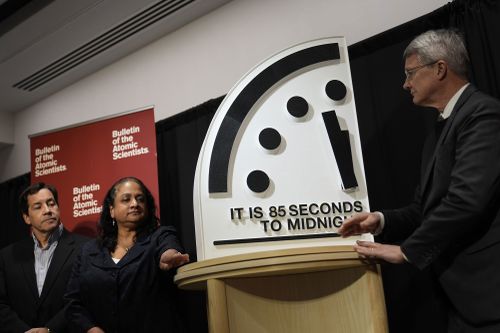
In a stark update on Tuesday (Wednesday AEST), the clock was set to a mere 85 seconds to midnight — marking the closest it has ever been to the symbolic hour of doom. This adjustment comes from the Bulletin of the Atomic Scientists, the organization responsible for establishing the clock back in 1947.
Midnight on this clock signifies the point at which human actions render Earth uninhabitable.
Is the Doomsday Clock real?
The clock is not intended as a precise measure of existential threats, but rather as a tool to provoke discussion around the complex scientific issues and crises facing our planet, according to the Bulletin. Some outside experts, however, have questioned the clock’s effectiveness in achieving this aim.
Dr. Michael Mann, a presidential distinguished professor in the department of Earth and environmental science at the University of Pennsylvania, expressed to CNN in 2022 that while the clock serves as “an imperfect metaphor,” it combines distinct risks that manifest differently over various timescales.
Yet, Dr. Mann acknowledged that the clock “remains an important rhetorical device,” serving as an annual reminder of the fragile state of our existence on this planet.
The Bulletin has made thoughtful decisions each year on how to get people’s attention about existential threats and the required action, Eryn MacDonald, senior analyst with the Union of Concerned Scientists’ Global Security Program, told CNN in 2022.
“While I wish we could go back to talking about minutes to midnight instead of seconds, unfortunately that no longer reflects reality.”
At the UN Climate Change Conference in Glasgow, Scotland, in 2021, then-UK Prime Minister Boris Johnson cited the Doomsday Clock when talking about the climate crisis the world is facing.
What happens when the clock hits midnight?
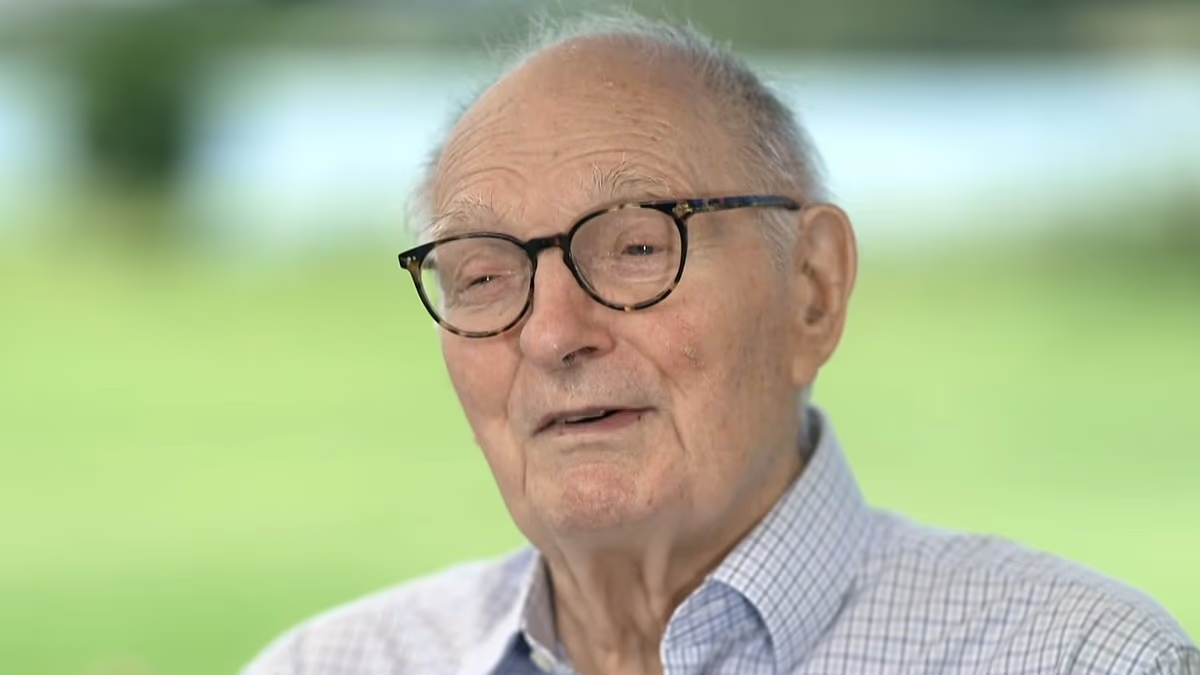
The Doomsday Clock has never reached midnight, and former Bulletin president and chief executive Rachel Bronson, who now serves as a senior adviser, said she hoped it never would.
“When the clock is at midnight, that means there’s been some sort of nuclear exchange or catastrophic climate change that’s wiped out humanity,” she said. “We never really want to get there, and we won’t know it when we do.”
What can we do to turn back time on the clock?
Moving the Doomsday Clock back with bold, substantial actions is still possible. In fact, the hand moved its farthest away from midnight — 17 minutes to the hour — in 1991, when then-president George HW Bush’s administration signed the Strategic Arms Reduction Treaty with the Soviet Union.
“We at the Bulletin believe that because humans created these threats, we can reduce them,” Bronson said. “But doing so is not easy, nor has it ever been. And it requires serious work and global engagement at all levels of society.”
Regarding what individuals can do, don’t underestimate the power of discussing these important issues with your peers, Bulletin scientists said. Sparking conversations can help combat misinformation, and public engagement can urge leaders to act.
“Without facts, you can’t have truth. Without truth, you can’t have trust,” Maria Ressa, cofounder and CEO of Rappler, a Filipino news outlet, said in the Bulletin news briefing. “Without these three, we have no shared reality. We can’t have journalism. We can’t have democracy. The radical collaboration this moment demands becomes impossible. Think of shared facts as the operating system of collective action.”
Other personal actions can also make a difference. To potentially help mitigate the climate crisis, for one, consider whether there are small changes you can make in your daily life, such as how often you walk versus drive and how you heat your home.
Eating seasonally and locally, reducing food waste, conserving water, reducing plastic use and recycling properly are other ways to help mitigate, or deal with the effects of, the climate crisis.
NEVER MISS A STORY: Get your breaking news and exclusive stories first by following us across all platforms.