
Share this @internewscast.com
Australians are switching up where they’re travelling to, according to the latest annual report from the Australian Bureau of Statistics.
The top five destination countries in 2024-25 were Indonesia, New Zealand, Japan, the US and China.

Indonesia — particularly Bali — remained at the top, accounting for 14 per cent, or 1,741,370, of Australian trips.

Japan also continued its rise, stepping into the third place with 910,640 visitors. The number of trips to Japan has tripled compared with data from 2014-15.
It overtook the US, which dropped to fourth with 746,220 visits — down from third in 2023-24. The US was the only country in the top five where travel volumes were lower than 10 years ago, with 253,220 fewer trips in 2024-25 than 2014-15, a 25 per cent drop.
China moved up two places to become Australia’s fifth most popular travel destination.

Ten years ago, in 2014-15, the top five countries were New Zealand, Indonesia, the US, the UK and Thailand.
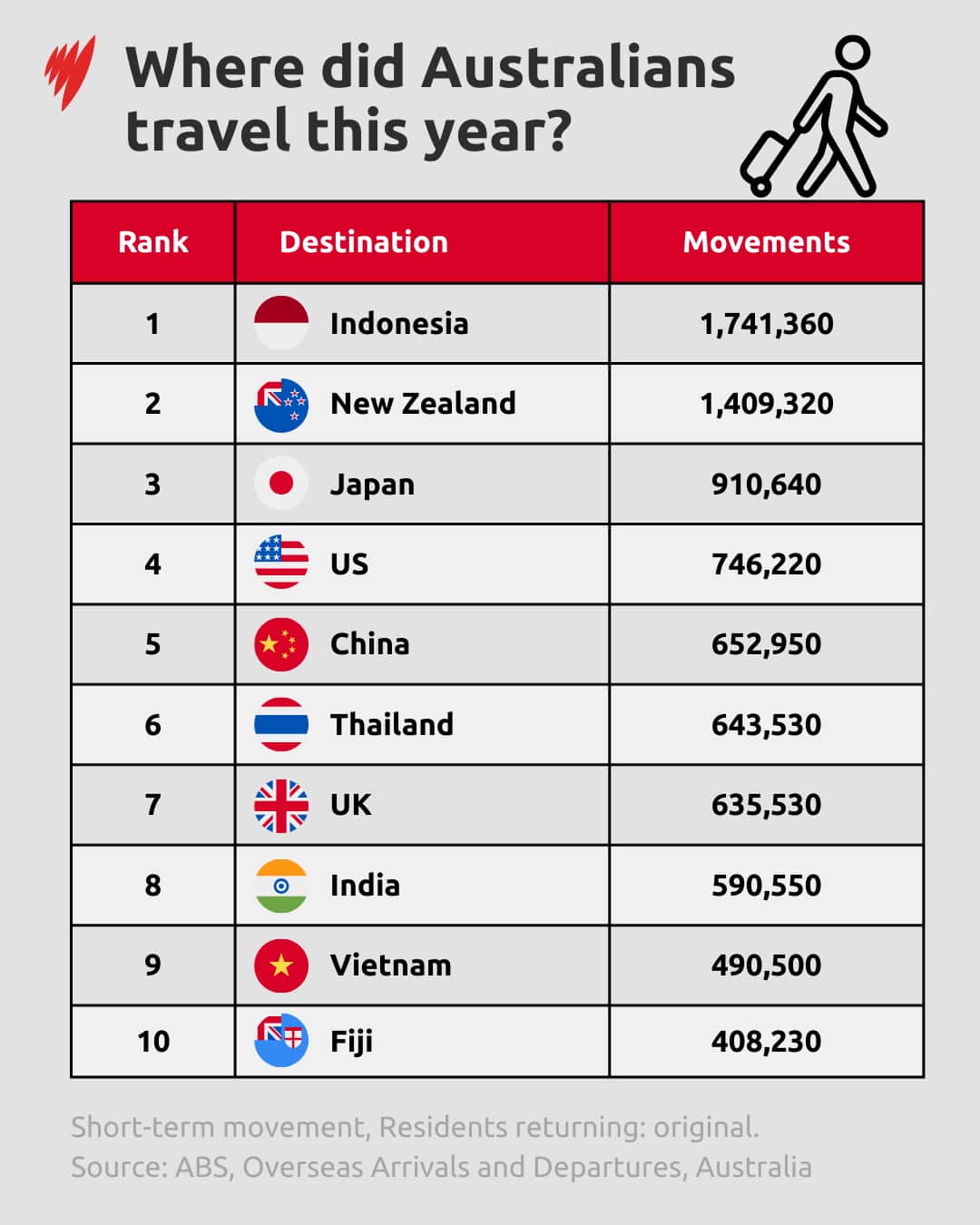
A graph showing Australia's top travel destinations.

Indonesia topped the list of Australians’ most popular travel destinations yet again, thanks to its island paradise of Bali. Meanwhile, the United States has dropped one place. Source: SBS News

Japan up, US down

According to Sara Dolnicar, Professor at the University of Queensland’s Business School, the rise in interest in Japan is multifaceted — including a strong exchange rate, more affordable and shorter direct flights, and cultural motives such as cuisine, scenery and traditions.

Skyscanner’s 2025 travel trends report found that the top factors influencing destination choice were weather (66 per cent), attractions (65 per cent), food (63 per cent) and culture (59 per cent).
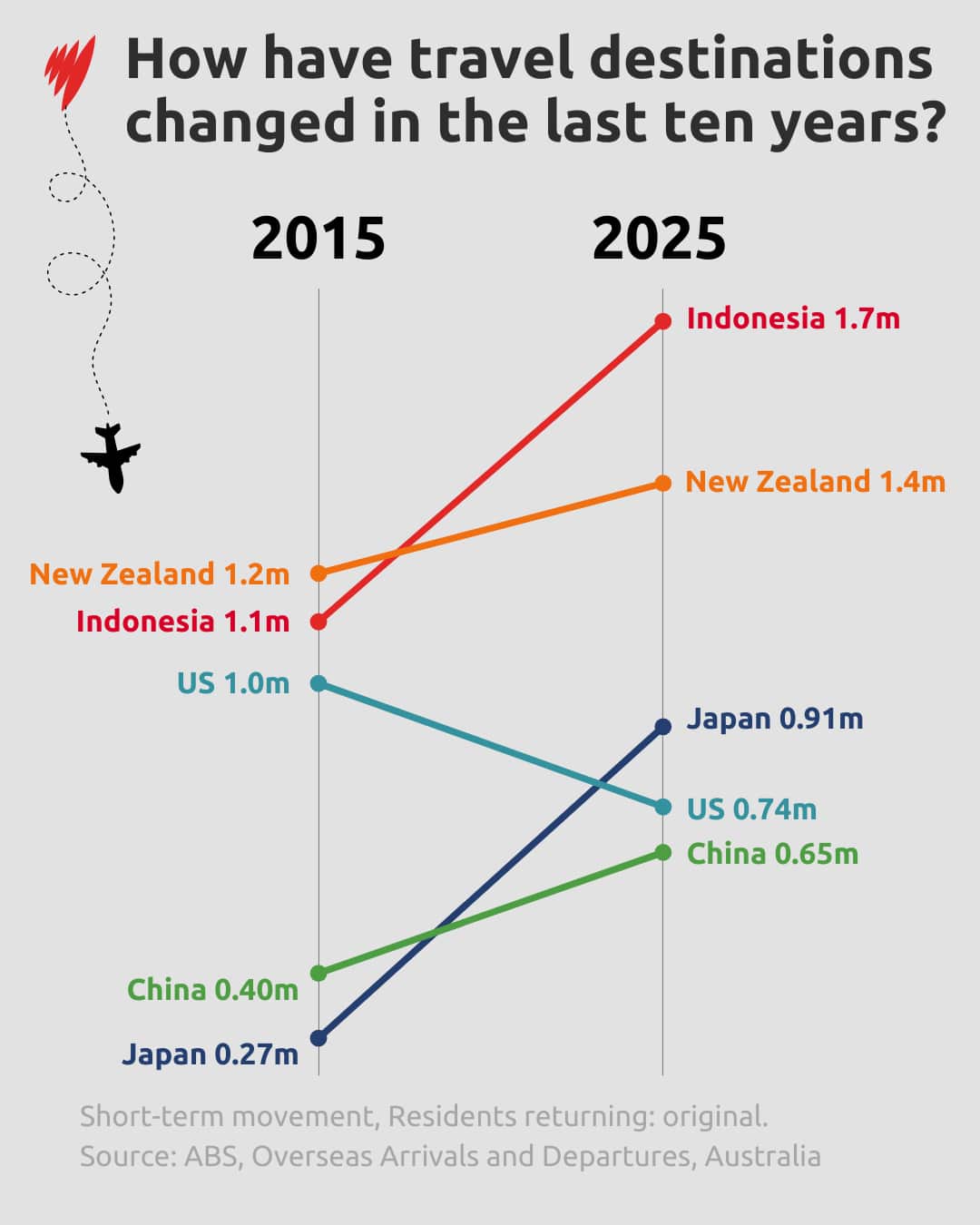
The 10 year trends of travel destinations.

Travel to the United States is 25 per cent lower than 10 years ago, while the number of trips to Japan has tripled compared to data from 2014-15. Source: SBS News

On the other hand, Dolnicar says the United States may be seeing a dip in travel interest partly due to political insecurity.

“I don’t know if it’s specifically the Trump administration or whether it’s the perceived volatility of decision-making, but there is absolutely no doubt that that has affected international travel into the US,” Dolnicar said.
“I think for Australians, there is a bit of unease. But I wouldn’t say it’s that people feel the fear in their bones.”

“The way consumers operate in their behaviour is that they’ll still want to go to New York, but they’ll say, ‘maybe I’ll just wait a couple of years.'”

An increase in travel to China is not necessarily politically motivated either, Dolnicar said. Instead, it’s more likely linked to the new policy introduced in November 2024, allowing Australian passport holders to travel in China for 30 days without a visa, she said.
“Being able to walk in and get a stamp for 30 days — that would have had a big effect [on the figures].”

“With the US, people might say they love it, but now is not a good time. And now with China, they might have always wanted to check it out and they’ve made it easier to get in — so why not?”

The bigger forces shaping travel

While destination-specific factors matter, Dolnicar says five broader forces are influencing where Australians go: exchange rates, political insecurities (including safety), natural disasters, the cost of living, and the post-COVID desire for international travel.
Cost is often the first consideration, especially in a cost-of-living crisis. “If you’ve seen that your disposable income is not sufficient, you’ll just say that you can’t travel that year,” she said.
Margy Osmond, CEO of peak industry group Tourism and Transport Forum Australia, said their data indicated two-thirds of the nation were planning a trip, but there was still a “noticeable drop” in those who actually took holidays.

“That suggests that while the desire to explore remains strong, cost-of-living pressures and economic uncertainty are influencing how and when people travel,” Osmond told SBS News.

Exchange rates are also having an effect. Dolnicar points to a roughly 25 per cent increase in the value of the Australian Dollar over the Japanese Yen in the last decade: “It’s gigantic. For a dollar now, you get 25 per cent more holiday than you used to.”
On the other side of the coin, the Australian Dollar’s exchange rate with the US Dollar has fallen by almost 9 per cent over the last five years.

Osmond added: “While the US remains a bucket-list destination for many Australians, higher costs, a weaker exchange rate and the rising expense of long-haul flights have dampened demand.”

What’s the next hotspot?

Osmond predicts Australians may increasingly choose destinations closer to home, particularly in South East Asia and the Pacific.
“Many travellers are now gravitating towards destinations that offer better value and shorter travel times, particularly across Asia and the Pacific, which has seen some of the US market share shift elsewhere,” she said.
“While traditional favourites like the US and Europe will remain aspirational, emerging destinations in Asia and the Pacific could enter the top five, and the industry will need to navigate challenges such as affordability, sustainability and seamless border experiences to meet travellers’ expectations.”
The Australian Travel Industry Association’s (ATIA) May 2025 travel trends report found Japan had the largest percentage increase year-on-year, with a 38.4 per cent rise, followed by China (+35 per cent) and Vietnam (+26.2 per cent).

“The whole of Asia is very attractive. It’s close and it’s affordable,” Dolnicar said. “Vietnam is kind of an alternative to Indonesia … it’s a little bit more off the beaten track.”

But climate change is also set to make a large impact on where and how Australians travel in the future — potentially making some destinations less viable and increasing ticket prices.
“Some popular ski areas will no longer have snow,” Dolnicar said. “That sunny and blue-skied destination might now have rainfall.”
She warns that measures such as carbon limits or a mandated use of biofuels — a more expensive fuel made from renewable sources — could make overseas travel less affordable.
“If the flight to Bali is suddenly very expensive, you’re not going to go,” she said.
“There is a real likelihood that we’ll need to move back to more local travel because the carbon emissions we generate with the way we’re currently travelling is out of control.”

Share this @internewscast.com
You May Also Like

UK Plans New Legislation to Prohibit Cigarette Sales for Those Born After 2008

In brief A rolling age ban means children and anyone born in…
Treasurer Jim Chalmers handed down the Budget on Tuesday night, boasting of a $9.3 billion surplus driven by a strong labour market and increased commodity prices

Budget 2024 Unveiled: $300 Cash Boost for Australians, Student Debt Forgiveness, Tax Cuts, and New Travel Policies by Albanese Government

In a strategic move to garner voter support ahead of elections, the…

Australia Boosts Fuel Reserves to Pre-Middle East Conflict Levels

In brief: Australia’s fuel reserves are now greater than before the US-Israeli…
Ed Sheeran's LOOP world tour got off to a flying start, raking in a staggering £5million per show during its opening leg

Ed Sheeran’s LOOP Tour: Unveiling the £5 Million Per Show Phenomenon!

Ed Sheeran’s LOOP world tour has started with remarkable success, earning an…
Kyle Sandilands and Jackie O Henderson

Network Faces Legal Battle as Sandilands’ Alleged Profanity-Laden Rant Sparks Controversy

Radio network ARN has brought to light a series of controversial comments…

Ben Roberts-Smith’s Relocation Plans Uncovered in New Court Documents

In brief: Court documents released Thursday show Roberts-Smith investigating opportunities overseas. A…
The owner of a service station in Sydney has been left fuming after a truck driver stole close to $3000 worth of petrol in one hit.

Brazen Petrol Theft Sparks Outrage: Service Station Owner Fumes Over Fuel Heist

A Sydney gas station proprietor is up in arms after a truck…
Robert F Kennedy has doubled down on Donald Trump's incorrect maths.

Trump and Kennedy’s Baffling Math Claims: Unraveling the Controversial Calculations

The President of the United States has consistently asserted that his initiatives…
Michelle Stalimeros (pictured) grew up in a 'chaotic' home where alcohol was woven into family life

Weekend Wine Habit Triggered Blackouts and Anxiety, Straining Marriage; Reflecting on Three Years of Sobriety

At first glance, Michelle Stalimeros appeared far from someone struggling with alcohol.…

Lebanon’s Pivotal Role: How Its Future May Shape Regional Conflict Dynamics

in brief World leaders have called for peace talks to take place…
Jade Elston

Adelaide Family Turns to Crowdfunding for Son’s Urgent Cancer Treatment: A Community’s Call to Action

An Adelaide family has found themselves seeking help from the kindness of…
Alexander Philogene and his uncle Chris Jarmer

Tragic Passing: 21-Year-Old Zander Succumbs to Sudden Illness Mid-Flight

Australians have been warned against a severe strain of meningococcal B circulating…