
IN BRIEF
- Elon Musk’s SpaceX has launched its most powerful Starship rocket yet.
- The latest version may be used by NASA to land astronauts on the moon.
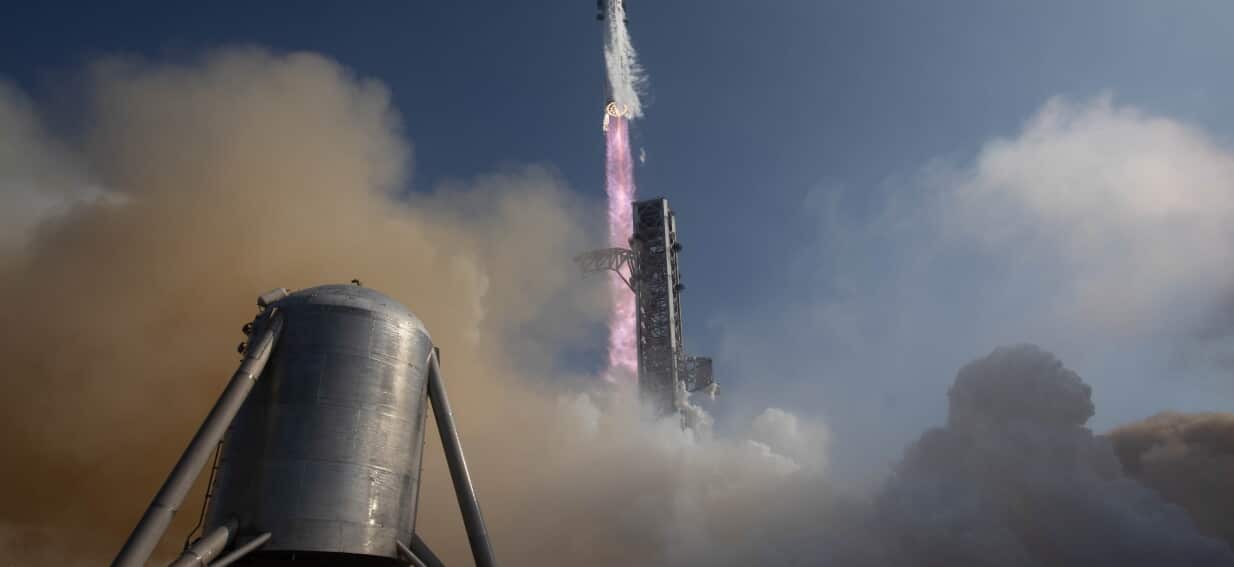
SpaceX has launched its largest and most powerful Starship yet in a test flight, marking an upgrade to the model NASA plans to use for future lunar landings.
This revamped mega rocket took flight just two days following an announcement by SpaceX CEO Elon Musk regarding the company’s plans to go public, potentially breaking records with its initial public offering.
The rocket launched from the southern tip of Texas, with a mission to deploy 20 mock Starlink satellites as it journeyed halfway around the globe.
The colossal spacecraft ascended into space shortly after 5:30 PM local time and successfully concluded its test by making a splashdown in the Indian Ocean on Friday.
This marks the 12th test flight for the rocket Musk envisions will one day transport humans to Mars. However, the immediate focus is on supporting NASA’s Artemis program for lunar exploration.
The last launch of the previous generation Starship took place in October. Now, SpaceX’s third-generation Starship, known as V3, has taken off from a newly constructed launch pad at Starbase, near the Mexican border.
Last-minute pad issues had thwarted Thursday evening’s launch attempt.
SpaceX was hoping to avoid the fireworks it experienced during back-to-back launches in 2025 when midair explosions rained wreckage down on the Atlantic. Earlier flights also ended in flames.
At 124 metres, the latest model eclipses the older Starship lines by more than a metre and packs more engine thrust.
The revamped booster sports fewer but bigger and stronger grid fins for steering it back to earth following liftoff, and a larger and more robust fuel transfer line to feed the 33 main engines.
The retro-looking, stainless steel spacecraft also has more of everything — more cameras and more navigation and computer power — as well as docking cones for future rendezvous and moon missions.
Starship is meant to be fully reusable, with giant mechanical arms at the launch pads to catch the returning rocket stages. But on this latest trial run, nothing was being recovered.
‘Billions of dollars’
NASA is paying SpaceX — and Jeff Bezos’ Blue Origin — billions of dollars to provide the lunar landers that will be used to land Artemis astronauts on the moon.
The two companies are scrambling to be first.
While Starship has reached the fringes of space on multiple flights lasting an hour at most, Bezos’ Blue Moon has yet to lift off, although a prototype is being readied for a moonshot later in 2026.
NASA is following April’s successful lunar flyaround by four astronauts with a docking trial run in orbit around earth planned for 2027.
For that Artemis III mission, astronauts will practice docking their Orion capsule with Starship, Blue Moon or both.
A moon landing by two astronauts — Artemis IV— could follow as soon as 2028 using either Starship or Blue Moon, whichever lander is safer and ready first.
It will be NASA’s first lunar landing with a crew since 1972’s Apollo 17. The goal this time is a moon base near the lunar south pole, staffed by astronauts as well as robots.
“We’re looking forward to seeing this fly, because hopefully at some point in the not-too-distant future we’re going to join up in Earth orbit,” NASA Administrator Jared Isaacman said during the pre-launch SpaceX program ahead of Friday’s test.
Following the test, Isaacman posted praise on X, congratulating SpaceX on “a hell of a V3 Starship launch.”
“One step closer to the Moon…one step closer to Mars,” the NASA official said.
SpaceX is already taking reservations for private flights to the moon and Mars on Starship, though the timing is uncertain.
For the latest from SBS News, download our app and subscribe to our newsletter.