
in brief
- Mouse numbers are thought to have hit plague proportions in some regions.
- The sheer volume of rodents seen on farms could rival the levels reached in 2021.
The surge in mouse populations across certain regions of Australia is causing significant concern for farmers, reminiscent of the severe outbreaks experienced in 2021.
Farmers in Western Australia and South Australia are witnessing a notable increase in mouse numbers, raising alarms about possible plagues similar to those from past outbreaks, experts caution.
In Western Australia, the situation is reaching critical levels, according to Steve Henry, a mouse expert and research officer at the CSIRO, who spoke with SBS News.
“While not quite matching the severity of the 2021 outbreak in New South Wales, it’s approaching similar levels,” Henry explained.
Data from the CSIRO highlights “very high” mouse populations across several regions, including the mid-west coast near Geraldton, the central wheatbelt around Merredin, and the Esperance area on the south coast, extending into the Kwinana region.
In South Australia, areas such as the Adelaide Plains and the Yorke Peninsula, including Kangaroo Island, are experiencing rising mouse densities. Experts suggest that an outbreak could potentially occur, contingent on future environmental conditions.
In northern NSW and southern QLD, the mouse activity has been lower, although moderate populations have been seen across Goodiwindi and northern Darling Downs.
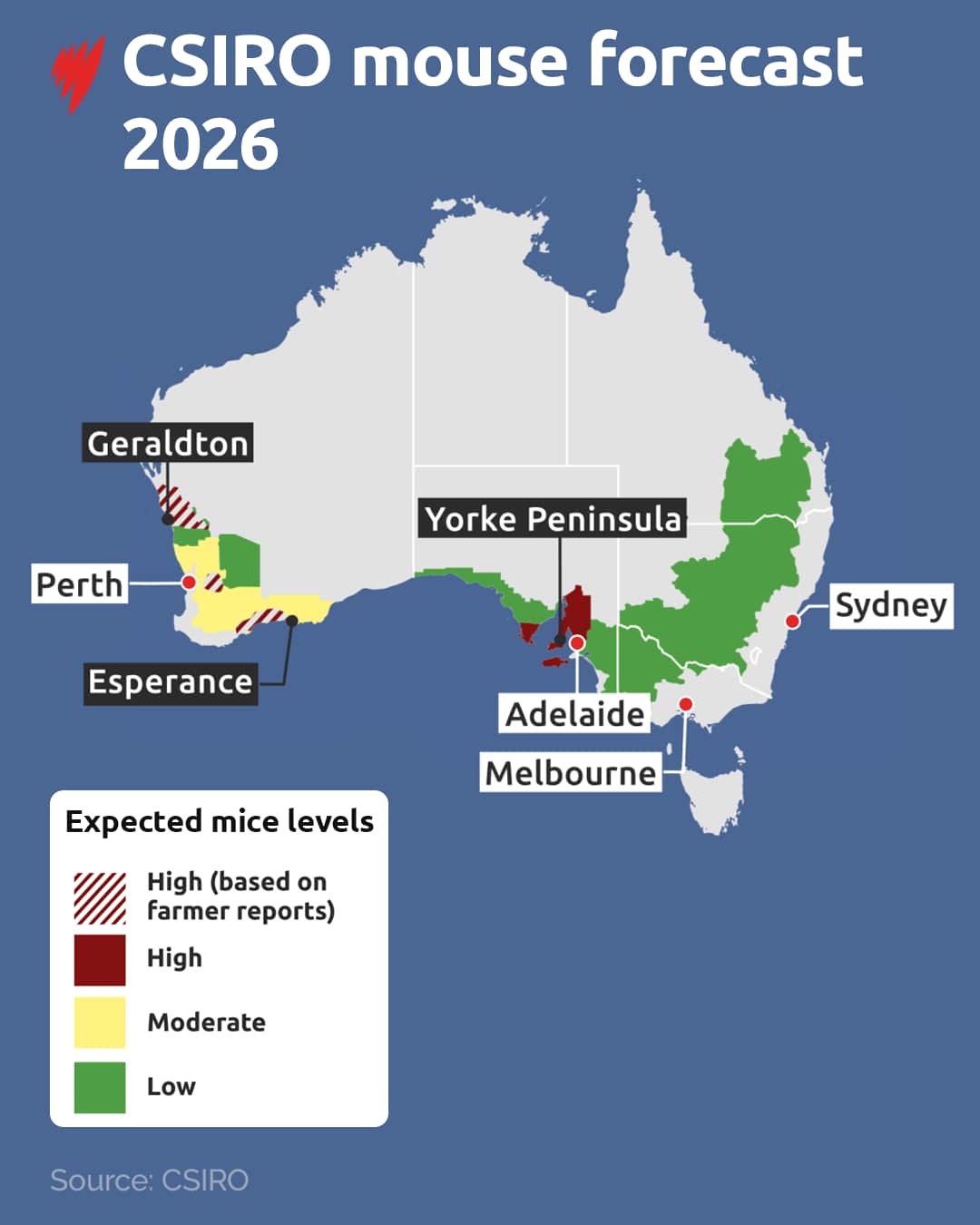
Mice populations are expected to remain low through the rest of NSW and Victoria, the CSIRO mouse forecast states.
While that data was published last month, the situation hasn’t changed, according to CSIRO research scientist Dr Matt Rees.
“Mice numbers are still concerningly high on the Adelaide Plains,” he told SBS News, adding that an outbreak is still possible depending on the conditions.
“We’ve also received lots more anecdotal reports of outbreak-like mouse numbers across WA.”
Agriculture, Fisheries, and Forestry Minister Julie Collins told ABC Radio National on Wednesday that the government would “continue” to work with farmers to deal with the situation and “keep them farming”.
Crops will be impacted
The 2020-2021 mouse plague that impacted eastern parts of the country caused an estimated $1 billion worth of damage. Mice ate seeds as they were planted, emerging crops as they grew, and damaged wiring in farm equipment and homes, while livestock feed became contaminated.
The impacts were also psychological as the rodents infested people’s homes.
“You open up your pantry to get food, the mice are there,” Henry said. “You go to get clothes out, the mice are in your clothes. Worst of all, they’re running across your bed at night while you’re trying to sleep.”
In 2021, farmers were grappling with the simultaneous impact of the COVID-19 pandemic. This time, they’re dealing with the double shocks of diesel shortages plus the difficulty in accessing fertiliser as both are impacted by the war in the Middle East.
“Mice are just another problem that farmers didn’t need this year,” Henry said. “If they aren’t able to take action in the form of baiting, then it’s almost certain that they will sustain crop losses.”
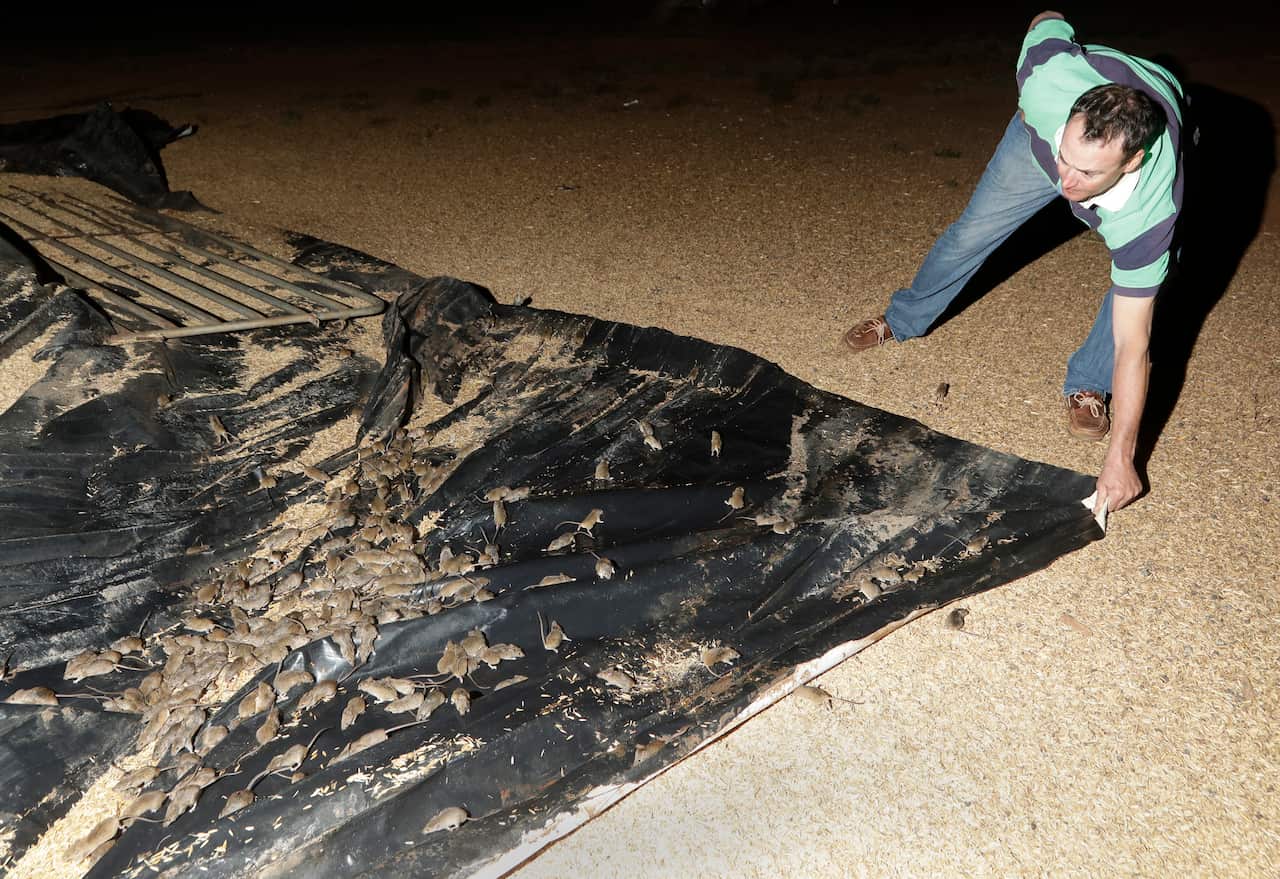
Mouse plagues typically occur on average every five years and are thought to cost farmers an estimated $20 million per year, according to a study in the journal One Health. Before 2021, the worst mouse plague on record in Australia was in 1993, with its impacts thought to have resulted in a conservatively estimated $64.5 million of direct damage.
That makes the 2021 plague far and away the worst on record, and farmers fear this year could be just as bad.
“My fear is that we’re heading that way,” Andrew Weidemann, southern region director at Grain Producers Australia (GPA), told SBS News.
“The reality is, you can get complete wipeouts of somebody sowing. It’s too expensive to sew a crop and not get something back, so it could be quite devastating for farmers.”
In addition to direct damages, mice can spread illnesses such as the bacterial infections leptospirosis and yersiniosis.
You open up your pantry to get food, the mice are there. You go to get clothes out, the mice are in your clothes. Worst of all, they’re running across your bed at night while you’re trying to sleep.
Steve Henry, mouse expert
The financial impact of plague is borne entirely by Australian farmers, who have little influence over the price of grain, which determines their overall sales figures for the year.
“They sustain the cost of baiting, they sustain the cost of re-sowing, but they often end up getting an average crop just the same,” Henry said.
What causes mouse plagues?
Normal mice populations during summer are roughly 5-10 animals per hectare, while anything over 200 per hectare can start to cause economic damage, the CSIRO says. Mouse plagues are defined as anything over 800 to 1,000 mice per hectare.
The sudden increases are usually seen after a region experiences a strong agricultural season following several poor ones, with scattered grain in paddocks causing a feeding frenzy for the animals.
“It’s when you get that sudden flush of food into the system at the end of the dry period, is when numbers tend to increase really dramatically,” Henry said.
Confusingly, that pattern follows for the current outbreaks in SA, he added, but it doesn’t fit for WA.
“I’m a bit at a bit of a loss, because [WA have] had basically four good seasons out of five,” Henry said.
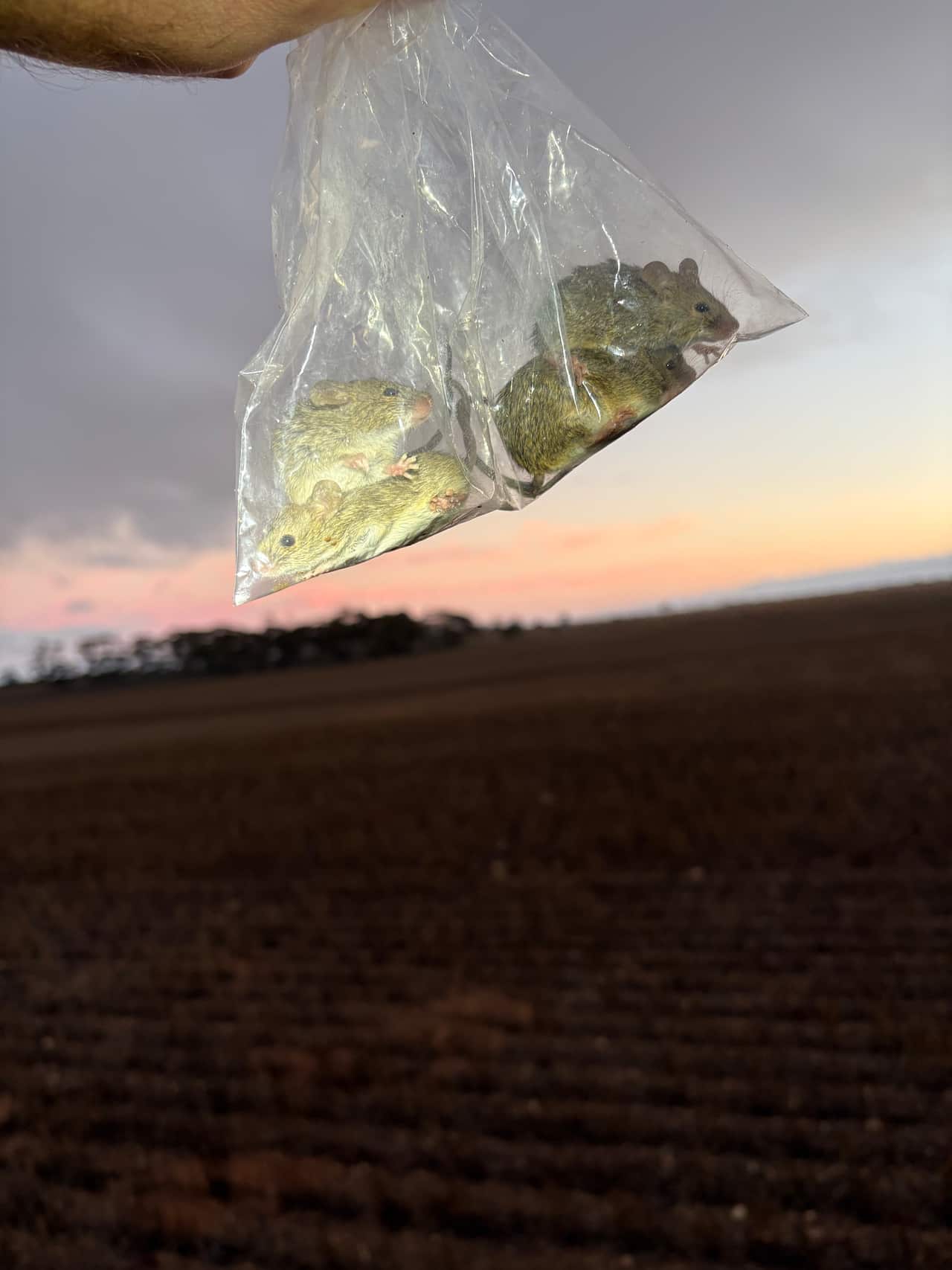
“The West Australian environment is very different to over East, so that’s something we’re just starting to learn about.”
“Historically, mice haven’t been a significant problem in the West, but in recent years, we’re starting to hear of more frequent outbreaks.”
‘Ultimate breeding machines’
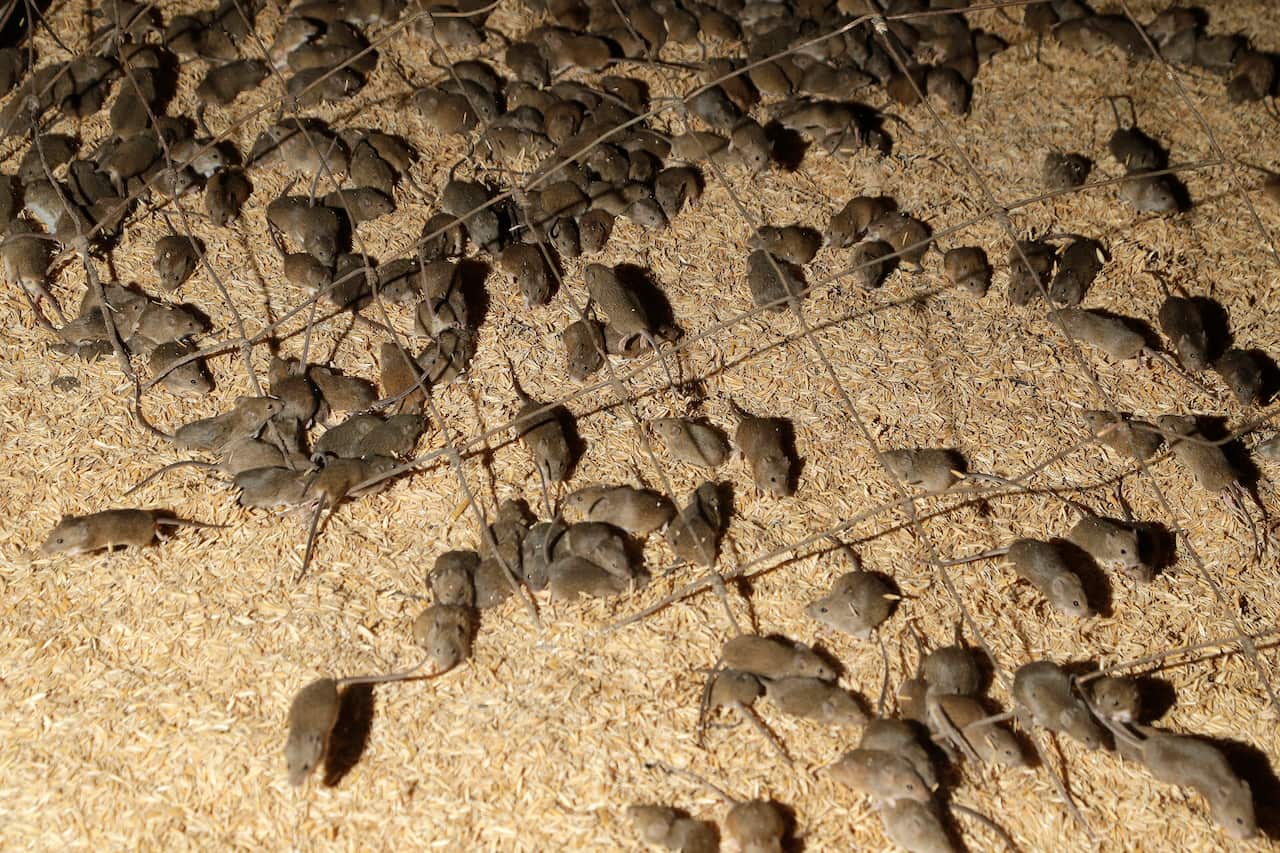
Mice are “the ultimate breeding machine,” the CSIRO says. A female can give birth to a litter of up to 10 pups every 20 days and can fall pregnant again two to three days later.
“If you’ve got 100 female mice per hectare, you’re only three weeks away from having over 600 mice per hectare,” Henry said.
While mouse plagues are cyclical, the waves of plague are thought to be becoming more persistent thanks to the spread of conservation cropping.
“It’s a direct consequence of no-till farming and stubble retention,” Weidemann said. “We’ve created this fantastic habitat to grow crops, but we’ve also increased the amount of mammals and birds and things in the paddocks.”
The practice, in which farmers drill seeds into undisturbed soil rather than turning it over as they once might have done, reduces erosion, increases moisture retention, and sequesters more carbon within the ground. But it comes at a cost.
“[Farmers] will start sewing, think ‘Oh, there’s a few mice there’, but all of a sudden they go back later and find that they’ve eaten all the grain,” Weidemann said.
“They’ve actually become accustomed to finding the grain really easy,” he added. “It’s sewn in a row, and so the mice have learnt how to follow that.
“They’re smart!”
What can be done to stop the mice plague now?
Once mice are established at plague levels, they become very difficult to control. Henry argues that the only way to effectively control existing populations is through the use of poison.
Zinc phosphide is the only rodent-specific pest control chemical that is approved for use in general cropping in Australia.
Henry said his research has found that it does not accumulate in the environment, and that any residual poison in the body of a dead mouse is dispersed in a gas.
Known as ZP25, the Australian Pesticides and Veterinary Medicines Authority (APVMA) temporarily approved the use of the double-strength version, ZP50, during the 2021 plague, something that the GPA is calling for once again.
“ZP50 requires mice to consume less of the baited grains to ensure a lethal dose, which is particularly important when mice have high amounts of background food available,” Weidermann said.
“An emergency permit application supported by evidence from growers is important as we appeal to the APVMA.”
SBS News has contacted the APVMA for comment.
Outside of poisons, the only way to reduce mouse populations is to reduce their food source, Henry said, as natural predators like snakes or birds can’t keep up with population explosions.
“In normal harvesting practices, there’s always a little bit of grain still in the paddock, that’s just inevitable,” Weidemann added.
“Getting on top of them early is important, not letting them breed up, because once they get to a certain number, it just gets too hard to manage and you see massive damage.”
For the latest from SBS News, download our app and subscribe to our newsletter.


