Share this @internewscast.com
Conflicting messages from Trump and Rubio have left many puzzled about the United States’ role in Venezuela. On one hand, it appears the US might be steering Venezuelan power dynamics, while on the other, there’s an indication that the US will not interfere with the country’s daily governance, allowing Maduro’s officials to maintain their roles for now.
Following Rubio’s briefing late Monday, House Speaker Mike Johnson informed reporters that he does not foresee any US military deployment in Venezuela.
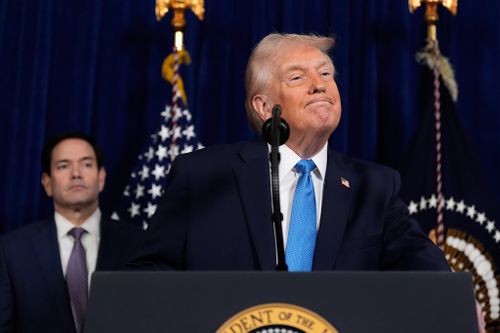
The situation is further complicated by Trump’s campaign promise to steer the US clear of foreign conflicts, a stance that resonates with his “Make America Great Again” base. This group is now eager for clarity on the president’s intentions regarding Venezuela.
Republican Representative Thomas Massie of Kentucky, who has occasionally broken ranks with his party’s unified support for Trump, took to X to voice his concerns post-operation.
“Wake up MAGA,” Massie wrote. “VENEZUELA is not about drugs; it’s about OIL and REGIME CHANGE. This is not what we voted for.”
Senator Rand Paul, another Kentucky Republican known for his critique of military interventions, remarked that only time will reveal whether the push for regime change in Venezuela can succeed without substantial financial or human costs.
“Easy enough to argue such policy when the action is short, swift and effective but glaringly less so when that unitary power drains of us trillions of dollars and thousands of lives, such as occurred in Afghanistan, Iraq, and Vietnam,” he wrote on social media.
In addition to the Venezuela operation, Trump is preparing to take the helm of an as-yet unformed Board of Peace to run post-war Gaza, involving the United States in yet another Mideast engagement for possibly decades to come.
And yet, as both the Iraq and Afghanistan experiences ultimately proved, no amount of planning guarantees success.