
Share this @internewscast.com
President Donald Trump seemed receptive to making public the findings of a recent MRI, although he admitted he was unsure about which body part was scanned.
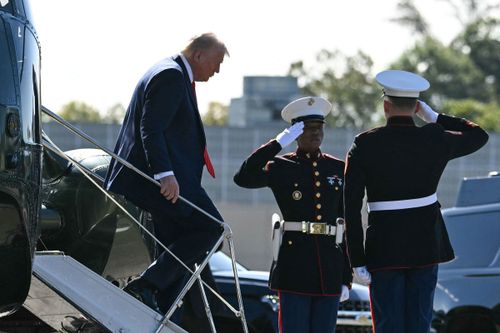
“If they want to release it, I’m fine with that. It’s perfect,” Trump remarked to journalists while on Air Force One.
When a reporter inquired about which area of his body underwent the MRI, Trump responded, “I have no clue. It was just an MRI—what part of the body? It wasn’t the brain, since I took a cognitive test and passed it with flying colors.”

These statements followed Minnesota Governor Tim Walz’s call for Trump to disclose the MRI results. This request was spurred by a Thanksgiving Truth Social post where the president criticized Walz’s management of the state’s Somali community, using derogatory language.
Governor Walz, speaking with NBC’s Meet the Press, questioned, “Has anyone ever had an MRI without knowing its purpose, as he claims?”
Later, Trump informed reporters that he had undergone an MRI and suggested they consult his doctors for the reason, though no explanation was offered.
In early November, CNN’s Kristen Holmes asked White House press secretary Karoline Leavitt why Trump got an MRI and she said, “I’ll check back on that,” but no follow up information was provided for why he received the MRI.

“Every single day the president is in optimal physical health. This was a follow up appointment, and we provided a detailed readout of that physical,” Leavitt said.
The White House announced in July that Trump was diagnosed with chronic venous insufficiency, a condition in which valves inside certain veins don’t work the way they should, which can allow blood to pool or collect in the veins.
About 150,000 people are diagnosed with it each year, and the risk goes up with age.
CNN chief medical correspondent Dr Sanjay Gupta said in September that chronic venous insufficiency is not uncommon in older adults and is a condition that prevents blood from “leaving the extremities as well as it should” and causes swelling.