
About 170 years ago, a bundle of stone tools was deliberately buried, or “cached”, near a waterhole in far-west Queensland and never recovered. Why?
Our team’s investigation of this extremely rare site has revealed a long story of Indigenous trade and innovation in the Australian outback.

A fascinating example of a stone tula mounted onto a wooden handle using a lump of spinifex resin provides a glimpse into ancient techniques. This ethnographic artifact, captured by Mary-Anne Stone, showcases the ingenuity of its creators. The photograph, attributed to Mary-Anne Stone under a CC BY license, displays the detailed craftsmanship involved in these tools.
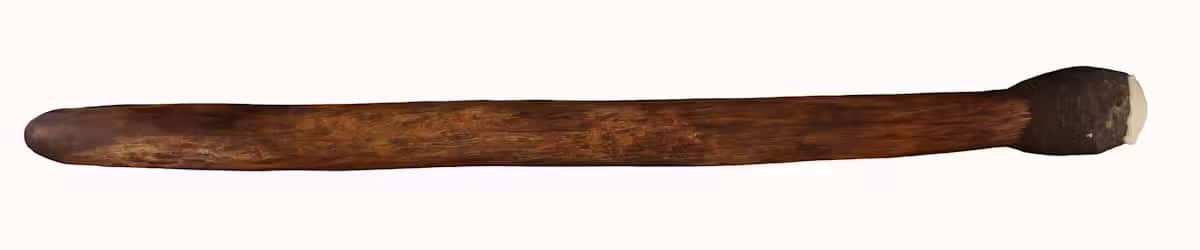
We excavated the site in 2023. A handful of stones poking out of the soil turned out to be a pile of 60 large Aboriginal stone “tulas”, deliberately cached just north of Boulia in far western Queensland.
We used scientific methods to analyse the tools, working closely with the Pitta Pitta, who hold Native Title for this place, and with approval from the station property owners.
A tula is a Wangkangurru word (from the Munga-Thirri/Simpson Desert) for a special flaked-stone tool that would be hafted onto a handle and used for woodworking. They were important tools, used across most of the continent to make objects such as boomerangs, wooden coolamon dishes, shields and clapsticks.
Aboriginal cache 2.jpeg

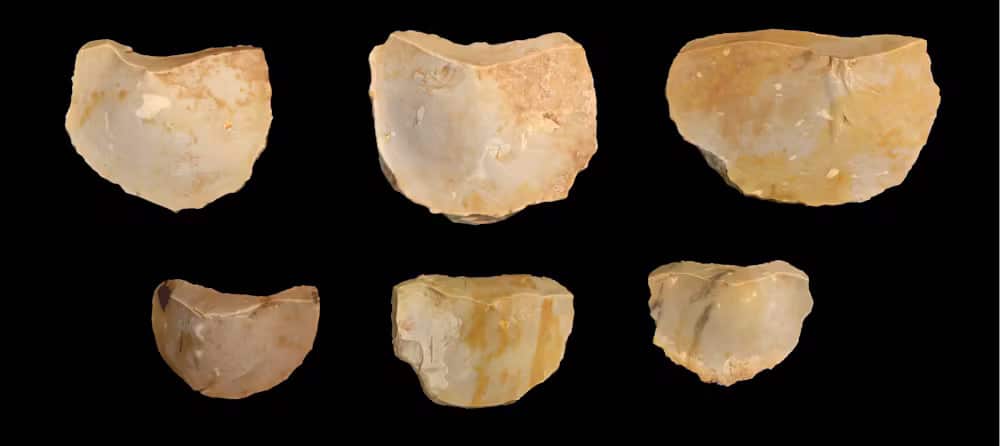
In addition to physical exhibits, 3D models of some of these cached stone tulas further highlight their intricate designs. These digital representations, also credited to Mary-Anne Stone, allow for a closer inspection of the tools’ features without risking damage to the originals. Such models are invaluable for educational purposes and for preserving the knowledge of these ancient practices.

Interestingly, historical accounts suggest that unhafted tulas were often exchanged, hinting at a sophisticated trade network. This particular cache might represent a collection of specially crafted artifacts intended for barter. The deliberate creation and exchange of these tools underscore their significance within the community.
This region’s climate is harsh. Even while we were excavating, bushfires raged to the north, preventing some of the team from joining us. Once we found the cache we knew were were in a race against time to recover the tools before they were washed away in the next flood.
Even when it doesn’t rain in the region, heavy rains in the north flow through the waterways towards Lake Eyre and slowly cover the land in a sea of brown water. After the floods, it dries again, until only the deepest pools hold any water.
The Pitta Pitta people built stone-based shelters as protection from the sun and winter winds. Innovation and connection helped them survive the region’s harsh climates. If they could not find resources locally, they bartered along vast trade routes.
Written and archaeological evidence shows traded goods included stone axes, ochre, pearl shells and more. People also traded a native tobacco called pituri – of which a couple of pounds was reportedly so valuable it could buy “two wives, husbands or many goods”.
Aboriginal cache 1.jpeg

The regularity of these findings indicates that the practice of caching unused stone tulas was not random but a consistent tradition. The act of burying these bundles reflects a deeper cultural or economic significance, ensuring that the knowledge and skills embedded in these tools were preserved and passed down through generations.

It’s also reported that unhafted tulas were exchanged, so it’s possible this cache was a bundle of specially made artefacts that were intended for trading.

The European invasion in the late 1800s was particularly brutal in this area, and disrupted many traditional practices. In Queensland, the Native Mounted Police were state-sanctioned forces sent to control Aboriginal people. At times they used extreme violence against men, women and children, and committed multiple massacres.

A uniquely familiar find

Incredibly, this isn’t the first time such a site has been found. In 1988, the year one of us (Yinika) was born, an archaeologist excavated a bundle of stone tulas less than eight kilometres from the one we worked on.
This discovery was unique, and provided priceless scientific data. But as an isolated find, the archaeologists were unsure whether the cache was a fluke, or evidence of a cultural practice. There was nothing else quite like it – until now.
The 1988 cache was similar to this one, but also different. It held 34 tulas and 18 other stone artefacts called flakes and retouched flakes, some of which might be unfinished tulas.
The more recent cache held nothing but 60 particularly large tulas, all of which were complete. Three pairs of the tulas in this cache fit back together, showing they were made at the same time and from the same piece of stone.

It is now clear this caching practice was no fluke. Burying bundles of unused stone tulas was a repeated practice here.

Stories in the sand

Using scientific methods, we are trying to figure out when, how and possibly why these tulas were buried.
Quartz grains in the soil can be dated using a method called optically stimulated luminescence, or OSL. This technique uses decay rates in quartz to calculate when the grains were last exposed to sunlight.
Using this method meant we had to collect samples from the centre of the cache on a dark and moonless night, to avoid exposing them to any kind of light.
Dating specialist Justine Kemp then dated the samples and found a 95% probability the tulas were buried sometime between 1793 and 1913. For context, the nearby town of Boulia was established around 1879, and the Burke River police camp operated from 1878 to 1886.
The tulas may have originally been buried in a container of kangaroo skin, bark, woven strings, or even cloth if the owners overlapped with European pastoralists.
To test this, the surfaces were examined under high-powered microscopes by specialist Kim Vernon.
No traces were found, but this might be because organic plant and animal matter does not survive well in desert conditions. We hope to continue this line of research, to look for other microscopic traces that can tell us about the lives of these tools.
We think the Pitta Pitta ancestors were likely planning to trade the tools in these caches when the time came, but for some reason never recovered them. Perhaps this was due to disruption caused by European arrival – but the dates aren’t precise enough to be sure.
The findings reveal how planning, resource management and collective cooperation allowed Aboriginal people to not only survive, but thrive, in this land of fire and floods.
Authored by Research Fellow Yinika L. Perston, Griffith University; Lorna Bogdanek, Indigenous Knowledge Holder, Pitta Pitta Aboriginal Corporation; and Professor Lynley Wallis, Griffith University.
You May Also Like

Socceroos Stumble in Pre-World Cup Friendly: Mexico Clinches Narrow 1-0 Victory

Stay informed about global happenings with our reliable updates. Receive complimentary daily…
The capture of Beaufort castle near the city of Nabatiyeh came after days of intense fighting and airstrikes

Israeli Forces Secure Key Fortress in Lebanon Conflict

Israeli troops have captured a strategic mountain topped with a Crusader-built castle…

Trump to Take Center Stage at US Celebration After Artists Withdraw

IN BRIEF The concerts were planned as the opening ceremony of the…
It's been almost five years since Brisbane locked in Olympic hosting rights, and after five years of talk but little action but tomorrow, construction on the centrepiece stadium will finally begin.Within hours, Victoria Park, will be closed to the public.

Construction of Brisbane’s Olympic Stadium at Victoria Park Set to Commence Amid Ongoing Protests

It’s been almost five years since Brisbane locked in Olympic hosting rights,…
One Nation Australia's most popular party in new poll

New Poll Reveals One Nation as Australia’s Leading Political Party

In a surprising political shake-up, recent polling data indicates that One Nation…
President Donald Trump dances at an event at a charter school in The Villages, Fla., Friday, May 1, 2026.

Trump Steps In as Headliner After Artists Withdraw from Festival

An upcoming celebration of America’s 250th anniversary – “The Great American State…

Unveiling the Legacy: Why Football Tracksuits Transcend Fashion and Define Eras

Neal Corcoran arrived from Ireland in 1991 wearing an Ireland O’Neills ‘Italia…

Australians Ditch Swipe Culture: Exploring New Dating Trends Amid Swipe Fatigue

Frustrated with the dating scene, Lilian James decided to go on a…
Hundreds arrested as shops and cars burned in wild football celebrations

Mass Arrests and Destruction Mark Chaotic Football Victory Celebrations

Police have detained 780 people involved in violent clashes in Paris and…
Rugby legend Howlett – a member of the Munster team that won the 2007/2008 Heineken Cup and the All Blacks’ top try scorer – held the post as the club’s head of commercial and marketing for two years before returning to New Zealand in 2019

Doug Howlett’s Charity Funds Under Scrutiny: Uncovering Connections to His Business and a Limerick Social Media Platform

The Irish Mail on Sunday has exposed that Doug Howlett, a celebrated…
The fight began after spectators entered the field of play at Amour Park.

Individual Faces Charges Following Intense Altercation at Sydney Soccer Match

A man has been charged following a chaotic altercation at a soccer…
First home deposit scheme backfires

First Home Deposit Scheme Falters Amid Plummeting Property Prices: What Buyers Need to Know

Investor retreat and waning buyer interest have led to a noticeable drop…